

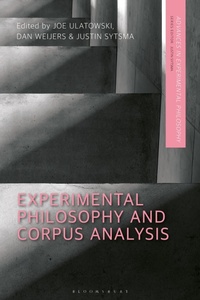
Experimental Philosophy and Corpus Analysis
Will be published approx. on 18. February 2027
Book
Hardback
272 pages
978-1-350-45307-4 (ISBN)
Description
Experimental Philosophy and Corpus analysis explores foundational philosophical concepts through the use of digitised collections of machine-readable written or oral formatted texts.
By analysing "real world" linguistic data they are able to engage with how language is used in ordinary settings. The collection makes use of corpora-curated collections of written or oral texts that represent an area of language use - to inform a wide array of philosophical debates. Covering the base form of the words, part-of-speech tagging, robust parsing, term and name identification, morphological analysis, anaphora resolution, syntactic structure, and references to Philosophical concepts in daily language.
This collection brings together philosophy with corpus linguistics not only to serve as exemplifications of different approaches to corpus analysis, but also to defend the use of corpus linguistics in philosophy. It moves away from data generated via vignettes and questions devised by an experimenter who might attempt to shape responses in a particular way and with a particular bias. Making the case for digital analysis and naturalised language in Philosophy makes it an important and exciting addition to Bloomsbury's Advances in Experimental Philosophy series.
By analysing "real world" linguistic data they are able to engage with how language is used in ordinary settings. The collection makes use of corpora-curated collections of written or oral texts that represent an area of language use - to inform a wide array of philosophical debates. Covering the base form of the words, part-of-speech tagging, robust parsing, term and name identification, morphological analysis, anaphora resolution, syntactic structure, and references to Philosophical concepts in daily language.
This collection brings together philosophy with corpus linguistics not only to serve as exemplifications of different approaches to corpus analysis, but also to defend the use of corpus linguistics in philosophy. It moves away from data generated via vignettes and questions devised by an experimenter who might attempt to shape responses in a particular way and with a particular bias. Making the case for digital analysis and naturalised language in Philosophy makes it an important and exciting addition to Bloomsbury's Advances in Experimental Philosophy series.
More details
Series
Language
English
Place of publication
London
United Kingdom
Publishing group
Bloomsbury Publishing PLC
Target group
Professional and scholarly
Product notice
sewn/stitched
Cloth over boards
With dust jacket
Illustrations
30 bw illus
Dimensions
Height: 234 mm
Width: 156 mm
Thickness: 28 mm
Weight
503 gr
ISBN-13
978-1-350-45307-4 (9781350453074)
Copyright in bibliographic data and cover images is held by Nielsen Book Services Limited or by the publishers or by their respective licensors: all rights reserved.
Schweitzer Classification
Persons
Joseph Ulatowski is Senior Lecturer in Philosophy at the University of Waikato, New Zealand
Dan Weijers is Senior Lecturer in Philosophy at the University of Waikato, New Zealand
Justin Sytsma is Associate Professor of Philosophy at the Victoria University of Wellington, New Zealand
Dan Weijers is Senior Lecturer in Philosophy at the University of Waikato, New Zealand
Justin Sytsma is Associate Professor of Philosophy at the Victoria University of Wellington, New Zealand
Content
Introduction to Corpus Analysis in Philosophy, Joseph Ulatowski, Dan Weijers, & Justin Sytsma
1. Using CHILDES as corpus analysis in philosophy, Jennifer Cole Wright
2. Are "Race" and "Rasse" the Same? Comparing race talk in the United States and Germany, Leda Berio, Daniel James, & Ben Eken
3. The folk concept of the unconscious mind, See-Young Cho & Beate Krickel
4. Language Trends in the Descriptions of Philosophy by Recent Philosophy PhD Graduates, Carolyn Dicey-Jennings & Alex Dayer
5. Interesting and Important Mathematics: A Corpus Linguistics Study, Fenner Tanswell & Matthew Inglis
6. Corpus, Meaning, and Neural Machine Translation, Masaharu Mizumoto
7. What is the Basic Unit of Philosophical Progress? A Quantitative, Corpus-Based Study, Moti Mizrahi & David Lowe
8. Mapping Controversy: A Cartography of Taxonomy and Biodiversity for the Philosophy of Biology, Maximilia Bautista Perpinya, Stijn Conix, & Charles H. Pence
9. Does Ordinary Meaning Exist? Legal Interpretation, Corpus Linguistics, and Waismann's Challenge to Ordinary Language Philosophy, Nat Hansen, Sara Vilar-Lluch, Maxime Lepoutre, and Emma Borg
10. How can a corpus tell us anything about the world? Statistical inference from corpora, Louis Chartrand & Edouard Machery
11. Is That a "Fact"?, Joseph Ulatowski & Michael P. Lynch
12. A Corpus Analysis of English Pain Language, Justin Sytsma & Kevin Reuter
1. Using CHILDES as corpus analysis in philosophy, Jennifer Cole Wright
2. Are "Race" and "Rasse" the Same? Comparing race talk in the United States and Germany, Leda Berio, Daniel James, & Ben Eken
3. The folk concept of the unconscious mind, See-Young Cho & Beate Krickel
4. Language Trends in the Descriptions of Philosophy by Recent Philosophy PhD Graduates, Carolyn Dicey-Jennings & Alex Dayer
5. Interesting and Important Mathematics: A Corpus Linguistics Study, Fenner Tanswell & Matthew Inglis
6. Corpus, Meaning, and Neural Machine Translation, Masaharu Mizumoto
7. What is the Basic Unit of Philosophical Progress? A Quantitative, Corpus-Based Study, Moti Mizrahi & David Lowe
8. Mapping Controversy: A Cartography of Taxonomy and Biodiversity for the Philosophy of Biology, Maximilia Bautista Perpinya, Stijn Conix, & Charles H. Pence
9. Does Ordinary Meaning Exist? Legal Interpretation, Corpus Linguistics, and Waismann's Challenge to Ordinary Language Philosophy, Nat Hansen, Sara Vilar-Lluch, Maxime Lepoutre, and Emma Borg
10. How can a corpus tell us anything about the world? Statistical inference from corpora, Louis Chartrand & Edouard Machery
11. Is That a "Fact"?, Joseph Ulatowski & Michael P. Lynch
12. A Corpus Analysis of English Pain Language, Justin Sytsma & Kevin Reuter