

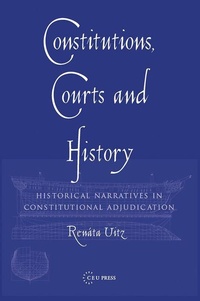
Constitutions, Courts, and History
Historical Narratives in Constitutional Adjudication
Published on 30. August 2005
Book
Paperback/Softback
362 pages
978-963-7326-32-5 (ISBN)
Description
Emphasizes the role history and historical narratives play in constitutional adjudication. Uitz provocatively draws attention to the often-tense relationship between the constitution and historical precedence highlighting the interpretive and normative nature of the law. Her work seeks to understand the conditions under which references to the past, history and traditions are attractive to lawyers, even when they have the potential of perpetuating indeterminacy in constitutional reasoning. Uitz conclusively argues that this constitutional indeterminacy is obscured by 'judicial rhetorical toolkits' of continuity and reconciliation that allow the court's reliance on the past to be unaccounted for. Uitz' rigorous analysis and extensive research makes this work an asset to legal scholars and practitioners alike.
More details
Language
English
Place of publication
Budapest
Hungary
Target group
College/higher education
Professional and scholarly
Academic
Product notice
Paperback (trade)
Unsewn / adhesive bound
Dimensions
Height: 231 mm
Width: 154 mm
Thickness: 24 mm
Weight
524 gr
ISBN-13
978-963-7326-32-5 (9789637326325)
Copyright in bibliographic data and cover images is held by Nielsen Book Services Limited or by the publishers or by their respective licensors: all rights reserved.
Schweitzer Classification
Other editions
Additional editions
Book
08/2005
Central European University Press
€148.50
Available (delivery time upon request)
E-Book
08/2005
1st Edition
Central European University Press
€30.99
Available for download
Person
Renata Uitz is Assistant Professor of Comparative Constitutional Law in the Legal Studies Department at Central European University.
Content
Preface and Acknowledgements INTRODUCTION Constitutional Adjudication Haunted by Indeterminacy CHAPTER ONE Historical Narratives in Constitutional Reasoning: Intuitions and Myths Revisited 1.1. History and tradition as accounts of the past: the need for a better distinction, or time to adopt a (not so) new methodology? 1.2. Common-law reasoning, Edmund Burke, and conservative/liberal ideals 1.3. Conclusion: towards a better understanding of historical narratives CHAPTER TWO An Overview of Arguments Used in Constitutional Adjudication 2.1. The limits of textualism in constitutional reasoning 2.2. Courts reaching beyond the text: means of construction outside the constitutional text 2.3. Arguments from context: the trace of the past, history, and traditions in constitutional cases 2.4. Conclusion: variety and recurring traits in constitutional argument CHAPTER THREE The Constitutional Text in the Light of History 3.1. Constitutions on their pasts; courts on the past of their constitutions 3.2. One Pole: the constitutional text calling for an inquiry into history 3.3. The middle of the continuum: a brief overview 3.4. The other pole: history as constitutional text in the Quebec secession reference 3.5. Summary of findings: towards disenchantment CHAPTER FOUR Behind Historical Narratives: The Promise of Continuity 4.1. On the vices and virtues of continuity in constitutional adjudication 4.2. Constructing constitutional continuity from the building blocks of preferred pasts 4.3. Seeing continuity and making it make a difference: lessons from transitional justice jurisprudence 4.4. Conclusion without closure: deceived by continuity in constitutional reasoning CHAPTER FIVE The Fruits of Reconciliation: A Bittersweet Harvest 5.1. The many faces of reconciliation and their many implications 5.2. Canada: continuity and reconciliation rhetoric hand in hand 5.3. Reconciliation winning over continuity in Hungarian transitional justice jurisprudence 5.4. Indigenous people in the maze of reconciliation: the suppressed subject revisited 5.5. Conclusion: the unfulfilled promise of reconciliation CONCLUSION Bibliography Index