

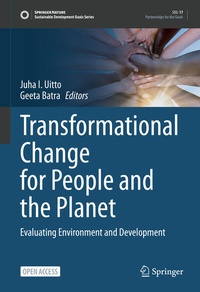
Transformational Change for People and the Planet
Description
This Open Access book deals with the pressing question of how to achieve transformational change that reconciles development with environmental sustainability. It particularly focuses on the role of evaluation in finding sustainable solutions. Environment and development are closely interlinked, as are human health and ecosystem health. The pandemic that began in 2020 demonstrated in no uncertain terms how destruction of habitats has allowed hitherto unknown pathogens spill over to humans wreaking havoc on people's lives and livelihoods. We are already seeing the impacts of global climate change in terms of heatwaves, forest fires and increased storms. The Sustainable Development Goals (SDGs) explicitly recognize the equal importance of the social, economic and environmental dimensions of development. In these turbulent times, when humankind faces multiple complex challenges it is essential to know that our responses are effective and that they make a positive difference. Evaluation can provide invaluable lessons to how we design policies, strategies and programs and how we allocate limited resources between competing priorities. This book brings together key thinkers and practitioners from the public and private sectors, from major multilateral organizations and from bilateral donor agencies, to present the latest knowledge and experience on how to evaluate interventions in the nexus of environment and development. The book does not promote any particular approach or methodology, but rather emphasizes the need for mixed methods to address the question at hand in the best and most suitable manner. It covers cases from a variety of fields, from climate change mitigation and adaptation, energy efficiency and renewable energy, natural resources management, biodiversity conservation and more.
This book is not a conference proceedings although it has its roots in the Third International Conference on Evaluating Environment and Development organized by the GEF Independent Evaluation Office in October 2019. The conference brought together a larger number of established and upcoming evaluators, researchers and evaluation users from the Global North and South, representing a wide variety of organizations, to discuss the frontiers of environment and development evaluation. Following the conference, the editors identified and contacted the participants who made key contributions at the conference and asked them to develop their ideas and papers into book chapters according to a coherent plan.
More details
Other editions
Additional editions
Persons
Geeta Batra is Chief Evaluation Officer and Deputy Director at the Global Environment Facility (GEF) Independent Evaluation Office (IEO). She has 25 years of experience in international development and evaluation in the private sector and at the World Bank. For ten years, she worked with the World Bank on private sector operations and advisory services, and over the last fifteen years she has worked as an evaluator-at the IFC heading the global unit for evaluation of advisory services, at the World Bank managing the portfolio of country and corporate evaluations in the Independent Evaluation Group, and with the GEF IEO conducting and managing evaluations focusing on environment interventions. In addition to managerial responsibilities, she continues to publish evaluation findings in journals and World Bank Group Publications.
Content
1. Introduction - Juha I. Uitto
Section I: Transformational Change
3. Transformational Change for Achieving Scale: Lessons for a Greener Recovery - Geeta Batra, Jeneen R. Garcia, & Kseniya Temnenko
Section II: Drivers of Sustainability - Introduction by Neeraj Kumar Negi
4. Sustainability After Project Completion: Evidence from the GEF - Neeraj Kumar Negi & Molly Watts Sohn
6. Staying Small and Beautiful: Enhancing Sustainability in the Small Island Developing States- Geeta Batra & Trond Norheim
8. Can We Assume Sustained Impact? Verifying the Sustainability of Climate Change Mitigation Results - Jindra Cekan & Susan Legro
Section III: Evaluating Climate Change Mitigation and Adaptation - Introduction by Anna Viggh
9. Using a Realist Framework to Overcome Evaluation Challenges in the Uncertain Landscape of Carbon Finance - Callum Murdoch, Lisa Keppler, Tillem Burlace, & Christine Wörlen
10. Evaluation's Role in Development Projects: Boosting Energy-Efficiency in a Traditional Industry in Chad - Serge Eric Yakeu Djiam
11. Enabling Systems Innovation in Climate Change Adaptation: Exploring the Role for MEL - Robbie Gregorowski & Dennis Bours
12. Assessing the Evaluability of Adaptation-focused Interventions: Lessons from the Adaptation Fund - Ronnie MacPherson, Amy Jersild, Dennis Bours, & Caroline Holo
13. Evaluating Transformational Adaptation in Smallholder Farming: Insights From an Evidence Review, by Laura Silici, Jerry Knox, Andy Rowe, and Suppiramaniam Nanthikesan
Section IV: Evaluation Approaches - Introduction by Carlo Carugi
14. Evaluation at the Endgame: Evaluating Sustainability and the SDGs by Moving Past Dominion and Institutional Capture - Andy Rowe
16. Pathway to the Transformative Policy of Agenda 2030: Evaluation of Finland's Sustainable Development Policy - Mari Räkköläinen & Anu Saxén
17. Evaluating for Resilient and Sustainable Livelihoods: Applying a Normative Framework to Emerging Realities - Prashanth Kotturi
18. Measuring the Impact of Monitoring: How We Know Transparent Near-Real-Time Data Can Help Save the Forests - Katherine Shea