

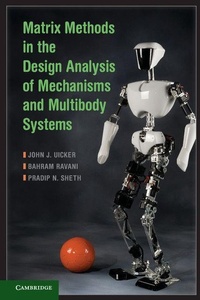
Matrix Methods in the Design Analysis of Mechanisms and Multibody Systems
Published on 15. April 2013
Book
Hardback
344 pages
978-0-521-76109-3 (ISBN)
Description
This book is an integrated approach to kinematic and dynamic analysis. The matrix techniques presented are general and fully applicable to two- or three-dimensional systems. They lend themselves to programming and digital computation and can act as the basis of a usable tool for designers. Techniques have broad applicability to the design analysis of all multibody mechanical systems. The more powerful and more flexible the approach, and the less specialisation and reprogramming required for each application, the better. The matrix methods presented have been developed using these ideas as primary goals. Matrix methods can be applied by hand to such problems as the slider-crank mechanism, but this is not the intent of this text, and often the rigor required for such an attempt becomes quite burdensome in comparison with other techniques. The matrix methods have been extensively tested, both in the classroom and in the world of engineering industry.
More details
Language
English
Place of publication
Cambridge
United Kingdom
Target group
College/higher education
Professional and scholarly
Illustrations
Worked examples or Exercises; 5 Tables, unspecified; 5 Halftones, unspecified; 100 Line drawings, unspecified
Dimensions
Height: 260 mm
Width: 183 mm
Thickness: 23 mm
Weight
850 gr
ISBN-13
978-0-521-76109-3 (9780521761093)
Copyright in bibliographic data and cover images is held by Nielsen Book Services Limited or by the publishers or by their respective licensors: all rights reserved.
Schweitzer Classification
Other editions
Additional editions
John J. Uicker | Bahram Ravani | Pradip N. Sheth
Matrix Methods in the Design Analysis of Mechanisms and Multibody Systems
E-Book
04/2013
1st Edition
Cambridge University Press
€67.99
Available for download
E-Book
04/2013
Cambridge University Press
€56.49
Available for download
Persons
John J. Uicker is Professor Emeritus of Mechanical Engineering at the University of Wisconsin, Madison. Throughout his career, his teaching and research have focused on solid geometric modeling and the modeling of mechanical motion, and their application to computer-aided design and manufacture, including the kinematics, dynamics and simulation of articulated rigid-body mechanical systems. He founded the UW Computer-Aided Engineering Center and served as its director for its initial ten years of operation. He has served on several national committees of ASME and SAE, and received the ASME Mechanisms Committee Award in 2004 and the ASME Fellow Award in 2007. He is a founding member of the US Council for the Theory of Mechanism and Machine Science (USCToMM), and of IFToMM, the international federation. He is a registered mechanical engineer in the state of Wisconsin and has served for many years as an active consultant to industry. Bahram Ravani is Professor of Mechanical Engineering at the University of California at Davis. He has served as the chair of the department of mechanical and aeronautical engineering as well as the interim chair of electrical and computer engineering. He is also a member of the graduate programs in biomedical engineering and in forensic science and engineering. Among his honors are the Young Manufacturing Engineer Award from the Society of Manufacturing Engineers, the Gustus L. Larson Memorial Award from ASME for outstanding achievements in mechanical engineering, and the Design Automation Award from the Design Engineering Division of ASME for his lifetime of sustained contributions. He is currently the technical editor of ASME Journal of Computers and Information Science in Engineering. He is a fellow of ASME and is the former chair of its design engineering division. He is also a member of the Society of Automotive Engineers, the International Society of Biomechanics and the Association for Advancement of Automotive Medicine. Pradip N. Sheth (1944-2009) was born in Vadodara, India. He earned his BE (1965) and MS (1968) in mechanical engineering at Maharaja Sayajirao University, Baroda, India, and his PhD in 1972 at the University of Wisconsin, Madison, where John Uicker served as his advisor. In his research he developed the Integrated Mechanisms Program for the computer-aided design and analysis of multibody mechanical systems. More than 200 industrial and educational organizations worldwide have utilized the system, which was the first of its kind.
Content
1. Concepts and definitions; 2. Topology and kinematic architecture; 3. Transformation matrices in kinematics; 4. Modeling mechanisms and multibody systems with transformation matrices; 5. Position analysis by kinematic equations; 6. Differential kinematics and numeric solution of posture equations; 7. Velocity analysis; 8. Acceleration analysis; 9. Modeling dynamic aspects of mechanisms and multibody systems; 10. Dynamic equations of motion; 11. Linearized equations of motion; 12. Equilibrium position analysis; 13. Frequency response of mechanisms and multibody systems; 14. Time response of mechanisms and multibody systems; 15. Collision detection; 16. Impact analysis; 17. Constraint force analysis.