

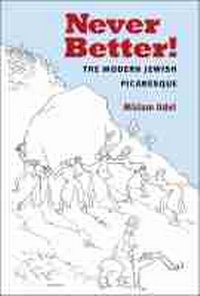
Never Better!
The Modern Jewish Picaresque
Published on 18. April 2016
Book
Paperback/Softback
266 pages
978-0-472-05305-6 (ISBN)
Description
It was only when Jewish writers gave up on the lofty Enlightenment ideals of progress and improvement that the Yiddish novel could decisively enter modernity. Animating their fictions were a set of unheroic heroes who struck a precarious balance between sanguinity and irony that author Miriam Udel captures through the phrase "never better." With this rhetorical homage toward the double-voiced utterances of Sholem Aleichem, Udel gestures at these characters' insouciant proclamation that things had never been better, and their rueful, even despairing admission that things would probably never get better.
The characters defined by this dual consciousness constitute a new kind of protagonist: a distinctively Jewish scapegrace whom Udel denominates the polit or refugee. Cousin to the Golden Age Spanish picaro, the polit is a socially marginal figure who narrates his own story in discrete episodes, as if stringing beads on a narrative necklace. A deeply unsettled figure, the polit is allergic to sentimentality and even routine domesticity. His sequential misadventures point the way toward the heart of the picaresque, which Jewish authors refashion as a vehicle for modernism-not only in Yiddish, but also in German, Russian, English and Hebrew. Udel draws out the contours of the new Jewish picaresque by contrasting it against the nineteenth-century genre of progress epitomized by the Bildungsroman.
While this book is grounded in modern Jewish literature, its implications stretch toward genre studies in connection with modernist fiction more generally. Udel lays out for a diverse readership concepts in the history and theory of the novel while also explicating the relevant particularities of Jewish literary culture. In addressing the literary stylistics of a "minor" modernism, this study illuminates how the adoption of a picaresque sensibility allowed minority authors to write simultaneously within and against the literary traditions of Europe.
The characters defined by this dual consciousness constitute a new kind of protagonist: a distinctively Jewish scapegrace whom Udel denominates the polit or refugee. Cousin to the Golden Age Spanish picaro, the polit is a socially marginal figure who narrates his own story in discrete episodes, as if stringing beads on a narrative necklace. A deeply unsettled figure, the polit is allergic to sentimentality and even routine domesticity. His sequential misadventures point the way toward the heart of the picaresque, which Jewish authors refashion as a vehicle for modernism-not only in Yiddish, but also in German, Russian, English and Hebrew. Udel draws out the contours of the new Jewish picaresque by contrasting it against the nineteenth-century genre of progress epitomized by the Bildungsroman.
While this book is grounded in modern Jewish literature, its implications stretch toward genre studies in connection with modernist fiction more generally. Udel lays out for a diverse readership concepts in the history and theory of the novel while also explicating the relevant particularities of Jewish literary culture. In addressing the literary stylistics of a "minor" modernism, this study illuminates how the adoption of a picaresque sensibility allowed minority authors to write simultaneously within and against the literary traditions of Europe.
Reviews / Votes
An intellectually mature, subtle work that illuminates with the use of a vast array of primary and interpretive literature so many crucial moments in the shaping of modern Yiddish, Hebrew, German and American- Jewish letters. Udel is a literary scholar with a sureness of touch and consummate scholarly command." -Steven J. Zipperstein, Stanford University"Never Better! is just that: a theoretically exciting study of the way in which Jewish writers translated and adapted a familiar European genre to create a distinctly modernist poetics of the picaresque." -Justin Cammy, Smith College
More details
Series
Language
English
Place of publication
Ann Arbor
United States
Target group
College/higher education
Professional and scholarly
Illustrations
1 table
Dimensions
Height: 229 mm
Width: 152 mm
ISBN-13
978-0-472-05305-6 (9780472053056)
Copyright in bibliographic data and cover images is held by Nielsen Book Services Limited or by the publishers or by their respective licensors: all rights reserved.
Schweitzer Classification
Person
Miriam Udel is an Associate Professor of Yiddish Language, Literature, and Culture in the German Studies department at Emory University, co-appointed in Emory's Tam Institute for Jewish Studies.