

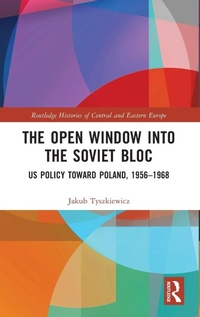
The Open Window into the Soviet Bloc
US Policy toward Poland, 1956-1968
1st Edition
Published on 29. September 2023
Book
Hardback
264 pages
978-1-032-33237-6 (ISBN)
Description
This volume analyzes US policy toward communist-ruled Poland in the fields of diplomacy, economy, culture, and public diplomacy. It highlights the limitations in developing cooperation between democratic and nondemocratic countries resulting from the Cold War conflict.
No comprehensive account of US policy toward Poland from 1956 to 1968 has emerged in historiography. This book aims to answer why, since the political changes of the Polish October 1956, Washington ceased to see Polish affairs as "Soviet-related matters." Instead, it recognized communist-ruled Poland as a separate political entity among other Kremlin-dependent states in Eastern Europe. This policy, introduced by the Dwight D. Eisenhower administration, was continued by his successors John F. Kennedy and Lyndon B. Johnson.
Recently declassified US and Polish archival sources allow the presentation of more considerations around the decision-making mechanisms by presidential administrations regarding communist Poland after 1956. They also reveal the dependence of the implementation of US actions on the climate of international relations. Moreover, they can now explain how Poland became an "open window" toward the Soviet bloc and a model example of the changes in the US policy of diversifying its approach to Eastern European countries under Soviet control in the next decades.
No comprehensive account of US policy toward Poland from 1956 to 1968 has emerged in historiography. This book aims to answer why, since the political changes of the Polish October 1956, Washington ceased to see Polish affairs as "Soviet-related matters." Instead, it recognized communist-ruled Poland as a separate political entity among other Kremlin-dependent states in Eastern Europe. This policy, introduced by the Dwight D. Eisenhower administration, was continued by his successors John F. Kennedy and Lyndon B. Johnson.
Recently declassified US and Polish archival sources allow the presentation of more considerations around the decision-making mechanisms by presidential administrations regarding communist Poland after 1956. They also reveal the dependence of the implementation of US actions on the climate of international relations. Moreover, they can now explain how Poland became an "open window" toward the Soviet bloc and a model example of the changes in the US policy of diversifying its approach to Eastern European countries under Soviet control in the next decades.
More details
Series
Language
English
Place of publication
London
United Kingdom
Publishing group
Taylor & Francis Ltd
Target group
College/higher education
Professional and scholarly
Academic and Postgraduate
Dimensions
Height: 240 mm
Width: 161 mm
Thickness: 19 mm
Weight
575 gr
ISBN-13
978-1-032-33237-6 (9781032332376)
Copyright in bibliographic data and cover images is held by Nielsen Book Services Limited or by the publishers or by their respective licensors: all rights reserved.
Schweitzer Classification
Other editions
Additional editions
Book
05/2025
1st Edition
Routledge
€67.50
Shipment within 10-20 days
E-Book
09/2023
1st Edition
Routledge
€60.49
Available for download
E-Book
09/2023
1st Edition
Routledge
€60.49
Available for download
Person
Jakub Tyszkiewicz is a historian at the University of Wroclaw, specializing primarily in US-Polish relations during the Cold War. He has been a visiting professor at many universities, including the University of Washington in Seattle as a Fulbright Scholar and the Hebrew University of Jerusalem.
Content
Introduction. PART I: An Open Window in the Iron Curtain: During the Presidency of Dwight D. Eisenhower 1. The United States and Polish October 2. The Swan Song of the Liberation 3. First PL 480 Agreement 4. Activities at the Political Level 5. Activities at the Economic Level 6. Public Diplomacy: Cultural and Scientific Cooperation and Humanitarian Aid 7. Radio Free Europe in the Eisenhower Administration's Policy toward Poland PART II: "Don't Shut the Door": During the Presidencies of John F. Kennedy and Lyndon B. Johnson 8. New Hopes and First Disappointments 9. Economic Negotiations in the Shadow of Politics 10. Other Fields of Cooperation 11. The Laborious "Bridge Building" 12. Poland in the Policy of "Bridge Building" 13. RFE and Other Propaganda Efforts PART III: The Dilemma of Oder-Neisse Border 14. The Polish Western Border in US Considerations. Conclusion