

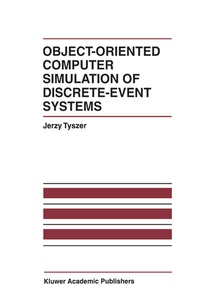
Object-Oriented Computer Simulation of Discrete-Event Systems
Published on 31. May 1999
Book
Hardback
XIV, 258 pages
978-0-7923-8506-6 (ISBN)
Description
Object-Oriented Computer Simulation of Discrete-Event Systems
offers a comprehensive presentation of a wide repertoire of computer simulation techniques available to the modelers of dynamic systems. Unlike other books on simulation, this book includes a complete and balanced description of all essential issues relevant to computer simulation of discrete event systems, and it teaches simulation users how to design, program and exploit their own computer simulation models. In addition, it uses the object-oriented methodology throughout the book as its main programming platform. The reader is expected to have some background in the theory of probability and statistics and only a little programming experience in C++, as the book is not tied down to any particular simulation language. The book also provides 50 complete simulation problems to assist with writing such simulation programs.
Object-Oriented Computer Simulation of Discrete-Event Systems demonstrates the basic and generic concepts used in computer simulation of discrete-event systems in a comprehensive, uniform and self-contained manner.
Object-Oriented Computer Simulation of Discrete-Event Systems demonstrates the basic and generic concepts used in computer simulation of discrete-event systems in a comprehensive, uniform and self-contained manner.
More details
Series
Edition
1999
Language
English
Place of publication
New York
United States
Target group
Professional and scholarly
Research
Illustrations
XIV, 258 p.
Dimensions
Height: 241 mm
Width: 160 mm
Thickness: 20 mm
Weight
582 gr
ISBN-13
978-0-7923-8506-6 (9780792385066)
DOI
10.1007/978-1-4615-5033-4
Schweitzer Classification
Other editions
Additional editions
E-Book
12/2012
Springer
€234.33
Available for download
Book
10/2012
Springer
€246.09
Shipment within 7-9 days
Content
1 Getting started.- 1.1 Basic notions.- 1.2 Manual simulation.- 1.3 Activity scanning.- 2 Event scheduling.- 2.1 Main paradigm.- 2.2 ABC approach.- 2.3 Events versus activities.- 3 Event lists.- 3.1 Doubly linked linear list.- 3.2 Indexed linear list.- 3.3 Henriksen's list.- 3.4 Two-level indexed list.- 3.5 Heaps.- 3.6 Splay trees.- 3.7 Run-time efficiency of event scheduling.- 4 Process interaction.- 4.1 Basic operations.- 4.2 Environment in C++.- 4.3 Distributed simulation.- 5 Random number generators.- 5.1 Uniform random variables.- 5.2 Statistical tests.- 5.3 Non-uniform variate generation.- 6 Design of simulation experiments.- 6.1 Validation of models.- 6.2 Analysis of variance.- 6.3 Linear regression.- 7 Collection and analysis of simulation results.- 7.1 Gathering of results.- 7.2 Transient phase characteristics.- 7.3 Estimation of steady-state phase characteristics.- 7.4 Variance reduction methods.- 8 Examples of simulation models.- 8.1 A simple preemptive system.- 8.2 A system with priorities and group servers.- 8.3 Assembly line.- 8.4 Finite-population queuing model.- 8.5 Satellite communication system.- 9 Epilog.- 10 Exercises.- A Probability distributions.- A.1 The standard normal distribution.- A.2 The Student's t distribution.- A.3 The chi-square distribution.- A.4 The F distribution.- A.5 The Kolmogorov-Smirnov distribution.