

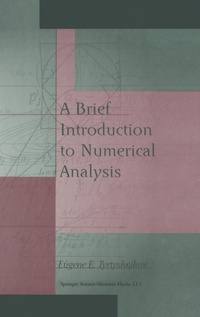
A Brief Introduction to Numerical Analysis
1st Edition
Published on 1. July 1997
Book
Hardback
XII, 202 pages
978-0-8176-3916-7 (ISBN)
Description
A logically organized advanced textbook, which turns the reader into an active participant by asking questions, hinting, giving direct recommendations, comparing different methods, and discussing "pessimistic" and "optimistic" approaches to numerical analysis. Advanced students and graduate students majoring in computer science, physics and mathematics will find this book helpful.
Reviews / Votes
"The title of this book reflects its structure and style with great exactness. The presentation of the material is very clear and supported by properly chosen exercises of good didactic value added to each lecture." - Zentralblatt Math"[The book] is a short and elegant coupling of simplicity and very deep results.[It] can be used both as an introduction and a refinement to a university course. Students [in] mathematics and physics but also other advanced readers and experienced researchers find both the classical fundamental results and new visions and ideas while reading this nice book." - ZAAMore details
Edition
1., 996
Language
English
Place of publication
Secaucus
United States
Target group
College/higher education
Professional and scholarly
Research
Product notice
sewn/stitched
Cloth over boards
Illustrations
XII, 202 p., 2 s/w Abbildungen
bibliography, index, 4 line drawings
Dimensions
Height: 241 mm
Width: 160 mm
Thickness: 18 mm
Weight
500 gr
ISBN-13
978-0-8176-3916-7 (9780817639167)
DOI
10.1007/978-0-8176-8136-4
Schweitzer Classification
Other editions
Additional editions
Eugene E. Tyrtyshnikov
A Brief Introduction to Numerical Analysis
Book
12/2012
Springer-Verlag New York Inc.
€53.49
Shipment within 15-20 days
Previous edition

Eugene E. Tyrtyshnikov
A Brief Introduction to Numerical Analysis
Book
04/1997
Birkhäuser Verlag GmbH
€55.71
Article exhausted; check for reprint
Content
Lecture 1: metric space; some useful definitions; nested balls; normed space; popular vector norms; matrix norms; equivalent norms; operator norms. Lecture 2: scalar product; length of a vector; isometric matricies; preservation of length and unitary matricies; Schur theorum; normal matricies; positive definite matricies; the singular value decomposition; unitarily invariant norms; a short way to the SVD; approximations of a lower rank; smoothness and ranks. Lecture 3: perturbation theory; condition of a matrix; convergent matricies and series; the simplest iteration method; inverses and series; condition of a linear system; consistency of matrix and right-hand side; eigenvalue perturbations; continuity of the polynomial roots. Lecture 4: diagonal dominance; Gerschgorin disks; small perturbations of eigen values and vectors; condition of a simple eigenvalue; analitic perturbations. Lecture 5: spectral distances; "symmetric" theorums; Hoffman-Wielandt theorum; permutation vector of a matrix; "unnormal" extension; eigenvalues of Hermitian matrices; interlacing properties; what are clusters?; singular value clusters; eigenvalue clusters. Lecture 6: floating-point numbers; computer arithmetic axioms; round-off errors for the scalar product; forward and backward analysis; some philosophy; an example of "bad" operation; one more example; ideal and machine tests; up or down; solving the triangular systems. Lecture 7: direct methods for linear systems; theory of the LU decomposition; round-off errors for the LU decomposition; growth of matrix entries and pivoting; complete pivoting; the Cholesky method; triangular decompositions and linear systems solution; how to refine the solution. Lecture 8: the QR decomposition of a square matrix; the QR decomposition of a rectangular matrix; householder matrices; elimination of elements by reflections; Givens matricies; elimination of elements by rotations; computer realizations of reflections and rotations; orthgonalization method; loss of orthogonality; modified Gram-Schmidt algorithm; bidiagonalization; unitary similarity reduction to the Hessenberg form. Lecture 9: the eigenvalue problem; the power method; subspace iterations; distances between subspaces; subspaces and orthoprojectors; distances and orthoprojectors; subspaces of equal dimension; the CS decomposition; convergence of subspace iterations for the block diagonal matrix; convergance of subspace iterations in the general case. Lecture 10: the QR algorithm; generalised QR algorithm; basic formulas; the QR iteration lemma; convergance of the QR iterations; pessimistric and optimistic; Bruhat decomposition; what if the inverse matrix is not strongly regular; the QR iterations and the subspace iterations. Lecture 11: quadratic convergence; cubic convergence; what makes the QR algorithm efficient; implicit QR iterations; arrangement of computations; how to find the singular value decomposition. Lecture 12: function approximation; (Part contents)