

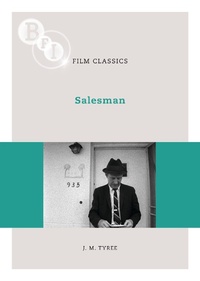
Salesman
Published on 18. September 2012
Book
Paperback/Softback
104 pages
978-1-84457-387-5 (ISBN)
Description
Selected by the Library of Congress as one of the most significant American films ever made, Salesman (1966-9) is a landmark in non-fiction cinema, equivalent in its impact and influence to Truman Capote's 'non-fiction novel'
In Cold Blood.
The film follows a team of travelling Bible salesmen on the road in Massachusetts, Chicago, and Florida, where the American dream of self-reliant entrepreneurship goes badly wrong for protagonist Paul Brennan. Long acknowledged as a high-water mark of the 'direct cinema' movement, this ruefully comic and quietly devastating film was the first masterpiece of Albert Maysles, David Maysles and Charlotte Zwerin, the trio who would go on to produce The Rolling Stones documentary, Gimme Shelter (1970).
Based on the premise that films drawn from ordinary life could compete with Hollywood extravaganzas, Salesman was critical in shaping 'the documentary feature'. A novel cinema-going experience for its time, the film was independently produced, designed for theatrical release and presented without voiceover narration, interviews, or talking heads. Working with innovative handheld equipment, and experimenting with eclectic methods and a collaborative ethos, the Maysles brothers and Zwerin produced a carefully-orchestrated narrative drama fashioned from unexpected episodes.
J. M. Tyree suggests that Salesman can be understood as a case study of non-fiction cinema, raising perennial questions about reality and performance. His analysis provides an historical and cultural context for the film, considering its place in world cinema and its critical representations of dearly-held national myths. The style of Salesman still makes other documentaries look static and immobile, while the film's allegiances to everyday subjects and working people indelibly marked the cinema. Tyree's insightful study also includes an exclusive exchange with Albert Maysles about the film.
In Cold Blood.
The film follows a team of travelling Bible salesmen on the road in Massachusetts, Chicago, and Florida, where the American dream of self-reliant entrepreneurship goes badly wrong for protagonist Paul Brennan. Long acknowledged as a high-water mark of the 'direct cinema' movement, this ruefully comic and quietly devastating film was the first masterpiece of Albert Maysles, David Maysles and Charlotte Zwerin, the trio who would go on to produce The Rolling Stones documentary, Gimme Shelter (1970).
Based on the premise that films drawn from ordinary life could compete with Hollywood extravaganzas, Salesman was critical in shaping 'the documentary feature'. A novel cinema-going experience for its time, the film was independently produced, designed for theatrical release and presented without voiceover narration, interviews, or talking heads. Working with innovative handheld equipment, and experimenting with eclectic methods and a collaborative ethos, the Maysles brothers and Zwerin produced a carefully-orchestrated narrative drama fashioned from unexpected episodes.
J. M. Tyree suggests that Salesman can be understood as a case study of non-fiction cinema, raising perennial questions about reality and performance. His analysis provides an historical and cultural context for the film, considering its place in world cinema and its critical representations of dearly-held national myths. The style of Salesman still makes other documentaries look static and immobile, while the film's allegiances to everyday subjects and working people indelibly marked the cinema. Tyree's insightful study also includes an exclusive exchange with Albert Maysles about the film.
Reviews / Votes
J.M.Tyree's monograph on Salesman for the B.F.I. [is currently on my nightstand]. I usually have one or two of these on the night stand - I can read one, usually, in a day, and then I go back and rewatch the movie. Salesman is one of my favorite documentaries of all time, so it's cool to get Tyree's perspective on it, and then go rewatch the movie. -- The New York Times * Patton Oswalt *More details
Series
Edition
2012 edition
Language
English
Place of publication
London
United Kingdom
Publishing group
Bloomsbury Publishing PLC
Target group
College/higher education
Product notice
Paperback (trade)
Unsewn / adhesive bound
Illustrations
56 b/w photos
Dimensions
Height: 188 mm
Width: 135 mm
Thickness: 8 mm
Weight
181 gr
ISBN-13
978-1-84457-387-5 (9781844573875)
Copyright in bibliographic data and cover images is held by Nielsen Book Services Limited or by the publishers or by their respective licensors: all rights reserved.
Schweitzer Classification
Other editions
Person
J.M. TYREE is a Writer-at-Large for Film Quarterly and the co-author (with Ben Walters) of the BFI Film Classic on The Big Lebowski. He has taught at Stanford University, spoken at the BFI's National Film Theatre, and contributed to Sight & Sound magazine.
Content
Acknowledgments.- Introduction.- 1 The Path to Salesman.- 2 Performers, Authors, Directors.- 3 Americana.- Conclusion: Reality and its Discontents.- Appendix: Albert Maysles on Salesman An exchange with J.M. Tyree.- Notes.- Credits.- Bibliography.