

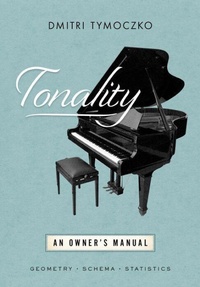
Tonality
An Owner's Manual
Published on 14. December 2023
Book
Hardback
632 pages
978-0-19-757710-3 (ISBN)
Description
This encyclopaedic book proposes a sweeping reformulation of the basic concepts of Western music theory, revealing simple structures underlying a wide range of practices from the Renaissance to contemporary pop. Its core innovation is a collection of simple geometrical models describing the implicit knowledge governing a broad range of music-making, much as the theory of grammar describes principles that tacitly guide our speaking and writing. Each of its central chapters re-examines a basic music-theoretical concept such as voice leading, repetition, nonharmonic tones, the origins of tonal harmony, the grammar of tonal harmony, modulation, and melody. These are flanked by two largely analytical chapters on rock harmony and Beethoven. Wide-ranging in scope, and with almost 700 musical examples from the Middle Ages to the present day, Tonality: An Owner's Manual weaves philosophy, mathematics, statistics, and computational analysis into a new and truly twenty-first century theory of music.
Reviews / Votes
Tonality: An Owner's Manual is Dmitri Tymoczko's dazzling answer to the controversial quest for a transhistorical definition of tonality. By disentangling what composers do from what theorists say, Tymoczko presents a fascinating exposition of common compositional principles that animate Western music from Renaissance polyphony to jazz, rock, and contemporary triadic idioms. * Suzannah Clark, Morton B. Knafel Professor of Music and Director of the Mahindra Humanities Center, Harvard University * Dmitri Tymoczko is an original musical thinker who combines mathematical skills and good musicianship in search of universal principles of pitch organization. Tonality: An Owner's Manual continues this quest in proposing a geometrical, hierarchical voice-leading theory that has applications across diverse musical styles. It is written with admirable clarity. * Fred Lerdahl, Fritz Reiner Professor Emeritus of Musical Composition, Columbia University * This volume is intended for readers with advanced training in music theory. It is in many ways a compendium of thought in the field of "tonal" music theory, that aspect of music theory concerned with musical harmonies as they can be related to each other, often via a central harmony or pitch--a "tonal center." The gathering of recent trends in music theory becomes a launch pad for the author's own astute theoretical projections, many of them informed by his work in the geometry of music theory. The book should be required reading for the specialist music theorist. * Choice *More details
Series
Language
English
Place of publication
New York
United States
Target group
Professional and scholarly
Product notice
sewn/stitched
Cloth over boards
Illustrations
698
Dimensions
Height: 259 mm
Width: 186 mm
Thickness: 40 mm
Weight
1272 gr
ISBN-13
978-0-19-757710-3 (9780197577103)
Copyright in bibliographic data and cover images is held by Nielsen Book Services Limited or by the publishers or by their respective licensors: all rights reserved.
Schweitzer Classification
Other editions
Person
Dmitri Tymoczko is a composer and music theorist who teaches at Princeton University. Widely recognized as one of the world's leading music theorists, his music has been performed all over the world.
Content
Preface and Acknowledgements
1. Implicit musical knowledge
1. Gesualdo's trick
2. The quadruple hierarchy
3. Philosophy
4. Statistics
5. Schema
6. Outline
Prelude: transposition along a collection
2. Rock logic
1. A melodic principle
2. A harmonic principle
3. A first chord-loop family
4. Two more families
5. Shepard-tone passacaglias
6. Minor triads and other trichords
7. A fourth family
8. Other modalities
9. Function and retrofunction
10. Continuity or reinvention?
Prelude: the Tinctoris transform
3. Line and configuration
1. The imperfect system
2. Voice exchanges
3. Other intervals
4. The circle of diatonic triads
5. Voice exchanges and multiple chord types
6. Four-voice triadic counterpoint
7. Counterpoint within the chord
8. Seventh chords
9. Harmony and counterpoint
Prelude: sequence and function
4. Repetition
1. Repetition reimagined
2. Repeating contrapuntal patterns
3. The geometry of two-voice sequences
4. Three voices and the circle of triads
5. Three voices arranged 2+1
6. Four voices
7. Contrary-motion sequences
8. Melodic sequences and near sequences
9. Near sequences
10. Sequences as reductional targets
Prelude: three varieties of analytical reduction
5. Nonharmonic tones
1. The first practice and the SNAP system
2. Schoenberg's critique
3. Monteverdi's "Ohime"
4. The standardized second practice
5. A loophole
6. After nonharmonicity
Prelude: functional and scale-degree analysis
6. The origins of functional harmony
1. The logical structure of protofunctionality
2. Similarities and differences
3. Origin and meaning
4. Harmony and polyphony
5. The Pope Marcellus Kyrie
6. A broader perspective
7. "I Cannot Follow"
Prelude: could the Martians understand our music?
7. Functional progressions
1. A theory of harmonic cycles
2. A more principled view
3. Rameau and Bach
4. Functional melody, functional harmony
5. Fauxbourdon and linear idioms
6. Sequences
7. Bach the dualist
Prelude: chromatic or diatonic?
8. Modulation
1. Two models of key distance
2. Enharmonicism and loops in scale space
3. Minor keys
4. Modulatory schemas
5. Up and down the ladder
6. Modal homogenization and scalar voice leading
7. Generalized set theory
Prelude: hearing and hearing-as
9. Melodic strategies
1. Strategy and reduction
2. Two models of the phrase
3. Chopin and the Prime Directive
4. An expanded vocabulary of melodic templates
5. Simple harmonic hierarchy
6. The four-part phrase
7. Grouping, melody, harmony
8. Beyond the phrase: hierarchy at the level of the piece
Prelude: why Beethoven?
10. Beethoven theorist
1. Meet the Ludwig
2. From schema to flow
3. The Tempest
4. The Fifth Symphony
5. The "Pastorale" sonata, op. 28
6. Schubert's Quartettsatz
7. The prelude to Lohengrin
11. Conclusion
12. Appendix 1: Fundamentals
13. Appendix 2: Deriving the spiral diagrams
14. Appendix 3: From sequence to transformation
15. Appendix 4: Music theory and corpus analysis
Terms and Abbreviations
Bibliography
1. Implicit musical knowledge
1. Gesualdo's trick
2. The quadruple hierarchy
3. Philosophy
4. Statistics
5. Schema
6. Outline
Prelude: transposition along a collection
2. Rock logic
1. A melodic principle
2. A harmonic principle
3. A first chord-loop family
4. Two more families
5. Shepard-tone passacaglias
6. Minor triads and other trichords
7. A fourth family
8. Other modalities
9. Function and retrofunction
10. Continuity or reinvention?
Prelude: the Tinctoris transform
3. Line and configuration
1. The imperfect system
2. Voice exchanges
3. Other intervals
4. The circle of diatonic triads
5. Voice exchanges and multiple chord types
6. Four-voice triadic counterpoint
7. Counterpoint within the chord
8. Seventh chords
9. Harmony and counterpoint
Prelude: sequence and function
4. Repetition
1. Repetition reimagined
2. Repeating contrapuntal patterns
3. The geometry of two-voice sequences
4. Three voices and the circle of triads
5. Three voices arranged 2+1
6. Four voices
7. Contrary-motion sequences
8. Melodic sequences and near sequences
9. Near sequences
10. Sequences as reductional targets
Prelude: three varieties of analytical reduction
5. Nonharmonic tones
1. The first practice and the SNAP system
2. Schoenberg's critique
3. Monteverdi's "Ohime"
4. The standardized second practice
5. A loophole
6. After nonharmonicity
Prelude: functional and scale-degree analysis
6. The origins of functional harmony
1. The logical structure of protofunctionality
2. Similarities and differences
3. Origin and meaning
4. Harmony and polyphony
5. The Pope Marcellus Kyrie
6. A broader perspective
7. "I Cannot Follow"
Prelude: could the Martians understand our music?
7. Functional progressions
1. A theory of harmonic cycles
2. A more principled view
3. Rameau and Bach
4. Functional melody, functional harmony
5. Fauxbourdon and linear idioms
6. Sequences
7. Bach the dualist
Prelude: chromatic or diatonic?
8. Modulation
1. Two models of key distance
2. Enharmonicism and loops in scale space
3. Minor keys
4. Modulatory schemas
5. Up and down the ladder
6. Modal homogenization and scalar voice leading
7. Generalized set theory
Prelude: hearing and hearing-as
9. Melodic strategies
1. Strategy and reduction
2. Two models of the phrase
3. Chopin and the Prime Directive
4. An expanded vocabulary of melodic templates
5. Simple harmonic hierarchy
6. The four-part phrase
7. Grouping, melody, harmony
8. Beyond the phrase: hierarchy at the level of the piece
Prelude: why Beethoven?
10. Beethoven theorist
1. Meet the Ludwig
2. From schema to flow
3. The Tempest
4. The Fifth Symphony
5. The "Pastorale" sonata, op. 28
6. Schubert's Quartettsatz
7. The prelude to Lohengrin
11. Conclusion
12. Appendix 1: Fundamentals
13. Appendix 2: Deriving the spiral diagrams
14. Appendix 3: From sequence to transformation
15. Appendix 4: Music theory and corpus analysis
Terms and Abbreviations
Bibliography