

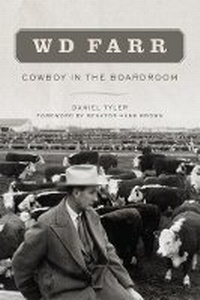
WD Farr
Cowboy in the Boardroom
Published on 30. August 2012
Book
Paperback/Softback
316 pages
978-0-8061-4328-6 (ISBN)
Description
Always a better way"" was WD Farr's motto. As a Colorado rancher, banker, cattle feeder, and expert in irrigation, Farr (1910-2007) had a unique talent for building consensus and instigating change in an industry known for its conservatism. With his persistent optimism and gregarious personality, Farr's influence extended from next-door neighbors and business colleagues to U.S. presidents and foreign dignitaries. In this biography, Daniel Tyler chronicles Farr's singular life and career. At the same time, he tells a broader story of sweeping changes in agricultural production and irrigated agriculture in Colorado and across the West during the twentieth century.
WD was a third-generation descendant of western farming pioneers, who specialized in sheep feeding. While learning all he could from his father and grandfather, WD developed a new vision: to make cattle profitable. He sought out experienced livestock experts to help him devise ways to produce beef year-round. When World War II ended, and the troops came home tired of wartime mutton, the beef industry took off. With his new innovations in place, WD was ready.
Tyler also reveals WD's influence in securing water supplies for farmers and ranchers and in establishing water conservation policies. Early in his career, WD helped sell the Colorado-Big Thompson Project to skeptical, debt-ridden farmers. In 1955, he became a board member for the Northern Colorado Water Conservancy District, a post he held for forty years.
Tyler bases his portrait of WD Farr on extensive archival research and dozens of interviews with people who knew him personally or by reputation. In the end, Tyler shows that although not everybody agreed, or will agree, with Farr's stands on particular issues, this ""cowboy in the boardroom"" led by his own example. By embracing change and seeking consensus rather than forcing his will on others, his greatest legacy - as revealed in this book - may be the model of leadership he provided.
WD was a third-generation descendant of western farming pioneers, who specialized in sheep feeding. While learning all he could from his father and grandfather, WD developed a new vision: to make cattle profitable. He sought out experienced livestock experts to help him devise ways to produce beef year-round. When World War II ended, and the troops came home tired of wartime mutton, the beef industry took off. With his new innovations in place, WD was ready.
Tyler also reveals WD's influence in securing water supplies for farmers and ranchers and in establishing water conservation policies. Early in his career, WD helped sell the Colorado-Big Thompson Project to skeptical, debt-ridden farmers. In 1955, he became a board member for the Northern Colorado Water Conservancy District, a post he held for forty years.
Tyler bases his portrait of WD Farr on extensive archival research and dozens of interviews with people who knew him personally or by reputation. In the end, Tyler shows that although not everybody agreed, or will agree, with Farr's stands on particular issues, this ""cowboy in the boardroom"" led by his own example. By embracing change and seeking consensus rather than forcing his will on others, his greatest legacy - as revealed in this book - may be the model of leadership he provided.
Reviews / Votes
Following in the footsteps of earlier visionaries such as Benjamin Eaton, Elwood Mead, Delphus Carpenter, Charles Hansen, and others, [WD] Farr's endeavors in the twentieth century helped define the modern West. From taming flood waters, constructing water storage, and developing year-round cattle feeding to leading the way in water conservation, improved meat grading standards, and environmental partnerships, WD continued the pioneering tradition and adapted it to the dynamics of a postwar world. . . . [B]ut without a doubt, his greatest effect was on those who were fortunate enough to have known him and to have witnessed his leadership. As [Daniel] Tyler points out, that unique and effective style was his most enduring legacy."" - from the foreword by Senator Hank Brown""An important account of the life, vision, and choices of a uniquely skilled gentleman who literally changed the course of the livestock and meat industries, as well as production agriculture in his region of the American West."" - Charles P. Schroeder, Executive Director of the National Cowboy & Western Heritage Museum
More details
Language
English
Place of publication
Oklahoma
United States
Target group
Professional and scholarly
Illustrations
31 black & white illustrations, 2 maps
Dimensions
Height: 229 mm
Width: 152 mm
Thickness: 19 mm
Weight
503 gr
ISBN-13
978-0-8061-4328-6 (9780806143286)
Copyright in bibliographic data and cover images is held by Nielsen Book Services Limited or by the publishers or by their respective licensors: all rights reserved.
Schweitzer Classification