

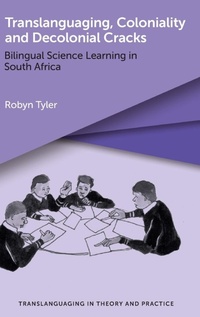
Translanguaging, Coloniality and Decolonial Cracks
Bilingual Science Learning in South Africa
Published on 13. January 2023
Book
Hardback
184 pages
978-1-80041-198-2 (ISBN)
Description
In this linguistic ethnography of bilingual science learning in a South African high school, the author connects microanalyses of classroom discourse to broader themes of de/coloniality in education. The book challenges the deficit narrative often used to characterise the capabilities of linguistically-minoritised youth, and explores the challenges and opportunities associated with leveraging students' full semiotic repertoires in learning specific concepts. The author examines the linguistic landscape of the school and the beliefs and attitudes of staff and students which produce both coloniality and cracks in the edifice of coloniality. A critical translanguaging lens is applied to analyse multilingual and multimodal aspects of students' science meaning-making in a traditional classroom and a study group intervention. Finally, the book suggests implications for decolonial pedagogical translanguaging in Southern multilingual classrooms.
Reviews / Votes
Through detailed ethnographic research, this book presents a vision of decolonial learning in South Africa - students drawing on their full semiotic repertoires to make their voices heard, as they shape the future of knowledge creation. It is essential reading for anyone concerned with de/coloniality in education and society. * Adrian Blackledge, University of Stirling, UK * Robyn Tyler provides a beautifully detailed, as well as theoretically and methodologically innovative, linguistic ethnography of the 'coloniality of language' and 'decolonial cracks' in high school science learning on the periphery of Cape Town. Making visible the resourceful, multi-semiotic meaning-making of marginalized African language speaking students, the book makes an invaluable contribution to scholarship in critical sociolinguistics and bi/multilingual education from the Global South. * Carolyn McKinney, University of Cape Town, South Africa * ...the book effectively conveys the intricate layers of language-in-education policy and practice in any given schooling context, encompassing the curriculum, school's physical environment, teacher ideologies, student affect, and more. It implies that a potential remedy toward a future with less colonialty lies in the hands of teachers, students, education leaders, and policy makers. * Maya Alkateb-Chami Editor, Harvard Educational Review * Anyone who is interested in better understanding the decolonial potential of translanguaging would find this book interesting and helpful. As decoloniality is about thinking "otherwise" to pursue pluriversality (Mignolo, 2000), showcasing what such pursuit can look like is important, and Tyler's work just does this. In addition, her work offers an example of the very job of noticing, valuing, and building on the emergent decolonial crack that is already in the coloniality. * Eunjeong Lee, University of Houston, USA, International Journal of Bilingualism 28 (4) *More details
Series
Language
English
Place of publication
Bristol
United Kingdom
Target group
College/higher education
Dimensions
Height: 240 mm
Width: 161 mm
Thickness: 14 mm
Weight
440 gr
ISBN-13
978-1-80041-198-2 (9781800411982)
Copyright in bibliographic data and cover images is held by Nielsen Book Services Limited or by the publishers or by their respective licensors: all rights reserved.
Schweitzer Classification
Other editions
Additional editions
Robyn Tyler
Translanguaging, Coloniality and Decolonial Cracks
Bilingual Science Learning in South Africa
Book
01/2023
Multilingual Matters
€47.90
Shipment within 10-20 days
Person
Robyn Tyler is a Senior Researcher in the Centre for Multilingualism and Diversities Research at the University of the Western Cape, South Africa. She supervises graduate students and student teachers and is a member of the bua-lit language and literacy collective (www.bua-lit.org.za). Her research interests include semiotic repertoires for learning, translingual practice, youth and identity, inquiry-based science education and language across the curriculum.
Content
Acknowledgements
Chapter 1. De/coloniality and Language in South African Schooling
Chapter 2. Language, the Body and Identity in Learning
Chapter 3. Language at Success High: Ideologies and Practices
Chapter 4. Constraint in Curriculum, Assessment and Classroom Discourse
Chapter 5. Decolonial Cracks Introduced by Students
Chapter 6. Decolonial Cracks in Pedagogy: Freedom and Resistance
Chapter 7. Conclusion: Widening the Cracks
Appendix 1: A Multilingual Science Resources list
Appendix 2: Grade 9 Chemical Reactions Tests and Worksheets: English, isiXhosa and Translingual
Appendix 3: Transcription Conventions
References
Index
Chapter 1. De/coloniality and Language in South African Schooling
Chapter 2. Language, the Body and Identity in Learning
Chapter 3. Language at Success High: Ideologies and Practices
Chapter 4. Constraint in Curriculum, Assessment and Classroom Discourse
Chapter 5. Decolonial Cracks Introduced by Students
Chapter 6. Decolonial Cracks in Pedagogy: Freedom and Resistance
Chapter 7. Conclusion: Widening the Cracks
Appendix 1: A Multilingual Science Resources list
Appendix 2: Grade 9 Chemical Reactions Tests and Worksheets: English, isiXhosa and Translingual
Appendix 3: Transcription Conventions
References
Index