

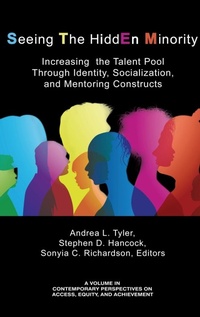
Seeing The HiddEn Minority
Increasing the Talent Pool through Identity, Socialization, and Mentoring Constructs
Published on 3. June 2020
Book
Hardback
170 pages
978-1-64113-949-6 (ISBN)
Description
The participation of Black students in science, technology, engineering, and mathematics (STEM) fields, is an issue of national concern. Educators and policymakers are seeking to promote STEM studies and eventual degree attainment, especially those from underrepresented groups, including Black students, women, economically disadvantaged, and students with disabilities. Literature shows that this has been of great interest to researchers, policymakers, and institutions for several years (Nettles & Millet, 2006; Council of Graduate School (CGS), 2009; National Science Foundation (NSF), 2006), therefore an extensive understanding of access, attrition, and degree completion for Black students in STEM is needed.
According to Hussar and Bailey (2014), the Black and Latino postsecondary enrollment rates will increase by approximately 25% between 2011 and 2022. It is critical that this projected enrollment increase translates into an increase in Black student STEM enrollment, persistence and consequently STEM workforce. In view of the shifting demographic landscape, addressing access, equity and achievement for Black students in STEM is essential. Institutions, whether they are secondary or postsecondary, all have unique formal and informal academic structures that students must learn to navigate in order to become academically and socially acclimated to the institution (Tyler, Brothers, & Haynes, 2014). Therefore positive experience with the academic environment becomes critical to the success of a student persisting and graduating.
Understanding and addressing the challenges faced by Black students in STEM begins with understanding the complexities they face at all levels of education. A sense of urgency is now needed to explore these complexities and how they impact students at all educational levels. This book will explore hidden figures and concerns of social connectedness, mentoring practices, and identity constructs that uncover unnoticed talent pools and encourage STEM matriculation among Black STEM students' in preK-12 and post-secondary landscapes.
According to Hussar and Bailey (2014), the Black and Latino postsecondary enrollment rates will increase by approximately 25% between 2011 and 2022. It is critical that this projected enrollment increase translates into an increase in Black student STEM enrollment, persistence and consequently STEM workforce. In view of the shifting demographic landscape, addressing access, equity and achievement for Black students in STEM is essential. Institutions, whether they are secondary or postsecondary, all have unique formal and informal academic structures that students must learn to navigate in order to become academically and socially acclimated to the institution (Tyler, Brothers, & Haynes, 2014). Therefore positive experience with the academic environment becomes critical to the success of a student persisting and graduating.
Understanding and addressing the challenges faced by Black students in STEM begins with understanding the complexities they face at all levels of education. A sense of urgency is now needed to explore these complexities and how they impact students at all educational levels. This book will explore hidden figures and concerns of social connectedness, mentoring practices, and identity constructs that uncover unnoticed talent pools and encourage STEM matriculation among Black STEM students' in preK-12 and post-secondary landscapes.
More details
Series
Language
English
Place of publication
United States
Publishing group
Emerald Publishing Inc
Target group
Professional and scholarly
Primary & secondary/elementary & high school
Dimensions
Height: 240 mm
Width: 161 mm
Thickness: 14 mm
Weight
426 gr
ISBN-13
978-1-64113-949-6 (9781641139496)
Copyright in bibliographic data and cover images is held by Nielsen Book Services Limited or by the publishers or by their respective licensors: all rights reserved.
Schweitzer Classification
Other editions
Additional editions
Andrea L. Tyler | Stephen Hancock | Sonyia C. Richardson
Seeing The HiddEn Minority
Increasing the Talent Pool through Identity, Socialization, and Mentoring Constructs
E-Book
06/2020
1st Edition
IAP - Information Age Publishing
€62.33
Available for download
Content
Preface.
Acknowledgements; Andrea L. Tyler.
Section I. Socialization.
Chapter 1. Using the Frameworks of Socialization and Acculturation to Understand the Trajectory of Scientists of Color; Karri A. Holley and Joretta Joseph.
Chapter 2. Strategies for Using Critical Systems Theory to Support Socialization of African American Students in STEM; Sonyia C. Richardson and Lenora Crabtree.
Section II. Mentoring.
Chapter 3. Mentoring for STEM Advocacy; Cameron Denson and Tamecia R. Jones.
Chapter 4. Different Worlds: A Picture of Mentorships at PWIs and HBCUs; Daniel Alston and Brandi Copeland-Kamp.
Chapter 5. STEM Doctoral Student Degree Attainment: How Demands, Structures, and Networks Impact Timely Degree Completion; Carrie Klein and Hironao Okahana.
Section III. Identity.
Chapter 6. The Role of Identity on Persistence for Black Women Doctoral Students in Science; Andrea L. Tyler, Letimicia Fears, and Monica Miles.
Chapter 7. Strengthening STEM Identities: Combatting Curriculum Trauma in African American Students; Stephen D. Hancock and Michelle B. Pass.
Chapter 8. Unearthing Factors That Contribute to Distorted Science, Identities in African American Women; Ansley Booker.
Chapter 9. Afterword-Recurring Themes, Constructs, Implications for Theory and Practice, and Recommendations, Guide, and Future Research; Stephen D. Hancock and Sonyia C. Richardson.
About the Contributors.
Acknowledgements; Andrea L. Tyler.
Section I. Socialization.
Chapter 1. Using the Frameworks of Socialization and Acculturation to Understand the Trajectory of Scientists of Color; Karri A. Holley and Joretta Joseph.
Chapter 2. Strategies for Using Critical Systems Theory to Support Socialization of African American Students in STEM; Sonyia C. Richardson and Lenora Crabtree.
Section II. Mentoring.
Chapter 3. Mentoring for STEM Advocacy; Cameron Denson and Tamecia R. Jones.
Chapter 4. Different Worlds: A Picture of Mentorships at PWIs and HBCUs; Daniel Alston and Brandi Copeland-Kamp.
Chapter 5. STEM Doctoral Student Degree Attainment: How Demands, Structures, and Networks Impact Timely Degree Completion; Carrie Klein and Hironao Okahana.
Section III. Identity.
Chapter 6. The Role of Identity on Persistence for Black Women Doctoral Students in Science; Andrea L. Tyler, Letimicia Fears, and Monica Miles.
Chapter 7. Strengthening STEM Identities: Combatting Curriculum Trauma in African American Students; Stephen D. Hancock and Michelle B. Pass.
Chapter 8. Unearthing Factors That Contribute to Distorted Science, Identities in African American Women; Ansley Booker.
Chapter 9. Afterword-Recurring Themes, Constructs, Implications for Theory and Practice, and Recommendations, Guide, and Future Research; Stephen D. Hancock and Sonyia C. Richardson.
About the Contributors.