

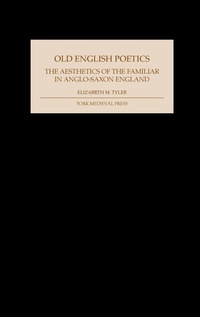
Old English Poetics
The Aesthetics of the Familiar in Anglo-Saxon England
Published on 17. August 2006
Book
Hardback
212 pages
978-1-903153-20-8 (ISBN)
Description
A new approach to the study of Old English Poetry, featuring close reading of the text, its form and style.
Traditions are created and maintained by groups of people living in specific times and places: they do not have a life of their own. In this radical new approach to Old English poetics, the author argues that the apparent timelessness and stability of Old English poetic convention is a striking historical phenomenon that must be accounted for, not assumed, and that the perceived conservatism of Old English poetic conventions is the result of choice. Successive generations of poets deliberately maintained the traditionality of Old English poetry, putting it into dialogue with contemporary conditions to express critique and dissent as well as nostalgia. The author makes particularuse of the rich language of treasure to be found in Anglo-Saxon verse to historicise her argument, but her argument has wide implications for how we approach the role of tradition in the poetry of earlier societies.
DrELIZABETH TYLER teaches in the Department of English and the Centre for Medieval Studies, University of York.
Traditions are created and maintained by groups of people living in specific times and places: they do not have a life of their own. In this radical new approach to Old English poetics, the author argues that the apparent timelessness and stability of Old English poetic convention is a striking historical phenomenon that must be accounted for, not assumed, and that the perceived conservatism of Old English poetic conventions is the result of choice. Successive generations of poets deliberately maintained the traditionality of Old English poetry, putting it into dialogue with contemporary conditions to express critique and dissent as well as nostalgia. The author makes particularuse of the rich language of treasure to be found in Anglo-Saxon verse to historicise her argument, but her argument has wide implications for how we approach the role of tradition in the poetry of earlier societies.
DrELIZABETH TYLER teaches in the Department of English and the Centre for Medieval Studies, University of York.
Reviews / Votes
A valuable book for what it contributes to our understanding of Anglo-Saxon poets' composition processes and the poetic tradition. * SPECULUM * Thought-provoking and original. * EARLY MEDIEVAL EUROPE *More details
Language
English
Place of publication
York
United Kingdom
Target group
Professional and scholarly
Product notice
Cloth over boards
Dimensions
Height: 236 mm
Width: 163 mm
Thickness: 21 mm
Weight
449 gr
ISBN-13
978-1-903153-20-8 (9781903153208)
Copyright in bibliographic data and cover images is held by Nielsen Book Services Limited or by the publishers or by their respective licensors: all rights reserved.
Schweitzer Classification
Other editions
Additional editions
E-Book
08/2006
1st Edition
De Gruyter
€48.99
Available for download
Persons
Content
Treasure and Old English Verse - Elizabeth M. Tyler
The Collocation of Words for Treasure in Old English Verse - Elizabeth M. Tyler
Formulas and the Aesthetics of the Familiar - Elizabeth M. Tyler
Verbal Repetition and the Aesthetics of the Familiar - Elizabeth M. Tyler
Poetics and the Past: Traditional Style at the Turn of the Millenium - Elizabeth M. Tyler
The Collocation of Words for Treasure in Old English Verse - Elizabeth M. Tyler
Formulas and the Aesthetics of the Familiar - Elizabeth M. Tyler
Verbal Repetition and the Aesthetics of the Familiar - Elizabeth M. Tyler
Poetics and the Past: Traditional Style at the Turn of the Millenium - Elizabeth M. Tyler