

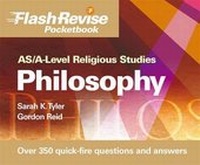
AS/A-level Religious Studies
Philosophy Flash Revise Pocketbook
Published on 29. January 2010
Book
Paperback/Softback
204 pages
978-1-4441-0912-2 (ISBN)
Description
Flash Revise Pocketbooks are ideal for quick revision. Written by subject experts for instant revision of key topics to help you achieve the very best grades, they provide over 350 quick-fire questions and answers with exam tips. With content organised in easy-to-follow sections, Flash Revise Pocketbooks are the answer to instant revision anytime, anywhere! Flash Revise your subject now! 1. Answer the question 2. Flick and check you've got it right 3. Make sure you read the exam tip ...and then why not test your friends?
More details
Language
English
Place of publication
United Kingdom
Publishing group
Hachette Learning
Target group
College/higher education
Dimensions
Height: 122 mm
Width: 101 mm
Thickness: 9 mm
Weight
118 gr
ISBN-13
978-1-4441-0912-2 (9781444109122)
Copyright in bibliographic data and cover images is held by Nielsen Book Services Limited or by the publishers or by their respective licensors: all rights reserved.
Schweitzer Classification
Persons
Sarah K. Tyler is a Principal Examiner for Religious Studies and Head of Religious Studies at Mander Portman Woodward in London.
Content
Foundations of religion 1 Plato 2 Plato's key ideas (1) 3 Plato's key ideas (2) 4 Aristotle 5 Aristotle and the principle of cause 6 The God of classical theism 7 Omnipotence and omniscience 8 God's goodness 9 God as creator (1) 10 God as creator (2) 11 God's revelation Proof and faith 12 Principles of philosophical proof 13 Types of proof 14 Faith The Cosmological Argument 15 The Cosmological Argument 16 Aquinas' First Way 17 Aquinas' Second Way 18 Aquinas' Third Way 19 Developing the Cosmological Argument 20 David Hume's criticisms 21 Modern criticisms of the Cosmological Argument The Design Argument 22 The Design Argument (1) 23 The Design Argument (2) 24 William Paley's analogy 25 Modern Design Arguments 26 Criticisms of the Design Argument The Ontological Argument 27 The Ontological Argument 28 Anselm's form of the Ontological Argument (1) 29 Anselm's form of the Ontological Argument (2) 30 Responding to Gaunilo's criticisms 31 Descartes' form of the argument 32 Existence as a predicate 33 Modern applications of the argument Religious experience 34 The argument from religious experience (1) 35 The argument from religious experience (2) 36 The argument from religious experience (3) 37 The nature of religious experience (1) 38 The nature of religious experience (2) 39 William James: four characteristics of religious experience 40 Mysticism Miracles 41 Miracles 42 Miracles: Thomas Aquinas 43 Miracles: philosophical issues 44 Miracles: David Hume 45 Miracles: testimony 46 Miracles in the Bible The problem of evil 47 The nature of evil 48 The problem of evil 49 The Augustinian theodicy (1) 50 The Augustinian theodicy (2) 51 The Irenaean theodicy 52 Problems with the Irenaean theodicy 53 Evil, God and humanity 54 Process theology 55 Evil and human freedom Science and religion 56 The Bible and creationism 57 Religious interpretations of the origin of the world (1) 58 Religious interpretations of the origin of the world (2) 59 Scientific interpretations of the origin of the world 60 The origin of the world: key ideas Atheism 61 Atheism 62 Critiques of atheism 63 Sociological critiques 64 Psychological critiques 65 Dawkins and anti-theism 66 Moral critiques 67 Other challenges to theism Life after death 68 Life after death 69 The immortality of the soul (1) 70 The immortality of the soul (2) 71 The resurrection of the body 72 The replica theory 73 The ghost in the machine 74 Reincarnation 75 Near-death experiences 76 Philosophical problems posed by life after death Religious language 77 Religious language (1) 78 Religious language (2) 79 Analogy 80 The verification principle 81 Criticisms of the verification principle 82 The falsification principle 83 Responses to the falsification principle 84 The parable of the partisan and the stranger 85 Language games 86 Symbol (1) 87 Symbol (2) 88 Myth (1) 89 Myth (2) Evaluation questions 90 God and morality 91 The Cosmological Argument 92 The Design Argument 93 The Ontological Argument 94 The argument from religious experience 95 Moral and theological problems of miracles 96 The problem of evil 97 Reconciling scientific and religious interpretations of the origin of the world 98 Atheism 99 Life after death 100 Religious language