

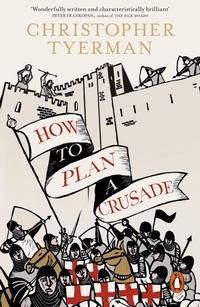
How to Plan a Crusade
Reason and Religious War in the High Middle Ages
Published on 29. September 2016
Book
Paperback/Softback
448 pages
978-0-241-95465-2 (ISBN)
Description
'Wonderfully written and characteristically brilliant' Peter Frankopan, author of The Silk Roads
'Elegant, readable ... an impressive synthesis ... Not many historians could have done it' - Jonathan Sumption, Spectator
'Tyerman's book is fascinating not just for what it has to tell us about the Crusades, but for the mirror it holds up to today's religious extremism' - Tom Holland, Spectator
Thousands left their homelands in the Middle Ages to fight wars abroad. But how did the Crusades actually happen? From recruitment propaganda to raising money, ships to siege engines, medicine to the power of prayer, this vivid, surprising history shows holy war - and medieval society - in a new light.
'Elegant, readable ... an impressive synthesis ... Not many historians could have done it' - Jonathan Sumption, Spectator
'Tyerman's book is fascinating not just for what it has to tell us about the Crusades, but for the mirror it holds up to today's religious extremism' - Tom Holland, Spectator
Thousands left their homelands in the Middle Ages to fight wars abroad. But how did the Crusades actually happen? From recruitment propaganda to raising money, ships to siege engines, medicine to the power of prayer, this vivid, surprising history shows holy war - and medieval society - in a new light.
Reviews / Votes
An impressive synthesis of a complicated subject, presented in elegant, readable prose. Not many historians could have done it -- Jonathan Sumption * The Spectator * His deeply researched study is dedicated to exploring the relationship between human reason and religious war in all its aspects - justification, propaganda, recruitment, finance, logistics - to show us how 'reason made religious war possible.' -- Diarmaid MacCulloch * London Review of Books * Mining details on victualing and logistics 800 years ago is Tyerman's forte, and he throws them on to the page like chaff from a trebuchet... it is comprehensive, laying down a great skein of fact where there was only supposition (much of it false). And, as the West gears up for the crusade of 2015-16 against Islamic State, it is horribly timely. -- Giles Whittell * The Times * Tyerman's book is fascinating not just for what it has to tell us about the Crusades, but for the mirror it holds up to today's religious extremism -- Tom Holland * Mail on Sunday * How to Plan a Crusade is serious and scholarly, the synthesis of decades of work on difficult, fragmented sources. Administrative records weren't routinely kept until around 1300, which makes Tyerman's task harder and more impressive...this is also a lively book, laced with wry asides and enough surprising details to pique the general reader. -- Jessie Childs * The Guardian * There is a deeper story here about the rise in Britain of both class structure and bureaucracy... -- Sinclair McKay * Telegraph * Wonderfully written and characteristically brilliant account of the logistics (and motivations) that underpinned the Crusades -- Peter FrankopanMore details
Language
English
Place of publication
London
United Kingdom
Product notice
Paperback (UK-B)
Dimensions
Height: 195 mm
Width: 126 mm
Thickness: 30 mm
Weight
338 gr
ISBN-13
978-0-241-95465-2 (9780241954652)
Copyright in bibliographic data and cover images is held by Nielsen Book Services Limited or by the publishers or by their respective licensors: all rights reserved.
Schweitzer Classification
Other editions
Additional editions
E-Book
09/2015
1st Edition
Penguin Books Ltd
€9.49
Available for download
Person
Christopher Tyerman is a Fellow and Tutor in History at Hertford College, Oxford and Lecturer in Medieval History at New College, Oxford. He has written extensively on the crusades, most recently God's War: A New History of the Crusades and The Debate on the Crusades. He is also the editor of the Penguin Classics edition of the Chronicles of the First Crusade.