

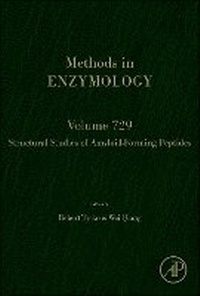
Structural Studies of Amyloid-Forming Peptides: Volume 729
Published on 8. May 2026
Book
Hardback
452 pages
978-0-443-42853-1 (ISBN)
Description
Structural Study of Amyloid-?, Volume 729 in the Methods in Enzymology series, highlights new advances in the field, with this new volume presenting interesting chapters on important topics such as the Extraction of Amyloids from Neurodegenerative Disease Tissues for Structural Analysis, Cryo-EM Structure Determination of Amyloid Fibrils: Methodology, Insights, and Practical Tools, Methods for studying molecular architecture of Ab aggregates in tissues using cryo-ET, Cryo-EM methods to study binding between amyloid fibrils and chemical compounds or ligan, Dynamics studies of side-chains and hydration shells in amyloid-beta fibrils using deuterium and oxygen-17 solid-state NMR, and much more.
Additional chapters cover the Technical aspects of pressure jump NMR applied to the study of Abeta and protein oligomerization, Characterizations of the beta-amyloid-membrane interaction intermediates, Time-resolved solid-state NMR studies of oligomer formation, Methods for characterizing the individual filament structures of amyloid peptide assemblies using atomic force microscopy, Single-molecule fluorescence spectroscopy and imaging on heterogeneous amyloid beta aggregation, Two-dimensional FT-IR methods on amyloid aggregation and folding pathways, and much more.
Additional chapters cover the Technical aspects of pressure jump NMR applied to the study of Abeta and protein oligomerization, Characterizations of the beta-amyloid-membrane interaction intermediates, Time-resolved solid-state NMR studies of oligomer formation, Methods for characterizing the individual filament structures of amyloid peptide assemblies using atomic force microscopy, Single-molecule fluorescence spectroscopy and imaging on heterogeneous amyloid beta aggregation, Two-dimensional FT-IR methods on amyloid aggregation and folding pathways, and much more.
More details
Series
Language
English
Place of publication
San Diego
United States
Publishing group
Elsevier Science Publishing Co Inc
Target group
College/higher education
Dimensions
Height: 229 mm
Width: 152 mm
Weight
450 gr
ISBN-13
978-0-443-42853-1 (9780443428531)
Copyright in bibliographic data and cover images is held by Nielsen Book Services Limited or by the publishers or by their respective licensors: all rights reserved.
Schweitzer Classification
Other editions
Additional editions
Persons
After completing studies for the A.B., A.M., and Ph.D. degrees in chemistry at Harvard University, David W. Christianson joined the faculty of the University of Pennsylvania, where he is currently the Roy and Diana Vagelos Professor in Chemistry and Chemical Biology. At Penn, Christianson's research focuses on the structural and chemical biology of the zinc-dependent histone deacetylases as well as enzymes of terpene biosynthesis. His research accomplishments have been recognized by several awards, including the Pfizer Award in Enzyme Chemistry and the Repligen Award in Chemistry of Biological Processes from the American Chemical Society, a Guggenheim Fellowship, and the Elizabeth S. and Richard M. Cashin Fellowship from the Radcliffe Institute for Advanced Study at Harvard University. Christianson is also a dedicated classroom teacher, and his accomplishments in this regard have been recognized by the Lindback Award for Distinguished Teaching at Penn and a Rhodes Trust Inspirational Educator Award from Oxford University. Christianson has also held visiting professorships in the Department of Biochemistry at Cambridge University and the Department of Chemistry and Chemical Biology at Harvard University. Christianson has served with Prof. Anna Pyle as Co-Editor-in-Chief of Methods in Enzymology since 2015.
Content
1. Extraction of Amyloids from Neurodegenerative Disease Tissues for Structural Analysis
Yang Yang, Mohammed Alhadidy, Tiara Hinton and Katelyn Ernst
2. Cryo-EM Structure Determination of Amyloid Fibrils: Methodology, Insights, and Practical Tools
Gunnar Schroder
3. Methods for studying molecular architecture of Ab aggregates in tissues using cryo-ET
Rene Werner Frank
4. Cryo-EM methods to study binding between amyloid fibrils and chemical compounds or ligan
Cong Liu, Dan Li, Qinyue Zhao and Kaien Liu
5. Dynamics studies of side-chains and hydration shells in amyloid-beta fibrils using deuterium and oxygen-17 solid-state NMR
Liliya Vugmeyster and Dmitry Ostrovsky
6. Technical aspects of pressure jump NMR applied to the study of Abeta and protein oligomerization
Adriaan Bax
7. Characterizations of the beta-amyloid-membrane interaction intermediates
Wei Qiang, Maurine Kengwerere and Tingyao Wang
8. Time-resolved solid-state NMR studies of oligomer formation.
Robert Tycko
9. Methods for characterizing the individual filament structures of amyloid peptide assemblies using atomic force microscopy
Wei-Feng Xue
10. Single-molecule fluorescence spectroscopy and imaging on heterogeneous amyloid beta aggregation
Hoi Sung Chung
11. Two-dimensional FT-IR methods on amyloid aggregation and folding pathways
Michal Maj
12. Application of EPR spectroscopy in the structural studies of A? oligomers and fibrils
Zhefeng Guo and Diana Portugal Barron
13. Identification of amyloid polymorphisms in brain tissues based on conformational-sensitive dyes
Carlo Condello
14. Molecular simulation methods for amyloid-membrane interactions
Birgit Strodel, Bastian Bundschuh and Franziska Kley
15. How to prepare Alzheimer's amyloid-beta oligomer samples with sufficient quantity and quality for solid-state NMR measurements
Anant K. Paravast
Yang Yang, Mohammed Alhadidy, Tiara Hinton and Katelyn Ernst
2. Cryo-EM Structure Determination of Amyloid Fibrils: Methodology, Insights, and Practical Tools
Gunnar Schroder
3. Methods for studying molecular architecture of Ab aggregates in tissues using cryo-ET
Rene Werner Frank
4. Cryo-EM methods to study binding between amyloid fibrils and chemical compounds or ligan
Cong Liu, Dan Li, Qinyue Zhao and Kaien Liu
5. Dynamics studies of side-chains and hydration shells in amyloid-beta fibrils using deuterium and oxygen-17 solid-state NMR
Liliya Vugmeyster and Dmitry Ostrovsky
6. Technical aspects of pressure jump NMR applied to the study of Abeta and protein oligomerization
Adriaan Bax
7. Characterizations of the beta-amyloid-membrane interaction intermediates
Wei Qiang, Maurine Kengwerere and Tingyao Wang
8. Time-resolved solid-state NMR studies of oligomer formation.
Robert Tycko
9. Methods for characterizing the individual filament structures of amyloid peptide assemblies using atomic force microscopy
Wei-Feng Xue
10. Single-molecule fluorescence spectroscopy and imaging on heterogeneous amyloid beta aggregation
Hoi Sung Chung
11. Two-dimensional FT-IR methods on amyloid aggregation and folding pathways
Michal Maj
12. Application of EPR spectroscopy in the structural studies of A? oligomers and fibrils
Zhefeng Guo and Diana Portugal Barron
13. Identification of amyloid polymorphisms in brain tissues based on conformational-sensitive dyes
Carlo Condello
14. Molecular simulation methods for amyloid-membrane interactions
Birgit Strodel, Bastian Bundschuh and Franziska Kley
15. How to prepare Alzheimer's amyloid-beta oligomer samples with sufficient quantity and quality for solid-state NMR measurements
Anant K. Paravast