

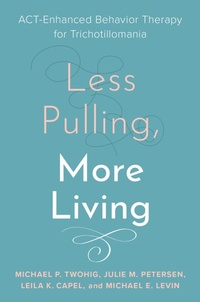
Less Pulling, More Living
Act-Enhanced Behavior Therapy for Trichotillomania
Will be published approx. on 27. November 2026
Book
Paperback/Softback
128 pages
978-0-19-781992-0 (ISBN)
Description
Trichotillomania is the irresistible urge to pull out the hair on one's face, head, or body. While trichotillomania, commonly referred to as "trich," is most common in teens and young adults, it can affect people at any age. Trich can take a major toll on family and social life, as well as on one's work and academic achievement. Those with trichotillomania often struggle to find help for their hair pulling, as mental health practitioners trained in its treatment are rare. Less Pulling, More Living: ACT-Enhanced Behavior Therapy for Trichotillomania will teach readers how to resist pulling, how to better respond to urges, and how to effectively manage the emotional challenges associated with this disorder. The tips and strategies taught in this book are based on Acceptance-Enhanced Behavior Therapy (A-EBT) for trichotillomania. A-EBT is based on years of scientific research by experts on how to best treat hair pulling in adults. Since hair pulling can have a tremendously negative impact on quality of life, this book offers more than just tips on stopping--it will also enable readers to reconnect with important relationships, hobbies, and values that pulling may have impeded.
More details
Persons
Michael P. Twohig, PhD, is a psychologist and professor at Utah State University, where he co-runs the ACT Research Group. He is past-President of the Association of Contextual Behavioral Science and winner of the 2025 D. Wynn Thorne career research award. His research focuses on the use of ACT across a variety of clinical presentations with an emphasis on OCD and trichotillomania disorders. He has published more than 250 peer-reviewed papers, many book chapters, and 13 books. In 2022, 2024, and 2025 he was rated as the most productive author on ACT in the world. Julie M. Petersen, PhD, is a postdoctoral fellow in the Lab for Youth Mental Health at Harvard University. She earned her doctorate in clinical and counseling psychology from Utah State University in 2024. She completed her predoctoral internship in child/adolescent psychology at Montefiore Medical Center/Albert Einstein College of Medicine. Her research is centralized around increasing the effectiveness and accessibility of transdiagnostic cognitive-behavioral therapies for youths, especially ACT. She has published more than 50 book chapters and peer-reviewed papers. Leila K. Capel, MS, is a sixth-year doctoral student in the Combined Clinical/Counseling Psychology program at Utah State University. She is currently completing her predoctoral internship in adult clinical psychology at Dartmouth-Hitchcock Medical Center. She received her bachelor's degree in psychology at Smith College and her master's in clinical/counselling psychology at USU. Her research primarily focuses on ACT for obsessive-compulsive and related disorders with adults. She has published more than 20 peer-reviewed manuscripts and book chapters. Michael E. Levin, PhD, is the co-director of the USU ACT Research Group and a professor in the Combined Clinical/Counseling Psychology PhD program at Utah State University. His research primarily focuses on the delivery of Acceptance & Commitment Therapy (ACT) through self-guided technologies for a wide range of problem areas including depression, anxiety, weight-related concerns, and coping with chronic health conditions. He has conducted more than 40 clinical trials evaluating digital ACT programs, several of which are available to the public through the USU ACT Guide service suite.
Content
- Chapter 1: You and Your Trichotillomania
- Chapter 2: Our View of Trichotillomania
- Chapter 3: How Has Your Pulling Gotten in the Way of Your Life?
- Chapter 4: Get Rid of the Triggers!
- Chapter 5: Want to Pull? Try This Instead
- Chapter 6: Setting Goals
- Chapter 7: What Is Important to You?
- Chapter 8: What Is an Urge, and Can It Be Controlled?
- Chapter 9: Forget Control: Letting the Urge Be There
- Chapter 10: Seeing the Urge for What It Is
- Chapter 11: Being Present
- Chapter 12: Being Kind to Yourself
- Chapter 13: You Are More Than Your Pulling
- Chapter 14: Looking to the Future
- References
- Chapter 2: Our View of Trichotillomania
- Chapter 3: How Has Your Pulling Gotten in the Way of Your Life?
- Chapter 4: Get Rid of the Triggers!
- Chapter 5: Want to Pull? Try This Instead
- Chapter 6: Setting Goals
- Chapter 7: What Is Important to You?
- Chapter 8: What Is an Urge, and Can It Be Controlled?
- Chapter 9: Forget Control: Letting the Urge Be There
- Chapter 10: Seeing the Urge for What It Is
- Chapter 11: Being Present
- Chapter 12: Being Kind to Yourself
- Chapter 13: You Are More Than Your Pulling
- Chapter 14: Looking to the Future
- References