

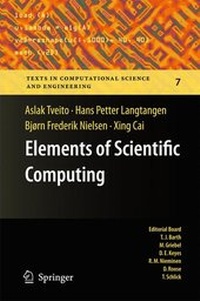
Elements of Scientific Computing
1st Edition
Published on 7. November 2012
Book
Paperback/Softback
XII, 468 pages
978-3-642-26519-8 (ISBN)
Description
Science used to be experiments and theory, now it is experiments, theory and computations. The computational approach to understanding nature and technology is currently flowering in many fields such as physics, geophysics, astrophysics, chemistry, biology, and most engineering disciplines. This book is a gentle introduction to such computational methods where the techniques are explained through examples. It is our goal to teach principles and ideas that carry over from field to field. You will learn basic methods and how to implement them. In order to gain the most from this text, you will need prior knowledge of calculus, basic linear algebra and elementary programming.
Reviews / Votes
From the reviews: "This gentle introduction to scientific computing aims to convey the basic ideas, principles and techniques of computational science to undergraduates in mathematics, science and engineering. ... The real strength of the text is its adroit mix of analytical and numerical, theoretical and practical. ... This is a top-notch book on scientific computing written with clarity ... and a good sense of what students need to learn. It is among the best books in this area that I have seen." (William J. Satzer, The Mathematical Association of America, February, 2011) "The text flows nicely, and Tveito (Simula Research Laboratory, Norway) and colleagues thoroughly explain different subjects in meaningful steps. In addition to exercises at the end of each chapter, an instructive 'Projects' section allows readers to practice new concepts. ... Overall, this textbook is a welcome addition to a small set of books currently available in scientific computing, an expanding area for undergraduate course development in many US colleges. Summing Up: Recommended. Lower-division undergraduates through researchers/faculty." (D. Papamichail, Choice, Vol. 48 (9), May, 2011) "This book is part of Springer's Texts in Computational Science and Engineering series, so it is written for students. ... chapters more or less serve as a limited introduction to computational mathematics: they cover basic algorithms in numerical integration, initial-value problems for scalar ODEs, initial-value problems for two-component ODEs, rootfinding in one or two dimensions, and least squares approximations using constants, lines, and parabolas."--- (Toby Driscoll, SIAM Review, Vol. 53 (4), 2011) "In this appealing book the authors introduce to basic principles of numerical calculations which every engineer or scientist working with computers should be familiar with. ... a very good selection of topics treated and presented important methods in a gentle style ... ." (Rudolf Gorenflo, Zentralblatt MATH, Vol. 1220, 2011)More details
Product info
Previously published in hardcover
Series
Language
English
Place of publication
Berlin, Heidelberg
Germany
Target group
Lower undergraduate
Illustrations
86 s/w Abbildungen
86 black & white illustrations, biography
Dimensions
Height: 235 mm
Width: 155 mm
Thickness: 25 mm
Weight
719 gr
ISBN-13
978-3-642-26519-8 (9783642265198)
DOI
10.1007/978-3-642-11299-7
Schweitzer Classification
Other editions
Additional editions
Aslak Tveito | Hans Petter Langtangen | Bjørn Frederik Nielsen
Elements of Scientific Computing
Book
09/2010
1st Edition
Springer
€53.49
Shipment within 7-9 days
Persons
Professor Aslak Tveito is the managing director of Simula Research Laboratory. His research is focused on computing the electrical activity in the heart. Tveito is the co-author of more than 60 papers published in international peer-reviewed journals, and one textbook introducing partial differential equations. Tveito has also edited four books published internationally. Professor Hans Petter Langtangen is the director of Center for Biomedical Computing, a Norwegian Center of Excellence at Simula Research Laboratory, and a professor of computer science at the University of Oslo. His research concerns numerical methods and software tools for continuum mechanical problems. Langtangen has published more than 40 journal papers, and more than 50 peer-reviewed contributions to conference proceedings and books. He is the author of three textbooks and an a co-editor of three books. Langtangen has been an active developer of open source and commercial software systems for computational sciences. He is a member of the European Academy of Sciences and serves on the editorial board of five leading international journals. Dr. Nielsen is a research scientist at Simula Research Laboratory where he investigates whether it is possible to compute the position and size of heart infarctions from ECG recordings. He has published a number of papers on computational mathematics and during his years at Norwegian Computing Center he solved many scientific computing problems for the Norwegian oil industry. The research interests of Professor Xing Cai center around parallel numerical methods and software for solving partial differential equations. He has more than 50 peer-reviewed publications in international journals and conference proceedings.
Content
Computing Integrals.- Differential Equations: The First Steps.- Systems of Ordinary Differential Equations.- Nonlinear Algebraic Equations.- The Method of Least Squares.- About Scientific Software.- The Diffusion Equation.- Analysis of the Diffusion Equation.- Parameter Estimation and Inverse Problems. - A Glimpse of Parallel Computing.- Index.