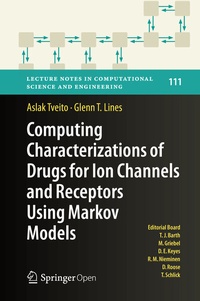
Flow of ions through voltage gated
channels can be represented theoretically using stochastic differential
equations where the gating mechanism is represented by a Markov model. The flow through a
channel can be manipulated using various drugs, and the effect of a given drug
can be reflected by
changing the Markov model. These lecture notes provide an accessible
introduction to the mathematical methods needed to deal with these models. They emphasize the use of
numerical methods and provide sufficient details for the reader to implement
the models and thereby study the effect of various drugs. Examples in the
text include stochastic calcium release from internal storage systems in cells,
as well as stochastic
models of the transmembrane potential. Well known Markov models are studied and
a systematic approach to
including the effect of mutations is presented. Lastly, the book shows how to derive the optimal properties
of a theoretical model of a drug for a given mutation defined in terms
of a Markov model.
Series
Edition
Language
Place of publication
Publishing group
Springer International Publishing
Target group
Professional and scholarly
Illustrations
99 s/w Abbildungen, 30 farbige Abbildungen
XVI, 261 p. 129 illus., 30 illus. in color.
Dimensions
Height: 241 mm
Width: 160 mm
Thickness: 22 mm
Weight
ISBN-13
978-3-319-30029-0 (9783319300290)
DOI
10.1007/978-3-319-30030-6
Schweitzer Classification
Professor Aslak Tveito is the managing director of Simula Research Laboratory. His research is focused on computing the electrical activity in the heart. Tveito is the co-author of more than 60 papers published in international peer-reviewed journals, and one textbook introducing partial differential equations. Tveito has also edited four books published internationally. Professor Hans Petter Langtangen is the director of Center for Biomedical Computing, a Norwegian Center of Excellence at Simula Research Laboratory, and a professor of computer science at the University of Oslo. His research concerns numerical methods and software tools for continuum mechanical problems. Langtangen has published more than 40 journal papers, and more than 50 peer-reviewed contributions to conference proceedings and books. He is the author of three textbooks and an a co-editor of three books. Langtangen has been an active developer of open source and commercial software systems for computational sciences. He is a member of the European Academy of Sciences and serves on the editorial board of five leading international journals. Dr. Nielsen is a research scientist at Simula Research Laboratory where he investigates whether it is possible to compute the position and size of heart infarctions from ECG recordings. He has published a number of papers on computational mathematics and during his years at Norwegian Computing Center he solved many scientific computing problems for the Norwegian oil industry. The research interests of Professor Xing Cai center around parallel numerical methods and software for solving partial differential equations. He has more than 50 peer-reviewed publications in international journals and conference proceedings.
Preface.- Background: Contents and Method.- One-dimensional calcium release.- Models of open and state blockers.- Two-dimensional calcium release.- Computing theoretical drugs in the two-dimensional case.- Generalized systems.- Calcium-induced calcium release.- Numerical release for CICR.- A prototypical model of an ion channel.- Inactivated ion channels.- A simple model of the sodium channel.- Mutations affecting the mean open time.- The burst mode.- Whole sale action potentials.-