

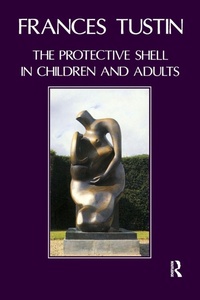
The Protective Shell in Children and Adults
Published on 31. December 1990
Book
Paperback/Softback
256 pages
978-0-946439-81-2 (ISBN)
Description
The Protective Shell in Children and Adults does not propose a 'cure' for autism. Rather, it suggests that psychotherapeutic treatment which is based on a deep understanding of the function of autism can modify and heal the overwhelming need for this powerful inbuilt survival reaction, so that it is used appropriately in a less overall and crippling way.This work is by a professional primarily for other professionals, but thoughtful people who are interested in the fundamental aspects of human nature will also find much to interest them. The papers which have been published in various journals or delivered to professional audiences since the appearance of Francis Tustin's previous book Autistic Barriers in Neurotic Patients are integrated with unpublished material written especially for this book, so that they can enrich and illuminate each other. A paper from the early days of her work with autistic children is the focus of this present work, since her awareness of encapsulation as being the major protective reaction associated with the autistic states of both psychotic and neurotic patients, has stemmed from that early paper.Her theme in this book concerns the protective and preservative aspects of the type of autism which seems to be mainly psychogenic in origin, although there may be a minimal organic and hormonal disturbances. Particularly valuable is her attempt to clarify the specific differential characteristics of this disorder. Based on this clarification, the functions and handicaps that are unique to 'Psychogenic' autism are discussed, and their sources pinpointed.Mrs Tustin adds to our understanding of autistic children, and the autistic capsule in neurotic adult patients, by showing that the autistic recourse to what she calls autistic sensation objects and autistic sensation shapes has handicapped cognitive, social and emotional development, which are shown to be intertwined. Here is a contribution from detailed psychotherapeutic work with autistic children, and the autistic capsules in neurotic adult patients, which not only help us to understand their tragic handicaps, but also throws light on certain details of the elemental levels of normal psychological development which they have missed. It is a kind of micro-psychology.
Reviews / Votes
This book is by a professional for other professionals, but thoughtful people who are interested in the fundamental aspects of human nature will also find much to interest them. The papers which have been published in various journals or delivered to professional audiences since the appearance of Francis Tustin's previous book Autistic Barriers in Neurotic Patients are integrated with unpublished material written especially for this book, so that they can enrich and illuminate each other. A paper from the early days of her work with autistic children is the focus of this present work, since her awareness of encapsulation as being the major protective reaction associated with the autistic states of both psychotic and neurotic patients, has stemmed from that early paper.Her theme in this book concerns the protective and preservative aspects of the type of autism which seems to be mainly psychogenic in origin, although there may be a minimal organic and hormonal disturbances. Particularly valuable is her attempt to clarify the specific differential characteristics of this disorder. Based on this clarification, the functions and handicaps that are unique to 'Psychogenic' autism are discussed, and their sources pinpointed.Mrs Tustin adds to our understanding of autistic children, and the autistic capsule in neurotic adult patients, by showing that the autistic recourse to what she calls autistic sensation objects and autistic sensation shapes has handicapped cognitive, social and emotional development, which are shown to be intertwined. Here is a contribution from detailed psychotherapeutic work with autistic children, and the autistic capsules in neurotic adult patients, which not only help us to understand their tragic handicaps, but also throws light on certain details of the elemental levels of normal psychological development which they have missed. It is a kind of micro-psychology.More details
Language
English
Place of publication
London
United Kingdom
Publishing group
Taylor & Francis Ltd
Target group
College/higher education
Professional and scholarly
Professional Practice & Development
Dimensions
Height: 229 mm
Width: 152 mm
Thickness: 14 mm
Weight
376 gr
ISBN-13
978-0-946439-81-2 (9780946439812)
Copyright in bibliographic data and cover images is held by Nielsen Book Services Limited or by the publishers or by their respective licensors: all rights reserved.
Schweitzer Classification
Other editions
Additional editions
Frances Tustin
The Protective Shell in Children and Adults
Book
09/2019
1st Edition
Routledge
€167.13
Shipment within 15-20 days
Frances Tustin
The Protective Shell in Children and Adults
E-Book
04/2018
Routledge
€59.49
Available for download
Frances Tustin
The Protective Shell in Children and Adults
E-Book
04/2018
1st Edition
Routledge
€59.49
Available for download
Person
Tustin, Frances
Content
Preface -- What autism is and what autism is not -- To be or not to be -- Psychotherapy as a treatment for autistic children -- Confirmations of findings from psychotherapy with autistic children -- Psychotherapy with children who cannot play -- The child who taught me about autistic encapsulation -- The autistic capsule in neurotic adult patients -- Other workers' applications of findings from autistic children to neurotic adult patients -- Being born from the autistic shell: becoming part of a group -- Autism in an adult patient -- Closing remarks -- A statement