

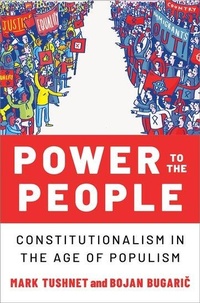
Power to the People
Constitutionalism in the Age of Populism
Published on 27. April 2022
Book
Hardback
294 pages
978-0-19-760671-1 (ISBN)
Description
Self-described populist leaders around the world are dismantling their nation's constitutions. This has led to a widespread view that populism as such is inconsistent with constitutionalism. This book proposes that some forms of populism are inconsistent with constitutionalism, while others aren't. Context and detail matter.
Power to the People offers a thin definition of constitutionalism that people from the progressive left to the conservative right should be able to agree on even if they would supplement the thin definition within other more partisan ideas. This is followed by a similarly basic definition of populism. Comparing the two, this book argues that one facet of populism -its suspicion of institutions that are strongly entrenched against change by political majorities-is sometimes inconsistent with constitutionalism's thinly understood definition.
The book provides a series of case studies, some organized by nation, others by topic, to identify, more precisely, when and how populist programs are inconsistent with constitutionalism-and, importantly, when and how they are not. Concluding with a discussion of the possibilities for a deeper, populist democracy, the book examines recent challenges to the idea that democracy is a good form of government by exploring possibilities for new, albeit revisable, institutions that can determine and implement a majority's views without always threatening constitutionalism.
Power to the People offers a thin definition of constitutionalism that people from the progressive left to the conservative right should be able to agree on even if they would supplement the thin definition within other more partisan ideas. This is followed by a similarly basic definition of populism. Comparing the two, this book argues that one facet of populism -its suspicion of institutions that are strongly entrenched against change by political majorities-is sometimes inconsistent with constitutionalism's thinly understood definition.
The book provides a series of case studies, some organized by nation, others by topic, to identify, more precisely, when and how populist programs are inconsistent with constitutionalism-and, importantly, when and how they are not. Concluding with a discussion of the possibilities for a deeper, populist democracy, the book examines recent challenges to the idea that democracy is a good form of government by exploring possibilities for new, albeit revisable, institutions that can determine and implement a majority's views without always threatening constitutionalism.
Reviews / Votes
Tushnet and Bugaric provide a series of case studies to identify when and how populist programs worldwide are inconsistent with constitutionalism and, importantly, when and how they are not. Concluding with a discussion of the possibilities for a deeper, populist democracy, they examine recent challenges to the idea that democracy is a good form of government by exploring possibilities for new, albeit revisable, institutions that can determine and implement a majority's views without always threatening constitutionalism. * Law & Social Inquiry * Defending constitutionalism may seem remote from the everyday experience of most lawyers in this country but if we can't - or won't - defend the rule of law, who will? Power to the People provides the tools to engage in a debate that is likely to define at least the first half of 21st-century constitutionalism. * Max D Winthrop, senior partner at Short Richardson & Forth, Newcastle, Law Society Gazette * Power to the People makes a compelling case for a more nuanced understanding ofthe relationship between populism and constitutionalism. The book is a useful corrective
to work (including my own) that treats norm-breaking and constitutional hardball tactics
as inherently problematic for liberal democracy."
-Steven Levitsky, Harvard University This book provides a much-needed and refreshing perspective on populism and its
relation to constitutionalism, avoiding the common mistake of casually dismissing or
demonising populism, and seeking instead to shine a light on the vast array of populist
programmes."
-Michael Wilkinson, London School of Economics and Political Science This book is so far the most promising comparative constitutional attempt to reconcile the
complex relationship between populism and constitutionalism, without generalization."
-Gabor Halmai, European University Institute Disaggregating constitutionalism and populism, this magnificent study leaves behind the
hasty diagnosis and prediction of others, bringing conceptual lucidity and comparative
learning to renewed debate."
-Samuel Moyn, Yale University Power to the People helps readers think about today's constitutional troubles. It has
become commonplace for scholars to blame "populism" for the rise of authoritarian and
ethno-nationalist leaders and parties. But not every effort to empower ordinary citizens
and unsettle entrenched elites is a step toward tyranny. Tushnet and Bugaric provide
us with the tools and case studies to begin understanding the differences between
changes that promote democracy and those that imperil it."
-William E. Forbath, The University of Texas at Austin, School of Law Challenging conventional political and scholarly wisdom, Mark Tushnet and Bojan
Bugaric make a powerful case that populism is the solution to rather than the cause
of contemporary democratic ills. Power to the People details how authoritarians
masquerading as populists are perverting an authentic form of democratic politics,
and that the numerous populist reforms championed by the populist left throughout
the globe are at least if not substantially more democratic than the contemporary
constitutional status quo. Much handwringing on the crisis of constitutional democracy
will need substantial reconsideration in light of this major work."
-Mark Graber, University of Maryland, Francis King Carey School of Law
More details
Language
English
Place of publication
New York
United States
Target group
Professional and scholarly
Product notice
sewn/stitched
Cloth over boards
With dust jacket
Dimensions
Height: 237 mm
Width: 163 mm
Thickness: 22 mm
Weight
562 gr
ISBN-13
978-0-19-760671-1 (9780197606711)
Copyright in bibliographic data and cover images is held by Nielsen Book Services Limited or by the publishers or by their respective licensors: all rights reserved.
Schweitzer Classification
Other editions
Additional editions
E-Book
11/2021
OUP eBook
€20.49
Available for download
E-Book
08/2021
OUP eBook
€20.49
Available for download
Persons
Mark Tushnet is William Nelson Cromwell Professor of Law emeritus at Harvard Law School. Before teaching at Harvard, he was a Professor of Law at the University of Wisconsin Law School and Georgetown University Law Center. He was President of the Association of American Law Schools in 2003. In 2002 he was elected a fellow of the American Academy of Arts and Sciences.
Bojan Bugaric is Professor of Law at Sheffield University, School of Law. Before teaching at Sheffield, he was a Professor of Law at the University of Ljubljana, School of Law.
Bojan Bugaric is Professor of Law at Sheffield University, School of Law. Before teaching at Sheffield, he was a Professor of Law at the University of Ljubljana, School of Law.
Content
Note on Sources
Introduction
Part One: The Framework
Chapter 1. What Is Constitutionalism?
Chapter 2. What Is Populism?
Chapter 3. Populism and Constitutionalism
Part Two: Populism in Practice
Chapter 4. Populist Authoritarianism: Hungary and Poland
Chapter 5. The Problem of the Frankenstate
Chapter 6. Populism in Western Europe
Chapter 7. Southern Europe: Greece and Spain
Chapter 8. Court- Packing or Court Reform?: Challenging Judicial Independence by Enhancing Accountability
Chapter 9. Populism and Executive Power: Term Limits and Rule by Decree
Chapter 10. Guardrails and Institutions
Part Three: Constitutionalism After Populism
Chapter 11. Rejecting Democracy
Chapter 12. Power to the People: Empowered Democracy
Epilogue
Introduction
Part One: The Framework
Chapter 1. What Is Constitutionalism?
Chapter 2. What Is Populism?
Chapter 3. Populism and Constitutionalism
Part Two: Populism in Practice
Chapter 4. Populist Authoritarianism: Hungary and Poland
Chapter 5. The Problem of the Frankenstate
Chapter 6. Populism in Western Europe
Chapter 7. Southern Europe: Greece and Spain
Chapter 8. Court- Packing or Court Reform?: Challenging Judicial Independence by Enhancing Accountability
Chapter 9. Populism and Executive Power: Term Limits and Rule by Decree
Chapter 10. Guardrails and Institutions
Part Three: Constitutionalism After Populism
Chapter 11. Rejecting Democracy
Chapter 12. Power to the People: Empowered Democracy
Epilogue