

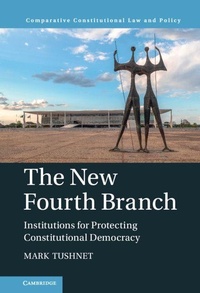
The New Fourth Branch
Institutions for Protecting Constitutional Democracy
Published on 2. September 2021
Book
Hardback
198 pages
978-1-316-51783-3 (ISBN)
Description
Twenty-first-century constitutions now typically include a new 'fourth branch' of government, a group of institutions charged with protecting constitutional democracy, including electoral management bodies, anticorruption agencies, and ombuds offices. This book offers the first general theory of the fourth branch; in a world where governance is exercised through political parties, we cannot be confident that the traditional three branches are enough to preserve constitutional democracy. The fourth branch institutions can, by concentrating within themselves distinctive forms of expertise, deploy that expertise more effectively than the traditional branches are capable of doing. However, several case studies of anticorruption efforts, electoral management bodies, and audit bureaus show that the fourth branch institutions do not always succeed in protecting constitutional democracy, and indeed sometimes undermine it. The book concludes with some cautionary notes about placing too much hope in these - or, indeed, in any - institutions as the guarantors of constitutional democracy.
Reviews / Votes
'In an age when integrity and democracy are under unprecedented pressure, Mark Tushnet's description of emerging constitutional 'best practice' worldwide - systematic, realistic, and unemotional - helps to launch a new debate on whether, and how, the civic virtues that underpin good governance might be better institutionalized for all.' A. J. Brown, Professor of Public Policy & Law, Griffith University; Board Member, Transparency International 'For a discipline that has inexplicably remained focused on the role of apex courts for much of its existence, comparative constitutional studies should welcome Mark Tushnet's new book on the fourth branch as a sorely necessary intervention in the field. Mark captures the intuition that there is something distinctive about this new category of constitutional actors, increasingly popular with constitution makers, with characteristic insight and scholarly rigour. His characterization of the fourth branch as comprising 'institutions to protect constitutional democracy' will no doubt encourage other theoretical attempts to find an appropriate conceptual substitute for the numerical placeholder for this branch. This book is an essential read for anyone interested in understanding constitutions, their functions, and their limits.' Tarunabh Khaitan, Professor of Public Law and Legal Theory & Hackney Fellow in Law, Wadham College, University of Oxford 'In this already indispensable work on the theory and practice of designing innovative government structures to protect constitutional democracy, Tushnet brilliantly and carefully appraises existing 'fourth branch' institutions. A scholarly provocation favoring decentralized structures and remedies with more face-to-face interactions, the book demands reading by all serious scholars of constitutional government.' Vicki C. Jackson, Laurence H. Tribe Professor of Constitutional Law, Harvard Law SchoolMore details
Series
Language
English
Place of publication
Cambridge
United Kingdom
Target group
College/higher education
Illustrations
Worked examples or Exercises
Dimensions
Height: 235 mm
Width: 157 mm
Thickness: 15 mm
Weight
445 gr
ISBN-13
978-1-316-51783-3 (9781316517833)
Copyright in bibliographic data and cover images is held by Nielsen Book Services Limited or by the publishers or by their respective licensors: all rights reserved.
Schweitzer Classification
Other editions
Additional editions
Book
09/2021
Cambridge University Press
€48.50
Shipment within 15-20 days
E-Book
09/2021
Cambridge University Press
€37.99
Available for download
E-Book
08/2021
Cambridge University Press
€37.99
Available for download
Person
Mark Tushnet is William Nelson Cromwell Professor of Law Emeritus at Harvard Law School. He clerked for Justice Thurgood Marshall before beginning his teaching career. He has written more than a dozen books, including Weak Courts, Strong Rights: Judicial Review and Social Welfare Rights in Comparative Constitutional Law (2008) and Advanced Introduction to Comparative Constitutional Law (2014). He was President of the Association of American Law Schools in 2003, and in 2002 was elected a fellow of the American Academy of Arts and Sciences.
Content
1. Introduction; 2. Why a fourth branch - the structural logic; 3. Why a fourth branch - the functional logic; 4. Design issues in general; 5. Design principles in practice - a survey; 6. Anticorruption investigations - case studies from Brazil and South Africa; 7. Electoral commissions - case studies from India, the United States, and South Korea; 8. Audit agencies; 9. Conclusion.