

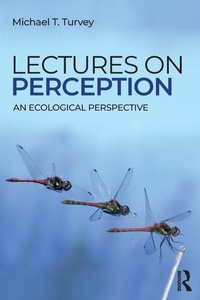
Lectures on Perception
An Ecological Perspective
1st Edition
Published on 5. November 2018
Book
Paperback/Softback
432 pages
978-1-138-33526-4 (ISBN)
Description
Lectures on Perception: An Ecological Perspective addresses the generic principles by which each and every kind of life form-from single celled organisms (e.g., difflugia) to multi-celled organisms (e.g., primates)-perceives the circumstances of their living so that they can behave adaptively. It focuses on the fundamental ability that relates each and every organism to its surroundings, namely, the ability to perceive things in the sense of how to get about among them and what to do, or not to do, with them. The book's core thesis breaks from the conventional interpretation of perception as a form of abduction based on innate hypotheses and acquired knowledge, and from the historical scientific focus on the perceptual abilities of animals, most especially those abilities ascribed to humankind. Specifically, it advances the thesis of perception as a matter of laws and principles at nature's ecological scale, and gives equal theoretical consideration to the perceptual achievements of all of the classically defined 'kingdoms' of organisms-Archaea, Bacteria, Protoctista, Fungi, Plantae, and Animalia.
Reviews / Votes
Michael Turvey is the leading exponent of a physical biology of intentional systems for all creatures great and nano. In these interwoven lectures, he charts a path to a thoroughly scientific psychology, grounded in philosophy, ecology, thermodynamics, and the theory of complex systems. Developed over the course of an esteemed career, Turvey's radical vision (in the sense of going to the root) throws down the gauntlet for the next generation of students of perceiving, acting, and knowing.William H. Warren, Chancellor's Professor of Cognitive Science, Brown UniversityMore details
Series
Language
English
Place of publication
London
United Kingdom
Publishing group
Taylor & Francis Ltd
Target group
College/higher education
Illustrations
5 s/w Tabellen
5 Tables, black and white
Dimensions
Height: 229 mm
Width: 152 mm
Thickness: 24 mm
Weight
644 gr
ISBN-13
978-1-138-33526-4 (9781138335264)
Copyright in bibliographic data and cover images is held by Nielsen Book Services Limited or by the publishers or by their respective licensors: all rights reserved.
Schweitzer Classification
Other editions
Additional editions
E-Book
10/2018
1st Edition
Routledge
€88.49
Available for download
E-Book
10/2018
1st Edition
Routledge
€88.49
Available for download
Book
10/2018
1st Edition
Routledge
€207.00
Shipment within 10-20 days
Person
Michael T. Turvey is Board of Trustees' Distinguished Professor of Experimental Psychology at the University of Connecticut and a Senior Scientist at Haskins Laboratories in Connecticut. He is the recipient of Guggenheim and Catell Fellowships, the American Psychological Association Early Career Award, Fellow of Society of Experimental Psychologists (SEP), Bernstein 2009 Prize in Motor Control, SEP Lifetime Achievement Award, Association for Psychological Science Lifetime Mentor Award, and two honorary doctorates.
Content
Table of Contents
Part 1: Foundational Concepts
What Kinds of Systems Do We Study?
Organism-Environment Dualism
Direct Perceiving, Indirect Perceiving
Simulative, Projective and Locality Assumptions
The Mechanistic Hypothesis
The Cartesian Program
Empiricism and the Man in the Inner Room
The Space Enigmas I: Berkeley
The Space Enigmas II: Kant, the Nature of Geometry, and the Geometry of Nature
The Space Enigmas III: Local Signs and Geometrical Empiricism
Doctrines of Sensations and Unconscious Inferences
The Space Enigmas. IV: On Learning Space Perception
Gestaltism I: Atomism, Anatomism and Mechanistic Order
Gestalt Theory II: Fields, Self-organization, and the Invariance Postulate of Evolution
Gestalt Theory III: Experience Error, CNS Error, Psycho-neural Isomorphism, Behavioral Environment
Part 2: Computational-Representational Perspective
The Computational-Representational Perspective: Preliminaries
Pattern Recognition and Representation Bearers
Turing Reductionism, Token Physicalism: The Computational System Assumption
Reflections on the Physical Symbol System Hypothesis
Part 3: Ecological Perspective
Ecology: The Science that Reasons Why
Barriers to Ecological Realism
Ontology at the Ecological Scale
Ecological Optics Primer
Perceiving "How to Get About Among Things"
The Mechanical Basis for "Getting About Among Things"
Strong Anticipation and Direct Perception
Part 1: Foundational Concepts
What Kinds of Systems Do We Study?
Organism-Environment Dualism
Direct Perceiving, Indirect Perceiving
Simulative, Projective and Locality Assumptions
The Mechanistic Hypothesis
The Cartesian Program
Empiricism and the Man in the Inner Room
The Space Enigmas I: Berkeley
The Space Enigmas II: Kant, the Nature of Geometry, and the Geometry of Nature
The Space Enigmas III: Local Signs and Geometrical Empiricism
Doctrines of Sensations and Unconscious Inferences
The Space Enigmas. IV: On Learning Space Perception
Gestaltism I: Atomism, Anatomism and Mechanistic Order
Gestalt Theory II: Fields, Self-organization, and the Invariance Postulate of Evolution
Gestalt Theory III: Experience Error, CNS Error, Psycho-neural Isomorphism, Behavioral Environment
Part 2: Computational-Representational Perspective
The Computational-Representational Perspective: Preliminaries
Pattern Recognition and Representation Bearers
Turing Reductionism, Token Physicalism: The Computational System Assumption
Reflections on the Physical Symbol System Hypothesis
Part 3: Ecological Perspective
Ecology: The Science that Reasons Why
Barriers to Ecological Realism
Ontology at the Ecological Scale
Ecological Optics Primer
Perceiving "How to Get About Among Things"
The Mechanical Basis for "Getting About Among Things"
Strong Anticipation and Direct Perception