

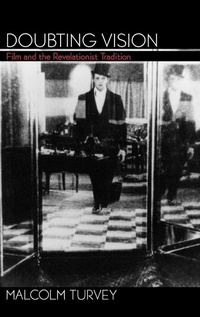
Doubting Vision
Film and the Revelationist Tradition
Published on 25. September 2008
Book
Hardback
160 pages
978-0-19-532097-8 (ISBN)
Description
The film theories of Jean Epstein, Dziga Vertov, Bela Balazs, and Siegfried Kracauer have long been studied separately from each other. In Doubting Vision, film scholar Malcolm Turvey argues that their work constitutes a distinct, hitherto neglected tradition, which he calls revelationism, and which differs in important ways from modernism and realism. For these four theorists and filmmakers, the cinema is an art of mass enlightenment because it escapes the limits of human sight and reveals the true nature of reality. Turvey provides a detailed exegesis of this tradition, pointing to its sources in Romanticism, the philosophy of Henri Bergson, modern science, and other intellectual currents. He also shows how profoundly it has influenced contemporary film theory by examining the work of psychoanalytical-semiotic theorists of the 1970s, Stanley Cavell, the modern-day followers of Kracauer and Walter Benjamin, and Gilles Deleuze.
Throughout, Turvey offers a trenchant critique of revelationism and its descendants. Combining the close analysis of theoretical texts with the philosophical method of conceptual clarification pioneered by the later Wittgenstein, he shows how the arguments theorists and filmmakers have made about human vision and the cinema's revelatory powers often traffic in conceptual confusion. Having identified and extricated these confusions, Turvey builds on the work of Epstein, Vertov, Balazs, and Kracauer as well as contemporary philosophers of film to clarify some legitimate senses in which the cinema is a revelatory art using examples from the films of filmmakers such as Alfred Hitchcock and Jacques Tati.
Throughout, Turvey offers a trenchant critique of revelationism and its descendants. Combining the close analysis of theoretical texts with the philosophical method of conceptual clarification pioneered by the later Wittgenstein, he shows how the arguments theorists and filmmakers have made about human vision and the cinema's revelatory powers often traffic in conceptual confusion. Having identified and extricated these confusions, Turvey builds on the work of Epstein, Vertov, Balazs, and Kracauer as well as contemporary philosophers of film to clarify some legitimate senses in which the cinema is a revelatory art using examples from the films of filmmakers such as Alfred Hitchcock and Jacques Tati.
Reviews / Votes
Classical film theory represents a rich body of work that is generally overlooked nowadays by contemporary scholars of cinema. In Doubting Vision, Malcolm Turvey demonstrates that this is a mistake. He identifies a hitherto ill-recognized strand of the tradition--the revelationist tradition--and he shows astutely how critical engagement with it has great significance for debates in contemporary film theory. * Noel Carroll, Temple University * In this philosophically acute and elegantly concise book, Turvey proves himself a bold and highly original interlocutor of the tradition of classical film theory. Anyone interested in the cognitive value of cinema, modernist aesthetics, and visual culture will find his study indispensable, and long overdue. * Edward Dimendberg, author of Film Noir and the Spaces of Modernity * In this profoundly original book Turvey anatomizes with acuity and precision a third revelationist tradition of film theory alongside the familiar creationist and realist traditions and traces its persistence in contemporary writers such as Cavell and Deleuze. Further, he demonstrates how the roots of this tradition lie in the denigration of vision within modernism, a denigration that is based upon a conceptual confusion about the nature of seeing. This Turvey systematically extirpates with the tools of ordinary language philosophy. Written with remarkably lucidity and panache, Doubting Vision is an intellectual tour de force that is required reading for all film scholars and anyone who is interested in the history of modernism. * Richard Allen, New York University * Classical film theory represents a rich body of work that is generally overlooked nowadays by contemporary scholars of cinema. In Doubting Vision, Malcolm Turvey demonstrates that this is a mistake. He identifies a hitherto ill-recognized strand of the tradition--the revelationist tradition--and he shows astutely how critical engagement with it has great significance for debates in contemporary film theory. * Noel Carroll, Temple University * In this philosophically acute and elegantly concise book, Turvey proves himself a bold and highly original interlocutor of the tradition of classical film theory. Anyone interested in the cognitive value of cinema, modernist aesthetics, and visual culture will find his study indispensable, and long overdue. * Edward Dimendberg, author of Film Noir and the Spaces of Modernity *More details
Language
English
Place of publication
New York
United States
Illustrations
15 illustrations
Dimensions
Height: 240 mm
Width: 161 mm
Thickness: 14 mm
Weight
414 gr
ISBN-13
978-0-19-532097-8 (9780195320978)
Copyright in bibliographic data and cover images is held by Nielsen Book Services Limited or by the publishers or by their respective licensors: all rights reserved.
Schweitzer Classification
Other editions
Additional editions
E-Book
07/2008
1st Edition
OUP eBook
€21.99
Available for download
E-Book
07/2008
1st Edition
OUP eBook
€17.49
Available for download
Person
Malcom Turvey is Professor of Film Theory and Chair of the Visual Cultural Department, Sarah Lawrence College
Content
Introduction ; 1. The Revelationist Tradition: Exegesis ; 2. The Revelationist Tradition: Critique ; 3. Revelationsim and Contemporary Film Theory ; 4. The Lure of Visual Skepticism ; Notes