

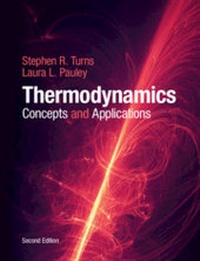
Thermodynamics
Concepts and Applications
2nd Edition
Published on 27. February 2020
Book
Hardback
854 pages
978-1-107-17971-4 (ISBN)
Description
Fully revised to match the more traditional sequence of course materials, this full-color second edition presents the basic principles and methods of thermodynamics using a clear and engaging style and a wealth of end-of-chapter problems. It includes five new chapters on topics such as mixtures, psychometry, chemical equilibrium, and combustion, and discussion of the Second Law of Thermodynamics has been expanded and divided into two chapters, allowing instructors to introduce the topic using either the cycle analysis in Chapter 6 or the definition of entropy in Chapter 7. Online ancillaries including new LMS testbanks, a password-protected solutions manual, prepared PowerPoint lecture slides, instructional videos, and figures in electronic format are available at www.cambridge.org/thermo
More details
Edition
2nd Revised edition
Language
English
Place of publication
Cambridge
United Kingdom
Target group
College/higher education
Edition type
Revised edition
Product notice
sewn/stitched
Cloth over boards
Illustrations
Worked examples or Exercises; 40 Tables, black and white; 365 Halftones, color; 740 Halftones, black and white
Dimensions
Height: 292 mm
Width: 222 mm
Thickness: 45 mm
Weight
2640 gr
ISBN-13
978-1-107-17971-4 (9781107179714)
Copyright in bibliographic data and cover images is held by Nielsen Book Services Limited or by the publishers or by their respective licensors: all rights reserved.
Schweitzer Classification
Other editions
Additional editions
E-Book
02/2020
2nd Edition
Cambridge University Press
€68.49
Available for download
Previous edition
Book
03/2006
Cambridge University Press
€85.99
Article exhausted; check for reprint
Persons
Stephen R. Turns is Professor Emeritus of mechanical engineering at The Pennsylvania State University. His research interests include combustion-generated air pollution, other combustion-related topics, and engineering education pedagogy. Turns was the recipient of the 2009 ASEE Mechanical Engineering Division Ralph Coats Roe Award and has been the recipient of several teaching awards at Penn State. He is the author of An Introduction to Combustion: Concepts and Applications (3rd edition, 2011), also appearing in Chinese, Korean, and Portuguese, and of Thermal-Fluid Sciences: An Integrated Approach (2008). Turns is a fellow of the American Society of Mechanical Engineering (ASME). Laura L. Pauley is Professor of mechanical engineering at the Pennsylvania State University. She teaches courses in the thermal sciences and conducts research in engineering education and computational fluid dynamics. Pauley has worked on grants focusing on aspects of engineering education including classroom experiments, presentation skills, and the climate for women in engineering. She has also initiated efforts in curriculum reform and experimental case studies for required courses in mechanical engineering. She is the recipient of Undergraduate Program Leadership Award (2003) and was selected as the first Arthur L. Glenn Professor of Engineering Education. Pauley is a fellow of the American Society of Mechanical Engineering (ASME).
Content
Conversion factors; Preface; Acknowledgements; 1. Beginnings; 2. Thermodynamic properties, property relationships, and processes; 3. Conservation of mass; 4. Energy and energy transfer; 5. First law of thermodynamics; 6. Second law of thermodynamics and some of its consequences; 7. Entropy and availability; 8. Thermal-fluid analysis of steady-flow devices; 9. Systems for power production, propulsion, and heating and cooling; 10. Ideal-gas mixtures; 11. Air-vapor mixtures; 12. Reacting systems; 13. Chemical and phase equilibrium; Appendix A. Timeline; Appendix B. Thermodynamic properties of H2O; Appendix C. Thermodynamic and thermo-physical properties of air; Appendix D. Thermodynamic properties of ideal gases and carbon; Appendix E. Various thermodynamic data; Appendix F. Thermo-physical properties of selected gases at 1 atm; Appendix G. Thermo-physical properties of selected liquids; Appendix H. Thermo-physical properties of hydrocarbon fuels; Appendix I. Psychrometric charts; Answers to selected problems; Index.