

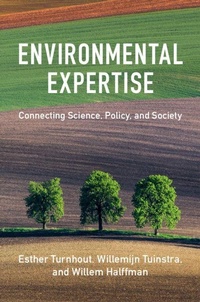
Environmental Expertise
Connecting Science, Policy and Society
Published on 21. February 2019
Book
Hardback
288 pages
978-1-107-09874-9 (ISBN)
Description
An important goal of environmental research is to inform policy and decision making. However, environmental experts working at the interface between science, policy and society face complex challenges, including how to identify sources of disagreement over environmental issues, communicate uncertainties and limitations of knowledge, and tackle controversial topics such as genetic modification and the use of biofuels. This book discusses the problems environmental experts encounter in the interaction between knowledge, society, and policy on both a practical and conceptual level. Key findings from social science research are illustrated with a range of case studies, from fisheries to fracking. The book offers guidance on how to tackle these challenges, equipping readers with tools to better understand the diversity of environmental knowledge and its role in complex environmental issues. Written by leading natural and social scientists, this text provides an essential resource for students, scientists and professionals working at the science-policy interface.
Reviews / Votes
'The novel perspectives in this book, as well as its cases and conceptual advances, will come as a welcome resource for those interested in understanding the controversies around the use of environmental expertise. Equally, it will be welcomed by environmental scientists seeking to navigate the shoals of practicing and representing science on the one hand, and effective communication and making a difference in the world on the other.' Arun Agrawal, University of Michigan 'This book is important and timely. There has never before been such great need for evidence to underpin environmental policy, and yet there is also a growing appreciation among researchers of the complexities and risks associated with engaging with the policy community. The book is rooted in the latest theoretical understandings from social science, explained in an accessible way, and it very quickly moves from theory to practice, showing how these insights can inform how environmental scientists work around controversial topics. The use of in-depth case studies complements the widespread use of helpful examples throughout the text. I have found reading this book both inspiring and instructive, and believe that many researchers will benefit considerably from reading it. I will certainly be recommending it to colleagues.' Mark Reed, Newcastle University 'The principal authors have done a very smart and novel job with this book, bringing together insights from environmental science, policy studies, science studies and the philosophy of science in a thoroughly practical way. The book should really help practitioners appreciate ways to handle the complexities of environmental policy-making in contexts of uncertainty, conflicting beliefs and competing societal values.' Steve Yearley, University of EdinburghMore details
Language
English
Place of publication
Cambridge
United Kingdom
Target group
Professional and scholarly
Illustrations
4 Tables, black and white; 2 Maps; 6 Halftones, black and white; 2 Line drawings, black and white
Dimensions
Height: 235 mm
Width: 157 mm
Thickness: 20 mm
Weight
574 gr
ISBN-13
978-1-107-09874-9 (9781107098749)
Copyright in bibliographic data and cover images is held by Nielsen Book Services Limited or by the publishers or by their respective licensors: all rights reserved.
Schweitzer Classification
Other editions
Additional editions
Esther Turnhout | Willemijn Tuinstra | Willem Halffman
Environmental Expertise
Connecting Science, Policy and Society
Book
02/2019
Cambridge University Press
€54.80
Shipment within 15-20 days
E-Book
02/2019
Cambridge University Press
€29.49
Available for download
Esther Turnhout | Willemijn Tuinstra | Willem Halffman
Environmental Expertise
Connecting Science, Policy and Society
E-Book
02/2019
Cambridge University Press
€35.49
Available for download
Persons
Esther Turnhout is a Professor at the Forest and Nature Conservation Policy Group of Wageningen Universiteit, The Netherlands. Her research program, 'The Politics of Environmental Knowledge', includes research into the different roles experts play at the science-policy interface, the political implications of policy-relevant environmental knowledge and the interaction between science, society and citizens. Willemijn Tuinstra works as an independent advisor on knowledge development for environmental policy. She advises research institutes and civil servants on procedural aspects of stakeholder participation, scenario development and dealing with uncertainties. She has been involved in projects for the European Environment Agency and the International Institute for Applied Systems Analysis. Willem Halffman is an associate professor in the Faculty of Science at Radboud Universiteit Nijmegen. His work focuses on studying how scientific knowledge is validated and how scientists advise public decision making. He has over twenty years' experience teaching science and society courses to natural scientists.
Content
List of contributors; Preface; List of abbreviations; 1. Introduction: the plight of the environmental scientist Willem Halffman, Esther Turnhout and Willemijn Tuinstra; 2. What is science? (And why does this matter?) Willem Halffman; 3. Frames: beyond facts versus values Willem Halffman; Case A. Framing climate change Mike Hulme; 4. Science, politics and the public in knowledge controversies Esther Turnhout and Thomas Gieryn; Case B. What does 'climategate' tell us about public knowledge controversies? Silke Beck; Case C. Whose deficit anyway? Institutional misunderstanding of fracking sceptical publics Laurence Williams and Phil Macnaghten; 5. The limits to knowledge Willemijn Tuinstra, Ad Ragas and Willem Halffman; Case D. Angry bulbs Ad Ragas and Marga Jacobs; 6. Usable knowledge: science, policy and society Willemijn Tuinstra, Willem Halffman and Esther Turnhout; Case E. Expertise for European fisheries policy Willem Halffman and Martin Pastoors; 7. Interdisciplinarity and the challenge of knowledge integration Esther Turnhout; Case F. Knowledge integration in the Millennium Ecosystem Assessment Clark Miller; Case G. Integrated assessment for long-range transboundary air pollution Willemijn Tuinstra; 8. Lay expertise Esther Turnhout and Katja Neves; Case H. Lay expertise and botanical science: a case of dynamic interdependencies in biodiversity conservation Katja Neves; Case I. The Loweswater Care Project Claire Waterton; 9. Environmental Experts at the science-policy-society interface Esther Turnhout; Case J. Group Think and whistle blowers in CO2 capture and storage Heleen de Coninck; 10. Environmental knowledge in democracy Esther Turnhout, Willem Halffman and Willemijn Tuinstra; 11. Conclusion: science, reason and the environment Willem Halffman, Willemijn Tuinstra and Esther Turnhout; Inde