

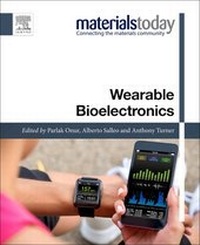
Wearable Bioelectronics
Published on 22. November 2019
Book
Paperback/Softback
238 pages
978-0-08-102407-2 (ISBN)
Description
Wearable Bioelectronics presents the latest on physical and (bio)chemical sensing for wearable electronics. It covers the miniaturization of bioelectrodes and high-throughput biosensing platforms while also presenting a systemic approach for the development of electrochemical biosensors and bioelectronics for biomedical applications. The book addresses the fundamentals, materials, processes and devices for wearable bioelectronics, showcasing key applications, including device fabrication, manufacturing, and healthcare applications. Topics covered include self-powering wearable bioelectronics, electrochemical transducers, textile-based biosensors, epidermal electronics and other exciting applications.
More details
Series
Language
English
Place of publication
London
United Kingdom
Publishing group
Elsevier Health Sciences
Target group
Professional and scholarly
Materials Scientists and Engineers, academics and researchers working in the area of bioelectronics and biosensors
Dimensions
Height: 235 mm
Width: 191 mm
Weight
510 gr
ISBN-13
978-0-08-102407-2 (9780081024072)
Copyright in bibliographic data and cover images is held by Nielsen Book Services Limited or by the publishers or by their respective licensors: all rights reserved.
Schweitzer Classification
Other editions
Additional editions
Anthony P. F. Turner | Alberto Salleo | Onur Parlak
Wearable Bioelectronics
E-Book
11/2019
Elsevier
€175.00
Available for download
Persons
Professor Anthony P.F. Turner PhD; DSc; FRSC; is a pioneer in the field of biosensors and bioelectronics. He is Emeritus Professor of Biotechnology at Cranfield University in the UK, a Foreign Member of the USA National Academy of Engineering, Editor-in-Chief of the journal Biosensors & Bioelectronics (Elsevier), and Executive Chair of the World Congress on Biosensors (Elsevier). He is Member of the Royal Swedish Academy of Engineering Science and Fellow of the Royal Society of Chemistry. Alberto Salleo is currently an Associate Professor of Materials Science at Stanford University. Alberto Salleo graduated as a Fulbright Fellow with a PhD in Materials Science from UC Berkeley in 2001 working at Lawrence Livermore National Laboratory on laser-induced optical breakdown in fused silica. From 2001 to 2005 Salleo was first post-doctoral research fellow and successively member of research staff at Xerox Palo Alto Research Center, where he worked with Bob Street on device and materials physics of disordered and polymeric semiconductors. In 2005 Salleo joined the Materials Science and Engineering Department at Stanford as an Assistant Professor. While at Stanford, Salleo won the NSF Career Award, the 3M Untenured Faculty Award, the SPIE Early Career Award, the Tau Beta Pi Excellence in Undergraduate Teaching Award and the Gores Teaching Award, Stanford's highest teaching honor. Prof. Salleo is a Principal Editor of MRS Communications. Onur Parlak is a postdoctoral research fellow at Stanford University, Materials Science and Engineering. He received his PhD degree in Bioelectronics from Linkoeping University, Biosensors and Bioelectronics Centre in September 2015. Earlier, he was visiting research intern at Nanyang Technological University, Materials Science and Engineering Department, Singapore in 2011. He received his master and bachelor degree from Izmir Institute of Technology, Department of Chemistry in 2011 and 2009, respectively.
Dr. Parlak's research in Stanford University focuses on wearable biosensors for early diagnosis of metabolic disease, and energy devices for wearable bioelectronics.
Dr. Parlak's research in Stanford University focuses on wearable biosensors for early diagnosis of metabolic disease, and energy devices for wearable bioelectronics.
Content
Part I: Introduction
1. Wearable bioelectronics: fundamentals, challenges, and future perspectives
Part II: Materials, processes and devices for wearable bioelectronics
2. Materials for wearable bioelectronics
3. Mechanics and designs of wearable bioelectronics
4. Manufacturing of wearable bioelectronics
5. Flexible energy devices for wearable bioelectronics
6. Wireless communication systems for wearable bioelectronics
Part III: Wearable bioelectronic systems for health applications
7. Wearable physical sensors
8. Wearable chemical sensors
9. Wearable biosensors
10. Sample-handling strategies in all wearable bioelectronic devices
11. Powering wearable bioelectronic devices
12. Special focus: e-skin
13. Special focus: Textile-based wearable bioelectronics for continuous health monitoring
1. Wearable bioelectronics: fundamentals, challenges, and future perspectives
Part II: Materials, processes and devices for wearable bioelectronics
2. Materials for wearable bioelectronics
3. Mechanics and designs of wearable bioelectronics
4. Manufacturing of wearable bioelectronics
5. Flexible energy devices for wearable bioelectronics
6. Wireless communication systems for wearable bioelectronics
Part III: Wearable bioelectronic systems for health applications
7. Wearable physical sensors
8. Wearable chemical sensors
9. Wearable biosensors
10. Sample-handling strategies in all wearable bioelectronic devices
11. Powering wearable bioelectronic devices
12. Special focus: e-skin
13. Special focus: Textile-based wearable bioelectronics for continuous health monitoring