

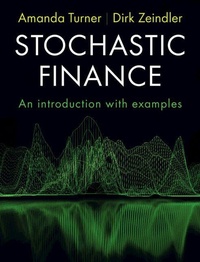
Stochastic Finance
An Introduction with Examples
Published on 9. February 2023
Book
Paperback/Softback
260 pages
978-1-009-04894-1 (ISBN)
Description
Stochastic Finance provides an introduction to mathematical finance that is unparalleled in its accessibility. Through classroom testing, the authors have identified common pain points for students, and their approach takes great care to help the reader to overcome these difficulties and to foster understanding where comparable texts often do not. Written for advanced undergraduate students, and making use of numerous detailed examples to illustrate key concepts, this text provides all the mathematical foundations necessary to model transactions in the world of finance. A first course in probability is the only necessary background. The book begins with the discrete binomial model and the finite market model, followed by the continuous Black-Scholes model. It studies the pricing of European options by combining financial concepts such as arbitrage and self-financing trading strategies with probabilistic tools such as sigma algebras, martingales and stochastic integration. All these concepts are introduced in a relaxed and user-friendly fashion.
Reviews / Votes
'The text does a great job of providing a comprehensive picture of basic mathematical finance concepts in both discrete and continuous settings. The authors provide a balanced amount of details in both the financial (arbitrage, replicating strategies, etc.) and mathematical aspects (probability, stochastic calculus, etc.) I really appreciate the fact that the technical details are presented in a way that is accessible to an advanced undergraduate student.' Triet Pham, Department of Mathematics, The School of Arts and Sciences, Rutgers, The State University of New Jersey 'This is a rigorous textbook on stochastic finance in which the reader will enjoy the path the authors take while introducing conditional expectations with respect to sigma-algebras, and the sequence of models from the binomial to Black-Scholes. In all, a careful construction of the theory with proofs that are both thorough and readable.' Ludolf E. Meester, Delft University of TechnologyMore details
Language
English
Place of publication
Cambridge
United Kingdom
Target group
College/higher education
Product notice
Paperback (trade)
Illustrations
Worked examples or Exercises
Dimensions
Height: 246 mm
Width: 189 mm
Thickness: 14 mm
Weight
517 gr
ISBN-13
978-1-009-04894-1 (9781009048941)
Copyright in bibliographic data and cover images is held by Nielsen Book Services Limited or by the publishers or by their respective licensors: all rights reserved.
Schweitzer Classification
Other editions
Additional editions
E-Book
02/2023
Cambridge University Press
€49.99
Available for download
Book
02/2023
Cambridge University Press
€134.50
Shipment within 15-20 days
Persons
Amanda Turner is Professor of Statistics at the University of Leeds. She received her Ph.D. from the University of Cambridge in Scaling Limits of Stochastic Processes in 2007. Before moving to Leeds, she taught probability and stochastic processes for finance at Lancaster University and the University of Geneva for over fifteen years. She is a founding member of the Royal Statistical Society's Applied Probability Section and is heavily involved in the London Mathematical Society, including as a member of council since 2021. When not doing mathematics, she enjoys mountaineering and skiing. Dirk Zeindler is Senior Lecturer in Pure Mathematics at Lancaster University. He holds a Ph.D. in random matrix theory from the University of Zurich. He has taught probability courses at Lancaster University and at the University of Bielefeld for over ten years. His teaching includes introductory first-year probability to advanced financial mathematics, for mathematics, accounting and finance students. His research interests are in probability and number theory. In particular, he and his co-authors have proven that at least 41.7% of the zeros of the Riemann zeta lie on the critical line, which is the current world record.
Content
Preface; Acknowledgements; Part I. Discrete-Time Models for Finance: 1. Introduction to finance; 2. Discrete probability; 3. Binomial or CRR model; 4. Finite market model; 5. Discrete Black-Scholes model; Part II. Continuous-Time Models for Finance: 6. Continuous probability; 7. Brownian motion; 8. Stochastic integration; 9. The Black-Scholes model; A Supplementary material; Bibliography; Symbol index; Index.