

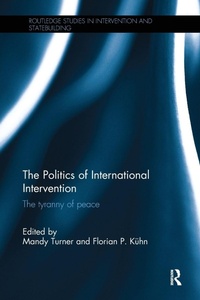
The Politics of International Intervention
The Tyranny of Peace
1st Edition
Published on 30. June 2017
Book
Paperback/Softback
302 pages
978-1-138-31052-0 (ISBN)
Description
This book critically explores the practices of peacebuilding, and the politics of the communities experiencing intervention.
The contributions to this volume have a dual focus. First, they analyse the practices of western intervention and peacebuilding, and the prejudices and politics that drive them. Second, they explore how communities experience and deal with this intervention, as well as an understanding of how their political and economic priorities can often diverge markedly from those of the intervener. This is achieved through theoretical and thematic chapters, and an extensive number of in-depth empirical case studies.
Utilising a variety of conceptual frameworks and disciplines, the book seeks to understand why something so normatively desirable - the pursuit of, and building of, peace - has turned out so badly. From Cambodia to Afghanistan, Iraq to Mali, interventions in the pursuit of peace have not achieved the results desired by the interveners. But, rather, they have created further instability and violence. The contributors to this book explore why.
This book will be of much interest to students, academics and practitioners of peacebuilding, peacekeeping, international intervention, statebuilding, security studies and IR in general.
The contributions to this volume have a dual focus. First, they analyse the practices of western intervention and peacebuilding, and the prejudices and politics that drive them. Second, they explore how communities experience and deal with this intervention, as well as an understanding of how their political and economic priorities can often diverge markedly from those of the intervener. This is achieved through theoretical and thematic chapters, and an extensive number of in-depth empirical case studies.
Utilising a variety of conceptual frameworks and disciplines, the book seeks to understand why something so normatively desirable - the pursuit of, and building of, peace - has turned out so badly. From Cambodia to Afghanistan, Iraq to Mali, interventions in the pursuit of peace have not achieved the results desired by the interveners. But, rather, they have created further instability and violence. The contributors to this book explore why.
This book will be of much interest to students, academics and practitioners of peacebuilding, peacekeeping, international intervention, statebuilding, security studies and IR in general.
More details
Series
Language
English
Place of publication
London
United Kingdom
Publishing group
Taylor & Francis Ltd
Target group
College/higher education
Professional and scholarly
Dimensions
Height: 234 mm
Width: 156 mm
Thickness: 16 mm
Weight
465 gr
ISBN-13
978-1-138-31052-0 (9781138310520)
Copyright in bibliographic data and cover images is held by Nielsen Book Services Limited or by the publishers or by their respective licensors: all rights reserved.
Schweitzer Classification
Other editions
Additional editions
Book
09/2015
1st Edition
Routledge
€242.30
Shipment within 10-20 days
E-Book
09/2015
Routledge
€64.49
Available for download
E-Book
09/2015
Routledge
€64.49
Available for download
Persons
Mandy Turner is Director of the Kenyon Institute, at the Council for British Research in the Levant, East Jerusalem and Visiting Research Fellow at the Middle East Centre, London School of Economics, UK.
Florian P. Kuehn is Interim Professor for Comparative Politics at Magdeburg's Otto von Guericke University, Germany.
Florian P. Kuehn is Interim Professor for Comparative Politics at Magdeburg's Otto von Guericke University, Germany.
Content
Introduction: The Tyranny of Peace and the Politics of International Intervention, Mandy Turner and Florian P. Kuehn 1. International Peace Practice: Ambiguity, Contradictions and Perpetual Violence, Florian P. Kuehn 2. Geographies of Reconstruction: Re-thinking Post-war Spaces, Scott Kirsch & Colin Flint 3. Still the Spectre at the Feast: Comparisons between Peacekeeping and Imperialism in Peacekeeping Studies Today, Philip Cunliffe 4. Lineages of Aggressive Peace, Michael Pugh 5. A Double-edged Sword of Peace? Reflections on the Tension Between Representation and Protection in Gendering Liberal Peacebuilding, Heidi Hudson 6. UNTAC, Peace and Violence in Cambodia, Caroline Hughes 7. Securing and stabilising: peacebuilding-as-counterinsurgency in the occupied Palestinian territory, Mandy Turner 8. Waging War and Building Peace in Afghanistan, Astri Suhrke 9. War and Peace in Cote d'Ivoire: Violence, Agency, and the Local/International Line, Bruno Charbonneau 10. Enemy Images, Coercive Socio-engineering and Civil War in Iraq, Toby Dodge 11. Libya in the shadow of Iraq: the Old Guard versus the Thuwwar in the battle for stability, Nicolas Pelham 12. Defending Neoliberal Mali: French Military Intervention and the Management of Contested Political Narratives, Bruno Charbonneau and Jonathan Sears 13. Intervention and Non-intervention in the Syria Crisis, Christopher Phillips