

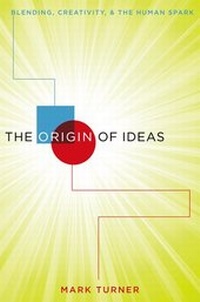
The Origin of Ideas
Blending, Creativity, and the Human Spark
Published on 3. April 2014
Book
Hardback
312 pages
978-0-19-998882-2 (ISBN)
Description
Why are we so innovative? Where do new ideas come from? Why are human beings so exceptionally good at innovation, leaving other species mentally in the dust? How can we hold onto new ideas once they are formed? This book explores the claim that the human spark, the source of innovation and the origin of ideas, was an advance that occurred in a particular kind of mental operation, which Turner calls blending. Blending is our ability to take two ideas or more and
create a new idea from the "blend." And what is so fascinating is how human beings are able to engage in blending almost without effort and usually unconsciously. It appears to be second nature to us, how we live and breathe in the course of processing information and ideas.
Human beings are profoundly different from all other species in this ability. While many species can do what we cannot-fly, run amazingly fast, see in the dark-only human beings can innovate. Beginning somewhere in the Paleolithic Age, everything changed in the course of human events. Before that, we were a bunch of large mammals. After that, we were poised to take over the world. Turner makes the controversial and provocative claim that what made human advances possible was the ability to
engage in the virtuosity of blending, which is everywhere apparent in our cultural record-in our creations and innovations-it is the origin of our ideas.
Turner's theory of blending is featured in Jonah Lehrer's bestselling book, Imagine, and this book will be the first to lay out this theory in detail for a lay audience and academics tackling the nature of the human brain and the fascinating puzzle of what it means to be human.
create a new idea from the "blend." And what is so fascinating is how human beings are able to engage in blending almost without effort and usually unconsciously. It appears to be second nature to us, how we live and breathe in the course of processing information and ideas.
Human beings are profoundly different from all other species in this ability. While many species can do what we cannot-fly, run amazingly fast, see in the dark-only human beings can innovate. Beginning somewhere in the Paleolithic Age, everything changed in the course of human events. Before that, we were a bunch of large mammals. After that, we were poised to take over the world. Turner makes the controversial and provocative claim that what made human advances possible was the ability to
engage in the virtuosity of blending, which is everywhere apparent in our cultural record-in our creations and innovations-it is the origin of our ideas.
Turner's theory of blending is featured in Jonah Lehrer's bestselling book, Imagine, and this book will be the first to lay out this theory in detail for a lay audience and academics tackling the nature of the human brain and the fascinating puzzle of what it means to be human.
Reviews / Votes
"Turner makes a cogent and often colorfully argued case for blending's importance as crucial to the development of new ideas and imaginative works."--Publishers Weekly
"Turner probes the nature of creativity. [...He applies] 'blending' to such complex topics as 'self,' 'identity,' and 'theory of mind' in a reader-friendly style that encompasses neurobiology, cartoons, Picasso, and Winnie-the-Pooh. Recommended. All readers." --S. Krippner, CHOICE
"Turner probes the nature of creativity. He does apply 'blending' to such complex topics as 'self,' identity,' and 'theory of mind' in a reader-friendly style that encompasses neurobiology, cartoons, Picasso, and Winnie-the-Pooh. Recommended. All readers." --S. Krippner, CHOICE Magazine
More details
Language
English
Place of publication
New York
United States
Dimensions
Height: 239 mm
Width: 162 mm
Thickness: 26 mm
Weight
536 gr
ISBN-13
978-0-19-998882-2 (9780199988822)
Copyright in bibliographic data and cover images is held by Nielsen Book Services Limited or by the publishers or by their respective licensors: all rights reserved.
Schweitzer Classification
Other editions
Additional editions
E-Book
01/2014
1st Edition
OUP eBook
€9.99
Available for download
E-Book
01/2014
1st Edition
OUP eBook
€9.99
Available for download
Person
Mark Turner, Ph.D., is Institute Professor and Professor of Cognitive Science at Case Western Reserve University. He is the founding director of the Cognitive Science Network and co-director of the Red Hen Lab. He has been a fellow of the Institute for Advanced Study, the John Simon Guggenheim Memorial Foundation, the Center for Advanced Study in the Behavioral Sciences, and the National Humanities Center.
Content
1. Where Do Ideas Come From? ; 2. Who Are You? ; 3. Who Am I? ; 4. Forbidden Fruit ; 5. The Artful Mind ; 6. The Sweep of Thought ; 7. Eeny, Meeny, Miny, Moe ; 8. Round and Round and Round We Go ; 9. Final Questions ; References