

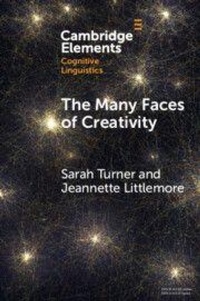
The Many Faces of Creativity
Exploring Synaesthesia through a Metaphorical Lens
Published on 9. February 2023
Book
Paperback/Softback
96 pages
978-1-108-97136-2 (ISBN)
Description
Creative metaphor has been of central interest to the cognitive linguistic research community in recent years. However, little is known about what propels people to use metaphor in a creative way. In this Element, the authors identify and explore some of the clues that synaesthesia may provide to help us better understand the factors that drive creativity, with a particular focus on creative metaphor. They identify the factors that seem to trigger the production of creative metaphor in synaesthetes, and explore what this can tell us about creativity in the population more generally. Their findings provide insights into the nature of creativity as it relates to metaphor, emotion and embodied experience. This title is also available as Open Access on Cambridge Core.
More details
Series
Language
English
Place of publication
Cambridge
United Kingdom
Product notice
Paperback (trade)
Illustrations
Worked examples or Exercises
Dimensions
Height: 229 mm
Width: 152 mm
Thickness: 5 mm
Weight
141 gr
ISBN-13
978-1-108-97136-2 (9781108971362)
Copyright in bibliographic data and cover images is held by Nielsen Book Services Limited or by the publishers or by their respective licensors: all rights reserved.
Schweitzer Classification
Other editions
Additional editions
Sarah Turner | Jeannette Littlemore
Many Faces of Creativity
E-Book
02/2023
Cambridge University Press
€22.49
Available for download
Sarah Turner | Jeannette Littlemore
The Many Faces of Creativity
Exploring Synaesthesia through a Metaphorical Lens
E-Book
02/2023
Cambridge University Press
€22.49
Available for download
Persons
Content
1. 'Tiny balloons filled with mashed potatoes': what is synaesthesia, and what has it got to do with creativity and metaphor?; 2. 'Those cookies tasted of regret...:' how we investigated evaluative descriptions of sensory experiences; 3. ...and rotting flesh: how do synaesthetes and non-synaesthetes evaluate sensory experiences? What we found...; 4. 'Yeurgh...': How we investigated synaesthetes' and non-synaesthetes' responses to emotion words and emotive expressions, and what we found; 5. 'I don't like looking at numbers with no discernible pattern': Conclusion.