

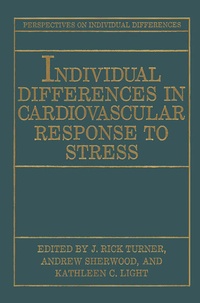
Individual Differences in Cardiovascular Response to Stress
Published on 6. June 2013
Book
Paperback/Softback
XVIII, 302 pages
978-1-4899-0699-1 (ISBN)
Description
Demonstrating that the magnitude and pattern of cardiovascular response to stress varies markedly between individuals, this work discusses the mechanisms by which the cardiovascular system is mobilized during stress, the determinants of individual differences, and the pathophysiological processes by which responses to stress may lead to cardiovascular disease. Behavioral scientists from a variety of disciplines will find the work pertinent to their research.
More details
Series
Edition
Softcover reprint of the original 1st ed. 1992
Language
English
Place of publication
New York
United States
Target group
Professional and scholarly
Research
Illustrations
XVIII, 302 p.
Dimensions
Height: 235 mm
Width: 155 mm
Thickness: 18 mm
Weight
487 gr
ISBN-13
978-1-4899-0699-1 (9781489906991)
DOI
10.1007/978-1-4899-0697-7
Schweitzer Classification
Other editions
Additional editions
J. Rick Turner | Andrew Sherwood | Kathleen C. Light
Individual Differences in Cardiovascular Response to Stress
Book
09/1992
Plenum Publishing Co.,N.Y.
€160.49
Shipment within 10-15 days
Content
One. Cardiovascular Reactivity: Laboratory and Ambulatory Assessment Procedures.- One. A Conceptual and Methodological Overview of Cardiovascular Reactivity Research.- Two. Sympathetic Nervous System Responses to Psychosocial Stressors.- Three. Individual Differences in Ambulatory Blood Pressure Patterns.- Four. The Ecological Validity of Laboratory Stress Testing.- Two. Determinants of Individual Differences in Cardiovascular Responses during Stress.- Five. Genes, Stress, and Cardiovascular Reactivity.- Six. Personality Characteristics, Reactivity, and Cardiovascular Disease.- Seven. Toward Understanding Race Difference in Autonomic Reactivity: A Proposed Contextual Model.- Eight. The Role of Reproductive Hormones in Cardiovascular and Neuroendocrine Function during Behavioral Stress.- Nine. The Role of Cardiovascular Reactivity in Hypertension Risk.- Ten. Stress Reactivity in Childhood and Adolescence.- Eleven. Does Aerobic Exercise Reduce Stress Responses?.- Three. Cardiovascular Stress Responses and Cardiovascular Disease.- Twelve. Endogenous Opioids and Stress Reactivity in the Development of Essential Hypertension.- Thirteen. Differential Responses to Salt Intake-Stress Interactions: Relevance to Hypertension.- Fourteen. A Biobehavioral Model of Hypertension Development.- Fifteen. High Cardiovascular Reactivity to Stress: A Predictor of Later Hypertension Development.