

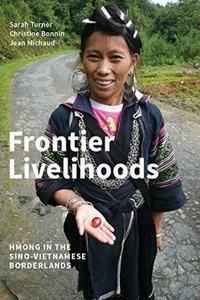
Frontier Livelihoods
Hmong in the Sino-Vietnamese Borderlands
Published on 15. March 2017
Book
Paperback/Softback
234 pages
978-0-295-74173-4 (ISBN)
Description
Do ethnic minorities have the power to alter the course of their fortune when living within a socialist state? In Frontier Livelihoods, the authors focus their study on the Hmong - known in China as the Miao - in the Sino-Vietnamese borderlands, contending that individuals and households create livelihoods about which governments often know little.
The product of wide-ranging research over many years, Frontier Livelihoods bridges the traditional divide between studies of China and peninsular Southeast Asia by examining the agency, dynamics, and resilience of livelihoods adopted by Hmong communities in Vietnam and in China's Yunnan Province. It covers the reactions to state modernization projects among this ethnic group in two separate national jurisdictions and contributes to a growing body of literature on cross-border relationships between ethnic minorities in the borderlands of China and its neighbors and in Southeast Asia more broadly.
The product of wide-ranging research over many years, Frontier Livelihoods bridges the traditional divide between studies of China and peninsular Southeast Asia by examining the agency, dynamics, and resilience of livelihoods adopted by Hmong communities in Vietnam and in China's Yunnan Province. It covers the reactions to state modernization projects among this ethnic group in two separate national jurisdictions and contributes to a growing body of literature on cross-border relationships between ethnic minorities in the borderlands of China and its neighbors and in Southeast Asia more broadly.
Reviews / Votes
"Recommended."(Choice) "A powerful ethnography of economics that reaches deep into local and regional economies and histories, tracing the pathways of key products made and traded."
- Magnus Fiskesjo (Journal of the Royal Anthropological Institute) "[This] important contribution . . . provides new insights into borderlands and everyday politics of ethnic minorities in the Southeast Asian Massif."
- Alexander Horstmann (SOJOURN: Journal of Social Issues in Southeast Asia) "Provides a vivid description of a myriad of activities in the everyday lives of Hmong on the fringes as they make their living in the sectors of agriculture, livestock transactions, locally distilled alcohol, cardamom, and the textile trade."
- Nguyen Thi Le (Southeast Asian Studies) "Written in an extremely clear and engaging style, this book has a lot to offer to all those interested in borderlands studies and in the lives of those who inhabit the Southeast Asian Massif."
- Stephane Gros (New Books Asia)
More details
Series
Language
English
Place of publication
Seattle
United States
Target group
Professional and scholarly
Product notice
Paperback (trade)
Illustrations
34 b&w illus., 4 maps
Dimensions
Height: 216 mm
Width: 144 mm
Thickness: 17 mm
Weight
322 gr
ISBN-13
978-0-295-74173-4 (9780295741734)
Copyright in bibliographic data and cover images is held by Nielsen Book Services Limited or by the publishers or by their respective licensors: all rights reserved.
Schweitzer Classification
Persons
Sarah Turner is professor of geography at McGill University. She is the author of Indonesia's Small Entrepreneurs: Trading on the Margins and editor of Red Stamps and Gold Stars: Fieldwork Dilemmas in Upland Socialist Asia. Christine Bonnin is lecturer in geography at University College Dublin. Jean Michaud is professor of social anthropology at Universite Laval. He is the author of The A to Z of the People of the Southeast Asian Massif and coeditor of Moving Mountains: Ethnicity and Livelihoods in Highland China, Vietnam, and Laos.
Content
Preface and Acknowledgments
1. Upland Alternatives
2. Frontier Dynamics
3. Borderland Livelihoods
4. Livestock Transactions
5. Locally Distilled Alcohol
6. Farming under the Trees
7. Weaving Livelihoods
8. The Challenge
Notes
Glossary
References
Index
1. Upland Alternatives
2. Frontier Dynamics
3. Borderland Livelihoods
4. Livestock Transactions
5. Locally Distilled Alcohol
6. Farming under the Trees
7. Weaving Livelihoods
8. The Challenge
Notes
Glossary
References
Index