

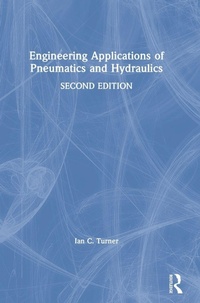
Engineering Applications of Pneumatics and Hydraulics
2nd Edition
Published on 11. August 2020
Book
Hardback
174 pages
978-0-367-46085-3 (ISBN)
Description
Requiring only a basic knowledge of the physics of fluids, Engineering Applications of Pneumatics and Hydraulics provides a sound understanding of fluid power systems and their uses within industry. It takes a strongly practical approach in describing pneumatics and hydraulics in modern industry and is filled with diagrams of components, equipment and plant.
The pneumatic and hydraulic graphical symbols used in everyday fluid power systems and circuits are particularly explained and well illustrated. In addition to descriptions of equipment and plant, maintenance and troubleshooting is also covered, with an emphasis on safety systems and safety regulations.
This second edition delves into the same fluid power technical areas as in the first edition, but with a complete update of current safety legislation and guidance on the latest regulations. Codes of practice, technical standards and standardisation organisations have also been updated to enable readers to search for the newest information and requirements regarding the use and application of pneumatics and hydraulics in industry whilst reflecting advances in technology.
The book is written for students from levels 3 to 5, and for a wide range of practising engineers, especially in the engineering disciplines of mechanical, plant, process and operations engineering, as well as measurement and control engineering within mechatronics.
The pneumatic and hydraulic graphical symbols used in everyday fluid power systems and circuits are particularly explained and well illustrated. In addition to descriptions of equipment and plant, maintenance and troubleshooting is also covered, with an emphasis on safety systems and safety regulations.
This second edition delves into the same fluid power technical areas as in the first edition, but with a complete update of current safety legislation and guidance on the latest regulations. Codes of practice, technical standards and standardisation organisations have also been updated to enable readers to search for the newest information and requirements regarding the use and application of pneumatics and hydraulics in industry whilst reflecting advances in technology.
The book is written for students from levels 3 to 5, and for a wide range of practising engineers, especially in the engineering disciplines of mechanical, plant, process and operations engineering, as well as measurement and control engineering within mechatronics.
More details
Edition
2nd edition
Language
English
Place of publication
London
United Kingdom
Publishing group
Taylor & Francis Ltd
Target group
Primary & secondary/elementary & high school
College/higher education
Professional and scholarly
Adult education
AS/A2, Adult education, Further/Vocational Education, Professional, and Undergraduate Core
Illustrations
3 s/w Tabellen, 40 s/w Photographien bzw. Rasterbilder, 165 s/w Zeichnungen, 208 s/w Abbildungen
3 Tables, black and white; 165 Line drawings, black and white; 40 Halftones, black and white; 208 Illustrations, black and white
Dimensions
Height: 250 mm
Width: 175 mm
Thickness: 15 mm
Weight
510 gr
ISBN-13
978-0-367-46085-3 (9780367460853)
Copyright in bibliographic data and cover images is held by Nielsen Book Services Limited or by the publishers or by their respective licensors: all rights reserved.
Schweitzer Classification
Other editions
Additional editions
Ian C. Turner
Engineering Applications of Pneumatics and Hydraulics
Book
08/2020
2nd Edition
Routledge
€73.70
Shipment within 15-20 days
Ian C. Turner
Engineering Applications of Pneumatics and Hydraulics
E-Book
08/2020
2nd Edition
Routledge
€68.49
Available for download
Ian C. Turner
Engineering Applications of Pneumatics and Hydraulics
E-Book
08/2020
2nd Edition
Routledge
€68.49
Available for download
Previous edition
Ian C. Turner
Engineering Applications of Pneumatics and Hydraulics
Book
10/2015
1st Edition
Routledge
€185.70
Withdrawn from sale
Person
Ian C. Turner is a registered European Engineer, UK Chartered Engineer and UK Chartered Environmentalist. He works across a wide range of industry, commerce and public service organisations including training, assessment and verification.
Content
Preface
Acknowledgements
1 Applications of Pneumatics and Hydraulics in Industry
2 Basic Principles of Fluid Power Systems
3 Features and Characteristics of Pneumatic and Hydraulic Systems
4 Component, Equipment and Plant Symbols
5 Fluid Power Generation, Supply and Distribution
6 Control Valves I - Types and Principles of Operation
7 Control Valves II - Types and Principles of Operation
8 Actuators
9 Pneumatic and Hydraulic Circuits and Arrangement of Components
10 Electro-Pneumatics and Electro-Hydraulics
11 Fluid Power Measurement Systems
12 Troubleshooting and Maintenance
13 Basic Principles of Fluid Power Control
14 Emergency Shutdown and Safety Systems
15 Health and Safety at Work
Appendix 1 Answers to revision questions
Appendix 2 City & Guilds specimen examination questions
Appendix 3 Standards and standardisation organisations:
relevant fluid power
Appendix 4 Bar litres: calculations
Appendix 5 UK professional engineering bodies and organisations
Acknowledgements
1 Applications of Pneumatics and Hydraulics in Industry
2 Basic Principles of Fluid Power Systems
3 Features and Characteristics of Pneumatic and Hydraulic Systems
4 Component, Equipment and Plant Symbols
5 Fluid Power Generation, Supply and Distribution
6 Control Valves I - Types and Principles of Operation
7 Control Valves II - Types and Principles of Operation
8 Actuators
9 Pneumatic and Hydraulic Circuits and Arrangement of Components
10 Electro-Pneumatics and Electro-Hydraulics
11 Fluid Power Measurement Systems
12 Troubleshooting and Maintenance
13 Basic Principles of Fluid Power Control
14 Emergency Shutdown and Safety Systems
15 Health and Safety at Work
Appendix 1 Answers to revision questions
Appendix 2 City & Guilds specimen examination questions
Appendix 3 Standards and standardisation organisations:
relevant fluid power
Appendix 4 Bar litres: calculations
Appendix 5 UK professional engineering bodies and organisations