

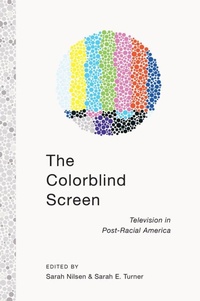
The Colorblind Screen
Television in Post-Racial America
Published on 4. April 2014
Book
Paperback/Softback
363 pages
978-1-4798-9153-5 (ISBN)
Description
The election of President Barack Obama signaled for many the
realization of a post-racial America, a nation in which racism was no longer a
defining social, cultural, and political issue. While many Americans espouse a
"colorblind" racial ideology and publicly endorse the broad goals of
integration and equal treatment without regard to race, in actuality this
attitude serves to reify and legitimize racism and protects racial privileges
by denying and minimizing the effects of systematic and institutionalized
racism.
In The Colorblind Screen, the contributors examine
television's role as the major discursive medium in the articulation and
contestation of racialized identities in the United States. While the dominant
mode of televisual racialization has shifted to a "colorblind" ideology that
foregrounds racial differences in order to celebrate multicultural
assimilation, the volume investigates how this practice denies the significant
social, economic, and political realities and inequalities that continue to
define race relations today. Focusing on such iconic figures as President
Obama, LeBron James, and Oprah Winfrey, many chapters examine the ways in which
race is read by television audiences and fans. Other essays focus on how visual
constructions of race in dramas like 24, Sleeper Cell, and The Wanted
continue to conflate Arab and Muslim identities in post-9/11 television. The
volume offers an important intervention in the study of the televisual
representation of race, engaging with multiple aspects of the mythologies
developing around notions of a "post-racial" America and the duplicitous
discursive rationale offered by the ideology of colorblindness.
realization of a post-racial America, a nation in which racism was no longer a
defining social, cultural, and political issue. While many Americans espouse a
"colorblind" racial ideology and publicly endorse the broad goals of
integration and equal treatment without regard to race, in actuality this
attitude serves to reify and legitimize racism and protects racial privileges
by denying and minimizing the effects of systematic and institutionalized
racism.
In The Colorblind Screen, the contributors examine
television's role as the major discursive medium in the articulation and
contestation of racialized identities in the United States. While the dominant
mode of televisual racialization has shifted to a "colorblind" ideology that
foregrounds racial differences in order to celebrate multicultural
assimilation, the volume investigates how this practice denies the significant
social, economic, and political realities and inequalities that continue to
define race relations today. Focusing on such iconic figures as President
Obama, LeBron James, and Oprah Winfrey, many chapters examine the ways in which
race is read by television audiences and fans. Other essays focus on how visual
constructions of race in dramas like 24, Sleeper Cell, and The Wanted
continue to conflate Arab and Muslim identities in post-9/11 television. The
volume offers an important intervention in the study of the televisual
representation of race, engaging with multiple aspects of the mythologies
developing around notions of a "post-racial" America and the duplicitous
discursive rationale offered by the ideology of colorblindness.
Reviews / Votes
"Collectively the essays document the dominance of colorblind ideology, which, the volume argues, has been enabling the continuation of 'racial apathy.' This volume contributes to postracial discourse and is also a valuable resource for those interested in media criticism." (Choice) "Overall, The Colorblind Screen is a timely anthology that joins a smallbut, I hope, growingnumber of works that address colorblind and post-race discourses in media. This collection demonstrates the continued need to consider the central role television plays in the articulation, construction, and contestation of contemporary racial politics . . . . This collection is essential for anyone interested in exploring current racial politics and representations of racial difference in media." (International Journal of Communication)More details
Language
English
Place of publication
New York
United States
Target group
College/higher education
Professional and scholarly
Product notice
Paperback (trade)
Dimensions
Height: 228 mm
Width: 151 mm
Thickness: 25 mm
Weight
497 gr
ISBN-13
978-1-4798-9153-5 (9781479891535)
Copyright in bibliographic data and cover images is held by Nielsen Book Services Limited or by the publishers or by their respective licensors: all rights reserved.
Schweitzer Classification
Other editions
Additional editions
E-Book
04/2014
1st Edition
New York University Press
€142.99
Available for download
E-Book
04/2014
New York University Press
€30.99
Available for download
Persons
Sarah E. Turner is Senior Lecturer of English at the University of Vermont.
Sarah Nilsen is Associate Professor in Film and Television Studies at the University of Vermont. She is the author of Projecting America: Film and Cultural Diplomacy at the Brussels World's Fair of 1958.
Sarah Nilsen is Associate Professor in Film and Television Studies at the University of Vermont. She is the author of Projecting America: Film and Cultural Diplomacy at the Brussels World's Fair of 1958.
Content
Introduction Sarah Nilsen and Sarah E. TurnerPart I: Theories of Colorblindness1. Shades of ColorblindnessAshley ("Woody") Doane 2. Rhyme and ReasonRoopali Mukherjee3. The End of Racism? Colorblind Racism and Popular Media Eduardo Bonilla-Silva and Austin AshePart II: Icons of Post-Racial America4. Oprah Winfrey5. The Race Denial CardDavid J. Leonard and Bruce Lee Hazelwood 6. Representations of Arabs and Muslims in Post-9/11 Television DramasEvelyn Alsultany7. Maybe Brown People Aren't So Scary If They're Funny ComediesDina IbrahimPart III: Reinscribing Whiteness8. "Some People Just Hide in Plain Sight"Sarah Nilsen9. Watching TV with White SupremacistsC. Richard King10. BBFFsPart IV: Post-Racial Relationships11. Matchmakers and Cultural CompatibilityShilpa Dave12. Mainstreaming Latina IdentityPhilip A. Kretsedemas13. Race in Progress, No Passing ZoneJinny Huh About the Contributors Index