

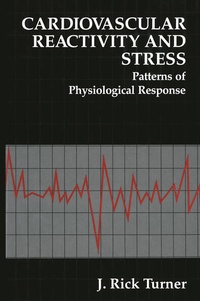
Cardiovascular Reactivity and Stress
Patterns of Physiological Response
Published on 4. June 2013
Book
Paperback/Softback
XX, 236 pages
978-1-4757-9581-3 (ISBN)
Description
This book is an articulate, concise, contemporary introduction to the study of important variables underlying cardiovascular reactivity. Its strength is in the combination of a scholarly but nonpedantic approach to cardiovascular psychophysiology and a solid understanding of be havioral medicine approaches to the study of hypertension. The topics covered are central to the study of relationships between behavior and cardiovascular reactivity; the list of suggested readings at the end of each chapter provides excellent guidance for more detailed study of specific issues. It has now been more than a dozen years since Plenum Press published Paul Obrist's seminal monograph Cardiovascular Psycho physiology. The volume had a major impact in relating cardiovascular regulation to behaving individuals and in developing thoughtful hy potheses concerning such factors as they might pertain to hypertension. The impact of that work extended across scientific disciplines as well as aross continents. At the time the Obrist book was published, a young psychologist, J. Rick Turner, was completing his Ph. D. thesis in psychol ogy at the University of Birmingham, England, on heart rate reactions to psychological challenge. After continued collaboration for the next several years with his former Ph. D. mentor, Douglas Carroll, Turner joined the Obrist laboratory at the University of North Carolina. Al though Obrist unfortunately died during Turner's tenure in the labora tory, collaboration continued with Kathleen Light and Andrew Sher wood. The enlightened legacy of the North Carolina laboratory can clearly be seen in this text.
More details
Series
Edition
Softcover reprint of the original 1st ed. 1994
Language
English
Place of publication
New York
United States
Target group
Professional and scholarly
Research
Product notice
Paperback (trade)
Unsewn / adhesive bound
Illustrations
XX, 236 p.
Dimensions
Height: 229 mm
Width: 152 mm
Thickness: 15 mm
Weight
382 gr
ISBN-13
978-1-4757-9581-3 (9781475795813)
DOI
10.1007/978-1-4757-9579-0
Schweitzer Classification
Other editions
Additional editions
E-Book
06/2013
Springer
€96.29
Available for download
Book
01/1994
Plenum Publishing Co.,N.Y.
€106.99
Shipment within 10-15 days
Person
Dr. Rick Turner is an experimental research scientist, clinical trialist, and author. He was awarded his doctoral degree in the field of Cardiovascular Behavioral Medicine in 1984. His innovative genetic research in that discipline led to 50 peer-reviewed papers, five books, and two international research awards. Fifteen years ago Dr. Turner moved into the pharmaceutical industry, holding positions as a Clinical Submissions Scientist at GlaxoSmithKline and as President and Chief Scientific Officer at Turner Medical Communications LLC. He is now Senior Scientific Director, Cardiac Safety Services, at Quintiles, the world's largest pharmaceutical contract research organization. His work focuses on assessing the cardiac safety of non-cardiac drugs. He has spoken before two FDA Advisory Committees on cardiovascular safety issues, given numerous presentations at international conferences, and published several recent peer-reviewed papers in this field. He is also the senior author of 'Integrated Cardiac Safety: Assessment Methodologies for Noncardiac Drugs in Discovery, Development, and Postmarketing Surveillance' (Turner and Durham, 2009).
Content
I: Orientation: Concepts, Systems, and Methods.- 1. Cardiovascular Reactivity and Stress: Introduction and Overview.- 2: The Nervous, Endocrine, and Cardiovascular Systems.- 3. Modeling Stress and Assessing Reactivity in the Laboratory.- 4. Hypertension: The Disease and the Possible Influence of Stress Responses in Its Development.- II. Laboratory Investigation of Cardiovascular Reactivity.- 5. Individual Differences in Cardiovascular Reactivity.- 6. Cardiac-Metabolic Dissociation: Additional Heart Rates during Psychological Stress.- 7. Genetic Determinants of Individual Differences in Cardiovascular Reactivity.- 8. Constitutional, Renal, and Personality Factors as Contributors to Individual Differences in Reactivity.- III. Everyday Reactivity and Risk for Cardiovascular Disease.- 9. Laboratory-Field Generalization of Cardiovascular Activity.- 10. The Risk Identification Protocol.- 11. Other Areas of Cardiovascular Reactivity and Behavioral Medicine Research and Some Final Thoughts.- References.