

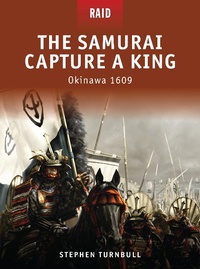
The Samurai Capture a King
Okinawa 1609
Published on 10. November 2009
Book
Paperback/Softback
64 pages
978-1-84603-442-8 (ISBN)
Description
A brilliant but little-known operation, the Shimazu clan raid on the independent kingdom of Rykyu (modern Okinawa) in 1609 is one of the most extraordinary episodes in samurai history and the culmination of centuries of rivalry between the two powers. The defeat of the Shimazu at Sekigahara in 1600, and their need to win favour with the new Shogun, led them to hatch an audacious plot to attack the islands on the Shogun's behalf and bring back the king of Rykyu as a hostage. Stephen Turnbull gives a blow-by-blow account of the operation, from the daring Shimazu amphibious landing, to their rapid advance overland, and the tactical feigned retreat that saw the Shimazu defeat the Okinawan army and kidnap their king in spectacular fashion. With a detailed background and specially commissioned artwork, the scene is set for a dramatic retelling of this fascinating raid.
More details
Series
Language
English
Place of publication
United Kingdom
Publishing group
Bloomsbury Publishing PLC
Product notice
Paperback (trade)
sewn/stitched
Illustrations
20 b/w; 20 col
Dimensions
Height: 248 mm
Width: 187 mm
Thickness: 7 mm
Weight
202 gr
ISBN-13
978-1-84603-442-8 (9781846034428)
Copyright in bibliographic data and cover images is held by Nielsen Book Services Limited or by the publishers or by their respective licensors: all rights reserved.
Schweitzer Classification
Other editions
Additional editions
E-Book
12/2011
1st Edition
Osprey Publishing
€15.49
Available for download
E-Book
12/2011
1st Edition
Osprey Publishing
€15.49
Available for download
Persons
Stephen Turnbull took his first degree at Cambridge University, and received a PhD from Leeds University for his work on Japanese religious history. He has travelled extensively in Europe and the Far East and also runs a well-used picture library. His work has been recognised by the awarding of the Canon Prize of the British Association for Japanese Studies and a Japan Festival Literary Award. He currently divides his time between lecturing in Japanese Religion at the University of Leeds and writing.
Donato Spedaliere was born in Lausanne, Switzerland, and moved to Tuscany, Italy, at the age of 10, where he still resides. He has studied in Florence, and served in the Italian Army as a paratrooper. Since 1995 he has worked as a professional, freelance, illustrator for publishers in Italy and abroad. His artworks are to be find in many books, encyclopaedias, magazines and museum collections as well. Recently he has cooperated at the realisation of two movies, with concept designs and matte paintings as well, as acting as the supervisor of the Special Effects Team for the film Obulus. Richard Hook was born in 1938 and trained at Reigate College of Art. After national service with 1st Bn, Queen's Royal Regiment, he became art editor of the much-praised magazine Finding Out during the 1960s. He has worked as a freelance illustrator ever since, earning an international reputation particularly for his deep knowledge of Native American material culture; and has illustrated more than 50 Osprey titles. Richard is married and lives in Sussex; his three children Adam, Jason, and Christa are all professionally active in various artistic disciplines.
Donato Spedaliere was born in Lausanne, Switzerland, and moved to Tuscany, Italy, at the age of 10, where he still resides. He has studied in Florence, and served in the Italian Army as a paratrooper. Since 1995 he has worked as a professional, freelance, illustrator for publishers in Italy and abroad. His artworks are to be find in many books, encyclopaedias, magazines and museum collections as well. Recently he has cooperated at the realisation of two movies, with concept designs and matte paintings as well, as acting as the supervisor of the Special Effects Team for the film Obulus. Richard Hook was born in 1938 and trained at Reigate College of Art. After national service with 1st Bn, Queen's Royal Regiment, he became art editor of the much-praised magazine Finding Out during the 1960s. He has worked as a freelance illustrator ever since, earning an international reputation particularly for his deep knowledge of Native American material culture; and has illustrated more than 50 Osprey titles. Richard is married and lives in Sussex; his three children Adam, Jason, and Christa are all professionally active in various artistic disciplines.
Content
Introduction
Origins
The Plan
The Raid
Aftermath
Analysis
Further Reading