

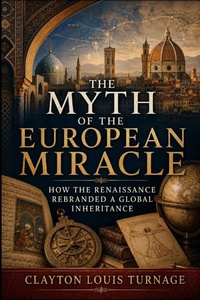
The Myth of the European Miracle
Description
For centuries, the Western Renaissance has been remembered as Europe's great awakening - the moment when art, science, philosophy, medicine, mathematics, and discovery returned after a long age of darkness.
But what if that story is too small?
Before Florence, there was Baghdad. Before European universities became centers of learning, Arabic and Latin translators carried vast libraries of knowledge across borders. Before Renaissance medicine, Islamic and Persian physicians had built systems of diagnosis, treatment, hospitals, and pharmacology. Before Europe celebrated algebra, astronomy, optics, and philosophy as pillars of modern genius, many of those foundations had already been developed, preserved, challenged, and transformed in the Persianate and Islamic worlds.
The Myth of the European Miracle is the capstone volume in the Before the Renaissance series. It asks a bold question: how did a shared global inheritance become remembered as a mostly European achievement?
This book does not deny Europe's brilliance. The Renaissance produced extraordinary artists, scholars, scientists, navigators, printers, and philosophers. Europe did something powerful with the knowledge it inherited. It translated, organized, taught, printed, criticized, amplified, and transformed older traditions into new forms of historical force.
But Europe did not create from nothing.
This book reveals how the Renaissance was shaped by centuries of transmission: Persian scholarship, Islamic science, Greek philosophy, Indian mathematics, Jewish intermediaries, Syriac translators, Byzantine preservation, Mediterranean trade, and Latin European institutions all formed part of the chain. It shows how translation made knowledge available, how universities turned inherited texts into European curriculum, how printing made old knowledge look newly born, and how empire later rewrote memory to make Europe appear self-made.
The result is not a smaller Renaissance.
It is a larger one.
Readable, dramatic, and historically serious, The Myth of the European Miracle challenges the familiar story of Western genius and restores the forgotten roads that carried knowledge from East to West. It is a book about memory, credit, inheritance, and the danger of mistaking power for originality.
The Renaissance did not begin when Europe invented genius.
It began when Europe entered, absorbed, transformed, and eventually claimed a conversation that had already crossed half the world.
For readers interested in world history, Islamic civilization, Persian influence, the Renaissance, the history of science, and the hidden origins of Western thought, this book offers a powerful new lens on one of history's most celebrated awakenings.