

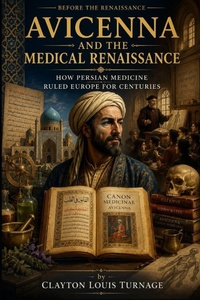
Avicenna and the Medical Renaissance
Description
Before Europe had a medical Renaissance, it had Avicenna.
For centuries, European medicine did not begin with a microscope, a laboratory, or a modern hospital. It began with books. And among the most important of those books was the Canon of Medicine, written by the Persian physician-philosopher Ibn Sina - known to the Latin West as Avicenna.
Long before Renaissance anatomists challenged ancient authority, long before modern science transformed the body into a world of cells, microbes, circulation, chemistry, and disease mechanisms, Avicenna gave medicine something it desperately needed: order.
His Canon gathered Greek inheritance, Persianate scholarship, Islamic medical practice, pharmacology, diagnosis, regimen, and philosophy into one of the most influential medical systems ever written. It crossed from Arabic into Latin, entered European universities, shaped medical education, and helped train generations of physicians.
This book tells the forgotten story of how a Persian Muslim thinker became one of the hidden architects of European medicine.
Avicenna and the Medical Renaissance reveals how Europe inherited far more than it later remembered. It follows the Canon of Medicine from the Persianate world of Islam into the classrooms of Christian Europe, showing how Avicenna's ideas about the body, disease, diagnosis, drugs, and treatment helped shape the learned medical tradition for centuries.
This is not a story about denying Europe's medical achievements. Renaissance anatomy, surgery, printing, clinical observation, and later modern science transformed medicine in ways Avicenna could not have imagined.
But Europe did not begin from nothing.
Before it surpassed Avicenna, it studied him.
For readers interested in the Islamic Golden Age, Persian history, medical history, Renaissance origins, forgotten science, and the hidden foundations of Western civilization, this book restores a missing chapter in the story of medicine.
The Renaissance did not create healing out of silence.
It inherited a Persian voice already waiting on the page.