

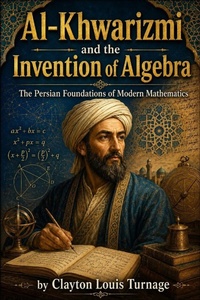
Al-Khwarizmi and the Invention of Algebra
Description
The modern world runs on algorithms.
But hidden inside the word algorithm is the name of a forgotten Persianate scholar from the Islamic Golden Age: Muhammad ibn Musa al-Khwarizmi.
Long before computers, artificial intelligence, search engines, banking software, engineering systems, or digital code, al-Khwarizmi helped give civilization something even more powerful than calculation itself: method. His work organized algebra, explained calculation with Hindu-Arabic numerals, and helped create mathematical tools that would later pass into Europe through translation, trade, and scholarship.
The West often tells the story of the Renaissance as if Europe suddenly awakened by itself.
But before Europe could calculate like the modern world, it had to inherit better numbers. Before Renaissance mathematicians could expand algebra, algebra had already been named and systematized in Arabic. Before the algorithm became the language of machines, al-Khwarizmi's name had already become associated with step-by-step calculation.
Al-Khwarizmi and the Invention of Algebra reveals the forgotten eastern foundation beneath Western mathematics. From Baghdad's scholarly culture to Latin translation, from Hindu-Arabic numerals to commercial arithmetic, from algebraic equations to the rise of the calculating age, this book traces how one scholar from the world before the Renaissance helped shape the future of science, technology, engineering, finance, and computation.
This is not a story about one man inventing everything.
It is a story about something even more important: how knowledge travels.
Al-Khwarizmi inherited Indian numerals, Greek geometry, Babylonian computation, Persian administrative culture, and the practical needs of Islamic law and commerce. His genius was synthesis. He turned scattered mathematical traditions into organized methods that could be taught, copied, translated, and used across civilizations.
Europe later transformed those methods in powerful ways.
But it did not create them from nothing.
For readers interested in hidden history, mathematics, science, the Islamic Golden Age, Persian influence, the Renaissance, and the forgotten origins of modern technology, this book offers a bold and accessible look at one of history's most important intellectual bridges.
The Renaissance did not invent the unknown.
It inherited the tools to solve it.