

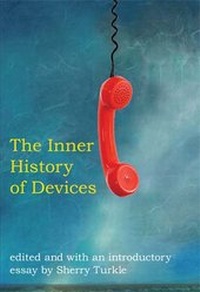
The Inner History of Devices
Published on 1. October 2008
Book
Hardback
224 pages
978-0-262-20176-6 (ISBN)
Description
For more than two decades, in such landmark studies as The Second Self and Life on
the Screen, Sherry Turkle has challenged our collective imagination with her insights about how
technology enters our private worlds. In The Inner History of Devices, she describes her process, an
approach that reveals how what we make is woven into our ways of seeing ourselves. She brings
together three traditions of listening--that of the memoirist, the clinician, and the ethnographer.
Each informs the others to compose an inner history of devices. We read about objects ranging from
cell phones and video poker to prosthetic eyes, from Web sites and television to dialysis machines.
In an introductory essay, Turkle makes the case for an "intimate ethnography" that
challenges conventional wisdom. One personal computer owner tells Turkle: "This computer means
everything to me. It's where I put my hope." Turkle explains that she began that conversation
thinking she would learn how people put computers to work. By its end, her question has changed:
"What was there about personal computers that offered such deep connection? What did a computer
have that offered hope?" The Inner History of Devices teaches us to listen for the answer. In
the memoirs, ethnographies, and clinical cases collected in this volume, we read about an American
student who comes to terms with her conflicting identities as she contemplates a cell phone she used
in Japan ("Tokyo sat trapped inside it"); a troubled patient who uses email both to
criticize her therapist and to be reassured by her; a compulsive gambler who does not want to win
steadily at video poker because a pattern of losing and winning keeps her more connected to the body
of the machine. In these writings, we hear untold stories. We learn that received wisdom never goes
far enough.
the Screen, Sherry Turkle has challenged our collective imagination with her insights about how
technology enters our private worlds. In The Inner History of Devices, she describes her process, an
approach that reveals how what we make is woven into our ways of seeing ourselves. She brings
together three traditions of listening--that of the memoirist, the clinician, and the ethnographer.
Each informs the others to compose an inner history of devices. We read about objects ranging from
cell phones and video poker to prosthetic eyes, from Web sites and television to dialysis machines.
In an introductory essay, Turkle makes the case for an "intimate ethnography" that
challenges conventional wisdom. One personal computer owner tells Turkle: "This computer means
everything to me. It's where I put my hope." Turkle explains that she began that conversation
thinking she would learn how people put computers to work. By its end, her question has changed:
"What was there about personal computers that offered such deep connection? What did a computer
have that offered hope?" The Inner History of Devices teaches us to listen for the answer. In
the memoirs, ethnographies, and clinical cases collected in this volume, we read about an American
student who comes to terms with her conflicting identities as she contemplates a cell phone she used
in Japan ("Tokyo sat trapped inside it"); a troubled patient who uses email both to
criticize her therapist and to be reassured by her; a compulsive gambler who does not want to win
steadily at video poker because a pattern of losing and winning keeps her more connected to the body
of the machine. In these writings, we hear untold stories. We learn that received wisdom never goes
far enough.
More details
Language
English
Place of publication
Cambridge, Mass.
United States
Publishing group
MIT Press Ltd
Target group
Adult education
Illustrations
4 s/w Photographien bzw. Rasterbilder
4 b&w photos
Dimensions
Height: 203 mm
Width: 127 mm
Thickness: 0 mm
Weight
431 gr
ISBN-13
978-0-262-20176-6 (9780262201766)
Copyright in bibliographic data and cover images is held by Nielsen Book Services Limited or by the publishers or by their respective licensors: all rights reserved.
Schweitzer Classification
Other editions
New editions
Sherry Turkle
The Inner History of Devices
Book
09/2011
MIT Press
€36.60
Article exhausted; check different version
Additional editions
Sherry Turkle
The Inner History of Devices
Book
09/2011
MIT Press
€36.60
Article exhausted; check different version
Persons
Sherry Turkle is Abby Rockefeller Mauzé Professor of the Social Studies of Science and Technology at MIT and Founder and Director of the MIT Initiative on Technology and Self. A psychoanalytically trained sociologist and psychologist, she is the author of The Second Self: Computers and the Human Spirit (Twentieth Anniversary Edition, MIT Press), Life on the Screen: Identity in the Age of the Internet, and Psychoanalytic Politics: Jacques Lacan and Freud's French Revolution. She is the editor of Evocative Objects: Things We Think With (MIT Press) and Falling for Science: Objects in Mind (MIT Press).