

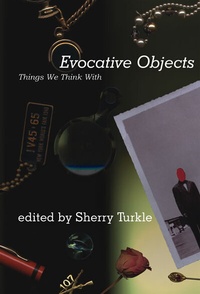
Evocative Objects
Things We Think with
Published on 2. July 2007
Book
Hardback
400 pages
978-0-262-20168-1 (ISBN)
Description
For Sherry Turkle, "We think with the objects we love; we love the
objects we think with." In Evocative Objects, Turkle collects writings by
scientists, humanists, artists, and designers that trace the power of everyday
things. These essays reveal objects as emotional and intellectual companions that
anchor memory, sustain relationships, and provoke new ideas.These days, scholars
show new interest in the importance of the concrete. This volume's special
contribution is its focus on everyday riches: the simplest of objects--an apple, a
datebook, a laptop computer--are shown to bring philosophy down to earth. The poet
contends, "No ideas but in things." The notion of evocative objects goes further:
objects carry both ideas and passions. In our relations to things, thought and
feeling are inseparable.Whether it's a student's beloved 1964 Ford Falcon (left
behind for a station wagon and motherhood), or a cello that inspires a meditation on
fatherhood, the intimate objects in this collection are used to reflect on larger
themes--the role of objects in design and play, discipline and desire, history and
exchange, mourning and memory, transition and passage, meditation and new vision.In
the interest of enriching these connections, Turkle pairs each autobiographical
essay with a text from philosophy, history, literature, or theory, creating
juxtapositions at once playful and profound. So we have Howard Gardner's keyboards
and Lev Vygotsky's hobbyhorses; William Mitchell's Melbourne train and Roland
Barthes' pleasures of text; Joseph Cevetello's glucometer and Donna Haraway's
cyborgs. Each essay is framed by images that are themselves evocative. Essays by
Turkle begin and end the collection, inviting us to look more closely at the
everyday objects of our lives, the familiar objects that drive our routines, hold
our affections, and open out our world in unexpected ways.
objects we think with." In Evocative Objects, Turkle collects writings by
scientists, humanists, artists, and designers that trace the power of everyday
things. These essays reveal objects as emotional and intellectual companions that
anchor memory, sustain relationships, and provoke new ideas.These days, scholars
show new interest in the importance of the concrete. This volume's special
contribution is its focus on everyday riches: the simplest of objects--an apple, a
datebook, a laptop computer--are shown to bring philosophy down to earth. The poet
contends, "No ideas but in things." The notion of evocative objects goes further:
objects carry both ideas and passions. In our relations to things, thought and
feeling are inseparable.Whether it's a student's beloved 1964 Ford Falcon (left
behind for a station wagon and motherhood), or a cello that inspires a meditation on
fatherhood, the intimate objects in this collection are used to reflect on larger
themes--the role of objects in design and play, discipline and desire, history and
exchange, mourning and memory, transition and passage, meditation and new vision.In
the interest of enriching these connections, Turkle pairs each autobiographical
essay with a text from philosophy, history, literature, or theory, creating
juxtapositions at once playful and profound. So we have Howard Gardner's keyboards
and Lev Vygotsky's hobbyhorses; William Mitchell's Melbourne train and Roland
Barthes' pleasures of text; Joseph Cevetello's glucometer and Donna Haraway's
cyborgs. Each essay is framed by images that are themselves evocative. Essays by
Turkle begin and end the collection, inviting us to look more closely at the
everyday objects of our lives, the familiar objects that drive our routines, hold
our affections, and open out our world in unexpected ways.
More details
Language
English
Place of publication
Cambridge, Mass.
United States
Publishing group
MIT Press Ltd
Target group
Professional and scholarly
Illustrations
70 illus.
Dimensions
Height: 203 mm
Width: 127 mm
Thickness: 0 mm
Weight
635 gr
ISBN-13
978-0-262-20168-1 (9780262201681)
Copyright in bibliographic data and cover images is held by Nielsen Book Services Limited or by the publishers or by their respective licensors: all rights reserved.
Schweitzer Classification
Other editions
New editions
Book
09/2011
01st Edition
MIT Press
€27.90
Article exhausted; check different version
Additional editions
E-Book
09/2011
MIT Press
€29.49
Available for download
Person
Sherry Turkle is Abby Rockefeller Mauzé Professor of the Social Studies of Science and Technology at MIT and Founder and Director of the MIT Initiative on Technology and Self.