

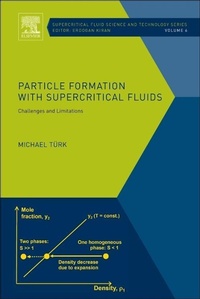
Particle Formation with Supercritical Fluids: Volume 6
Challenges and Limitations
Published on 7. November 2014
Book
Hardback
152 pages
978-0-444-59486-0 (ISBN)
Description
Particle formation with supercritical fluids is a promising alternative to conventional precipitation processes as it allows the reduction of particle size and control of morphology and particle size distribution without degradation or contamination of the product. The book comprehensively examines the current status of research and development and provides perspectives and insights on promising future directions.
The introduction to high pressure and high temperature phase equilibria and nucleation phenomena provides the basic principles of the underlying physical and chemical phenomena, allowing the reader an understanding of the relationship between process conditions and particle characteristics.
Bridging the gap between theory and application, the book imparts the scientific and engineering fundamentals for innovative particle formation processes. The interdisciplinary "modus operandi" will encourage cooperation between scientists and researchers from different but complementary disciplines.
The introduction to high pressure and high temperature phase equilibria and nucleation phenomena provides the basic principles of the underlying physical and chemical phenomena, allowing the reader an understanding of the relationship between process conditions and particle characteristics.
Bridging the gap between theory and application, the book imparts the scientific and engineering fundamentals for innovative particle formation processes. The interdisciplinary "modus operandi" will encourage cooperation between scientists and researchers from different but complementary disciplines.
More details
Series
Language
English
Place of publication
Oxford
United Kingdom
Publishing group
Elsevier Science & Technology
Target group
College/higher education
Professional and scholarly
Chemical engineers, materials scientist, chemists and physicists from both academia and industry
Product notice
sewn/stitched
Cloth over boards
Dimensions
Height: 238 mm
Width: 154 mm
Thickness: 15 mm
Weight
388 gr
ISBN-13
978-0-444-59486-0 (9780444594860)
Copyright in bibliographic data and cover images is held by Nielsen Book Services Limited or by the publishers or by their respective licensors: all rights reserved.
Schweitzer Classification
Other editions
Additional editions
E-Book
11/2014
Elsevier
€175.00
Available for download
Person
Michael Tuerk received his Dipl.-Ing. degree in Chemical Engineering from the Universitaet Karlsruhe (Technische Hochschule). In 1993 M. Tuerk completed his PhD thesis in the field of thermodynamic properties and intermolecular interactions of binary gaseous mixtures. In his professorial dissertation of 2001 a theory was proposed allowing understanding of the relationship between process conditions and the properties of organic particles produced by supercritical fluid based processes. His current research activities are focused on the use of supercritical fluids (mainly CO2 and H2O) as media to prepare organic, inorganic and metallic materials by physical transformation or chemical reaction and the development of new, energy-efficient and environmentally-friendly strategies to create novel products with extraordinary performance for pharmaceutical, energy and biomedical applications. So far, M. Tuerk has authored 125 articles (including 13 book chapters); has graduated 20 PhD students (10 as supervisor and 10 as co-advisor) and more than 50 Diploma / Master and 15 Bachelor students.
Content
1. Introduction 2. Fundamentals 3. Basics of particle formation processes4. Formation of organic particles using a supercritical fluid as solvent 5. Formation of organic particles using a supercritical fluid as anti-solvent 6. Formation of organic particles using a supercritical fluid as solute 7. Formation of inorganic particles using a supercritical fluid as reaction media8. State of the art modeling particle formation in supercritical fluids 9. Conclusions