

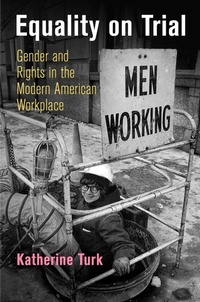
Equality on Trial
Gender and Rights in the Modern American Workplace
Published on 8. March 2019
Book
Paperback/Softback
296 pages
978-0-8122-2440-5 (ISBN)
Description
In 1964, as part of its landmark Civil Rights Act, Congress outlawed workplace discrimination on the basis of such personal attributes as sex, race, and religion. This provision, known as Title VII, laid a new legal foundation for women's rights at work. Though President Kennedy and other lawmakers expressed high hopes for Title VII, early attempts to enforce it were inconsistent. In the absence of a consensus definition of sex equality in the law or society, Title VII's practical meaning was far from certain.
The first history to foreground Title VII's sex provision, Equality on Trial examines how the law's initial promise inspired a generation of Americans to dispatch expansive notions of sex equality. Imagining new solidarities and building a broad class politics, these workers and activists engaged Title VII to generate a pivotal battle over the terms of democracy and the role of the state in all labor relationships. But the law's ambiguity also allowed for narrow conceptions of sex equality to take hold. Conservatives found ways to bend Title VII's possible meanings to their benefit, discovering that a narrow definition of sex equality allowed businesses to comply with the law without transforming basic workplace structures or ceding power to workers. These contests to fix the meaning of sex equality ultimately laid the legal and cultural foundation for the neoliberal work regimes that enabled some women to break the glass ceiling as employers lowered the floor for everyone else.
Synthesizing the histories of work, social movements, and civil rights in the postwar United States, Equality on Trial recovers the range of protagonists whose struggles forged the contemporary meanings of feminism, fairness, and labor rights.
The first history to foreground Title VII's sex provision, Equality on Trial examines how the law's initial promise inspired a generation of Americans to dispatch expansive notions of sex equality. Imagining new solidarities and building a broad class politics, these workers and activists engaged Title VII to generate a pivotal battle over the terms of democracy and the role of the state in all labor relationships. But the law's ambiguity also allowed for narrow conceptions of sex equality to take hold. Conservatives found ways to bend Title VII's possible meanings to their benefit, discovering that a narrow definition of sex equality allowed businesses to comply with the law without transforming basic workplace structures or ceding power to workers. These contests to fix the meaning of sex equality ultimately laid the legal and cultural foundation for the neoliberal work regimes that enabled some women to break the glass ceiling as employers lowered the floor for everyone else.
Synthesizing the histories of work, social movements, and civil rights in the postwar United States, Equality on Trial recovers the range of protagonists whose struggles forged the contemporary meanings of feminism, fairness, and labor rights.
Reviews / Votes
"Turk explains how sex equality at work came to be defined as women's access to the same jobs as men, with no acknowledgment of differences due to motherhood or consideration of the unpaid labor necessary to care for a family. . . . Turk's innovative and deeply researched book is essential reading for anyone interested in the history of women's labor and social policy."-American Historical Review"A truly original, deeply researched, eye-opening new account of the last half century of U.S. history that puts the struggle over gender and economic justice at its center."-Dorothy Sue Cobble, Rutgers University
"Exhaustively researched and cogently argued, Equality on Trial transforms how we think of the 1964 Civil Rights Act's inclusion of sex."-Eileen Boris, University of California Santa Barbara
"An extraordinary and extraordinarily important piece of scholarly work. Katherine Turk's Equality on Trial is a stunning achievement: deeply researched, powerfully argued, brilliantly elaborated, attentive to detail, nuance, complexity and contradiction, and never losing sight of the individual lives and livelihood at stake."-Barbara Welke, University of Minnesota
More details
Series
Language
English
Place of publication
Pennsylvania
United States
Target group
College/higher education
Product notice
Paperback (trade)
Illustrations
11 illus.
Dimensions
Height: 229 mm
Width: 152 mm
Thickness: 17 mm
Weight
435 gr
ISBN-13
978-0-8122-2440-5 (9780812224405)
Copyright in bibliographic data and cover images is held by Nielsen Book Services Limited or by the publishers or by their respective licensors: all rights reserved.
Schweitzer Classification
Other editions
Additional editions
E-Book
04/2016
1st Edition
University of Pennsylvania Press
€28.99
Available for download
Person
Katherine Turk is Associate Professor of History and Adjunct Associate Professor of Women's and Gender Studies at the University of North Carolina, Chapel Hill.
Content
Introduction. Notions of Sex Equality
Chapter 1. Defining Sex Discrimination
Chapter 2. Class and Class Action
Chapter 3. Feminism and Workplace Fairness
Chapter 4. Reevaluating Women's Work
Chapter 5. Sex Equality and the Service Sector
Chapter 6. A Man's World, but Only for Some
Chapter 7. Opting Out or Buying In
Conclusion. Illusions of Sex Equality
List of Abbreviations
Notes
Index
Acknowledgments
Chapter 1. Defining Sex Discrimination
Chapter 2. Class and Class Action
Chapter 3. Feminism and Workplace Fairness
Chapter 4. Reevaluating Women's Work
Chapter 5. Sex Equality and the Service Sector
Chapter 6. A Man's World, but Only for Some
Chapter 7. Opting Out or Buying In
Conclusion. Illusions of Sex Equality
List of Abbreviations
Notes
Index
Acknowledgments