

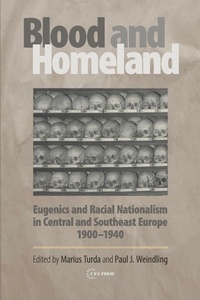
Blood and Homeland
Eugenics and Racial Nationalism in Central and Southeast Europe, 1900-1940
Published on 11. January 2006
Book
Paperback/Softback
476 pages
978-963-7326-81-3 (ISBN)
Description
The history of eugenics and racial nationalism in Central and Southeast Europe is a neglected topic of analysis in contemporary scholarship. The 20 essays in this volume, written by distinguished scholars of eugenics and fascism alongside a new generation of scholars, excavate the hitherto unknown eugenics movements in Central and Southeast Europe, including Austria and Germany. Eugenics and racial nationalism are topics that have constantly been marginalized and rated as incompatible with local national traditions in Central and Southeast Europe. These topics receive a new treatment here. On the one hand, the historiographic perspective connects developments in the history of anthropology and eugenics with political ideologies such as racial nationalism and anti-Semitism; on the other hand, it contests the 'Sonderweg' approach adopted by scholars dealing with these issues.
Reviews / Votes
"These essays make the convincing argument that race was more important in Eastern Europe, compared with eugenics in other parts of the world, and that the region's political leaders believed that racial nationalism was the key to creating national identity, thus their support to the science of better breeding. Summing up: recommended for upper-division undergraduates and above." * Choice * "The editors tell us that in Central and Eastern Europe, eugenics and national racism were the cornerstones used in building the nation and the state. Far from giving in to the siren call of the forces of reaction, this 'parti de la nature', as Claude Levi-Strauss calls it, brought together two modern and highly toxic substances: eugenics and ultra nationalism." * Medical History * "Filled with new information and original ideas and offering intriguing incentives for further research, this well-edited volume is not only a remarkable edition to the literature on European eugenics but provides invaluable insights into the broader currents of intellectual life in central and southeast Europe." * Slavic Review * "Bisher kaum bekannt war die Entwicklung der Eugenik in den ostmitteleuropaeischen Staaten. Marius Turda und Paul J. Weindling haben sich dieses weissen Flecks angenommen und bieten mit ihrem Sammelband einen umfangreichen UEberblick zu verschiedenen Aspekten und Tendenzen in den Laendern von OEsterreich bis Rumaenien und von Estland bis nach Bulgarien. Waehrend die Forschung zur Eugenik meist im Bereich der Medizinalgeschichte oder im Kontext des Nationalsozialismus abgehandelt wird, gehen die Autoren des Buches der Frage in einem allgemeinhistorischen Zusammenhang nach: Wie beeinflusste eugenisches Denken die Ausformung der Nationalismen in den jungen Staaten des 'Cordon sanitaire' oder konstituierte ihn gar? Der Sammelband is nicht nur ein aufschlussreiches Kompendium, er wird ein Standardwerk zum Thema Eugenik in Ostmitteleuropa bleiben." * Jahrbuecher fuer Geschichte Osteuropas * "The Central European University Press is to be congratulated for publishing two outstanding scholarly analyses of the root causes of anti-Roma racism, which is rapidly taking center stage in the drama of the East European transition process. The books (Blood and Homeland and The Roma in Romanian History) fill a large gap in urgently needed knowledge. They may well become essential research tools for politicians and social and educational planning departments that are approaching the challenge of European integration. The books will be useful also for university courses in history, sociology, and politics, as well as Holocaust and genocide studies." * Transitions Online *More details
Language
English
Place of publication
Budapest
Hungary
Target group
Professional and scholarly
Academic
Product notice
Paperback (trade)
Unsewn / adhesive bound
Dimensions
Height: 229 mm
Width: 152 mm
Thickness: 26 mm
Weight
686 gr
ISBN-13
978-963-7326-81-3 (9789637326813)
Copyright in bibliographic data and cover images is held by Nielsen Book Services Limited or by the publishers or by their respective licensors: all rights reserved.
Schweitzer Classification
Other editions
Additional editions
Marius Turda | Paul J. Weindling
Blood and Homeland
Eugenics and Racial Nationalism in Central and Southeast Europe, 1900-1940
Book
11/2006
Central European University Press
€169.50
Available (delivery time upon request)
Marius Turda | Paul J. Weindling
Blood and Homeland
Eugenics and Racial Nationalism in Central and Southeast Europe, 1900-1940
E-Book
11/2006
1st Edition
Central European University Press
€33.99
Available for download
Persons
Marius Turda is Professor in 20th Century Central and Eastern European Biomedicine at Oxford Brookes University. He is Director of the Centre for Medical Humanities.
Paul J. Weindling is Wellcome Trust Research Professor in the History of Medicine at Oxford Brookes University.
Paul J. Weindling is Wellcome Trust Research Professor in the History of Medicine at Oxford Brookes University.
Content
Introduction, Marius Turda and Paul Weindling: Eugenics, Race and Nation in Central and Southeast Europe, 1900-1940 Part I. Ethnography and Racial Anthropology Egbert Klautke: German "Race Psychology" and Its Implementation in Central Europe: Egon von Eickstedt and Rudolf Hippius Margit Berner: From "Prisoners of War Studies" to Proof of Paternity: Racial Anthropologists and the Measuring of "Others" in Austria Maria Teschler-Nicola: "Volksdeutsche" and Racial Anthropology in Interwar Vienna: The "Marienfeld Project" Rory Yeomans, Of Yugoslav Barbarians and Croatian Gentlemen Scholars: Nationalist Ideology and Racial Anthropology in Interwar Yugoslavia Sevasti Trubeta: Anthropological Discourse and Eugenics in Interwar Greece Part II. Eugenics and Racial Hygiene in National Contexts Michal Simunek, Between "Eugenics" and "Racial Hygiene": Plans for the Regulation of Human Heredity in the Czech Lands, 1900-1925 Magdalena Gavin, Progressivism and Eugenic Thinking in Poland, 1905-1939 Marius Turda, "Faj egeszsegtana" or "Eugenika"? The First Debates on Eugenics in Hungary, 1910-1918 Christian Promitzer, Taking Care of the National Body: Eugenic Visions in Interwar Bulgaria, 1905-1940 Ken Kalling, The Self Perception of A Small Nation: The Reception of Eugenics in Interwar Estonia Paul J. Weindling, Central Europe Confronts German Racial Hygiene: Friedrich Hertz, Hugo Iltis and Ignaz Zollschan as Critics of Racial Hygiene Part III. Religion, Public Health and Population Policies Kamila Uzarczyk, "Moses als Eugeniker"? The Reception of Eugenic Ideas in Jewish Medical Circles in Interwar Poland Monica Loescher: Eugenics and the Catholic Church in Interwar Austria Sabine Schleiermacher, Eugenics and Protestantism: Public Health, Population Policy and Protestant Welfare Organisations during the Weimar Republic Herwig Czech, From Welfare to Selection: Vienna's Public Health Office and the Implementation of Racial Hygiene Politics under the Nazi Regime Maria Bucur, Fallen Women and Necessary Evils: Eugenic Representations of Prostitution in Interwar Romania Part IV. Anti-Semitism, Nationalism and Biopolitics Razvan Paraianu, Culturalist Nationalism and Anti-Semitism in Fin-de-Siecle Romania Attila Pok, The Politics of Hatred: Scapegoating in Interwar Hungary Aristotle Kallis, Racialist Politics and Bio-Medical Totalitarianism in Interwar Europe Roger Griffin, Tunnel Visions and Mysterious Trees: Modernist Projects of National and Racial Regeneration, 1880-1939