

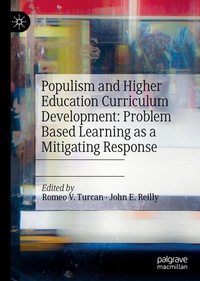
Populism and Higher Education Curriculum Development: Problem Based Learning as a Mitigating Response
Problem Based Learning as a Mitigating Response
Published on 22. November 2020
Book
Hardback
XXXVI, 446 pages
978-3-030-47375-4 (ISBN)
Description
Against a background of increasing inequality and a rising tide of nationalism and populism, this book raises concerns that curriculum is being shaped by powerful non-academic, non-accountable forces and that populism - and its manifestations - represent a grave challenge to learning. It explores the extent to which curriculum and learning methods in higher education should respond to this challenge. Using problem based learning as a case study it draws on crossdisciplinary studies to examine how regional, national and organizational perspectives emphasize different aspects of PBL. It questions whether PBL provides an effective response to external influences and a 'populist' highereducation agenda. In conclusion the book poses an uncomfortable question whether graduates reflect the external forces shaping curriculum and hence may be as vulnerable to populist rhetoric as non-graduates precisely because the curriculum and learning methods do not engage with the challenges. This book will appeal to scholars of problem based learning, as well as populism and therole of higher education in society.
Reviews / Votes
"Writing in the midst of the Covid 19 pandemic, it is arresting to read a book that identifies the challenge of a totally different type of pandemic - Populism - and the threat which it poses to the academic world. This is a timely, thought provoking book precisely because it is searching for a type of academic vaccine to the undermining threats of populism, which will require wholehearted engagement to achieve."- Professor Ilan Alon , Department of Management, University of Agder, Norway"Turcan and Reilly have crystallised what people working in and around higher education have begun to feel. In the book, the seismic shifts affecting the top tiers of academe are laid bare and their consequences on the sector explored. The range of voices brought together in the volume lead to recommended priorities and possible pathways for those engaged in curriculum design, learning development, research, and research dissemination."- Dr Simon Haslam , Visiting Fellow, Durham University Business School, UK
More details
Edition
2020 ed.
Language
English
Place of publication
Cham
Switzerland
Publishing group
Springer International Publishing
Target group
Professional and scholarly
Illustrations
16 s/w Abbildungen
XXXVI, 446 p. 16 illus.
Dimensions
Height: 216 mm
Width: 153 mm
Thickness: 31 mm
Weight
733 gr
ISBN-13
978-3-030-47375-4 (9783030473754)
DOI
10.1007/978-3-030-47376-1
Schweitzer Classification
Other editions
Additional editions
Romeo V. Turcan | John E. Reilly
Populism and Higher Education Curriculum Development: Problem Based Learning as a Mitigating Response
Book
11/2021
Palgrave Macmillan
€139.09
Shipment within 7-9 days
Romeo V. Turcan | John E. Reilly
Populism and Higher Education Curriculum Development: Problem Based Learning as a Mitigating Response
E-Book
11/2020
1st Edition
Palgrave Macmillan
€128.39
Available for download
Persons
Romeo V. Turcan
is Professor of International Entrepreneurship and Organization Theory at the Aalborg University Business School in Denmark. Romeo's research interests relate to creation and legitimation of new sectors and new organizations; high impact international entrepreneurship; and cross-disciplinary theory building.
John E. Reilly is a higher education consultant with wide European and international experience. He has written on University Autonomy and Governance; Quality Assurance; Education Policy on Entrepreneurship; Internationalisation; Erasmus and the Bologna Process; Credit Systems in Higher Education.
John E. Reilly is a higher education consultant with wide European and international experience. He has written on University Autonomy and Governance; Quality Assurance; Education Policy on Entrepreneurship; Internationalisation; Erasmus and the Bologna Process; Credit Systems in Higher Education.
Content
Chapter 1. Politics and Curriculum Content in a Global Perspective: Addressing the Populism Tsunami; John E. Reilly and Romeo V. Turcan.- Chapter 2. Making Sense of Emerging Populist Agendas; Peter Scott.- Chapter 3. Challenges for the University: Recovering Authentic Liberal Culture during Ascendant and Populist Neoliberalism; Nikhilesh Dholakia, A. Fuat Fırat, Aras Ozgun, and Deniz Atik.- Chapter 4. The Origins of the Current 'Crisis' facing British Universities: Ideology or Incrementalism; John Baldock.- Chapter 5. The Paradox of Democracy; Samuel Rachlin.- Chapter 6. Modern Border Security; Rt Hon Bruce George, OBE.- Chapter 7. Management , Philosophy and Consciousness in the shaping of PBL; Michael Fast and Woodrow W. Clark II.- Chapter 8. Is University Management Part of the Problem or Part of the Solution for PBL Development and Critical Thinking?; Birgitte Gregersen.- Chapter 9. The Socially Engaged University: The Complexities of Business Relations under the New Political Paradigm; Olav Jull Sørensen.- Chapter 10. Stakeholder Politics and PBL Curriculum: A Learner Perspective; Maria Kriegsbaum and Bernadett Deak.- Chapter 11. Internships: Meeting Stakeholder Demand for Vocational Curriculum? Benefits and Costs of PBL Based Practice-Learning; Jesper Lindgaard Christensen.- Chapter 12. PBL: A Teaching and Learning Concept is Facing Artificial Intelligence; Ralph Dreher and Gesine Haseloff.- Chapter 13. PBL and Social Inclusion; Sofia Daskou and Nikolaos Tzokas.- Chapter 14. Establishing a Link between Meaning and Success via PBL: Rethinking Entrepreneurship and Communication; Kim Malmbak Møller, Mads, Lauridsen, and Jeppe Spedtsberg.- Chapter 15. Storytelling Sustainability in Problem-Based Learning; Kenneth Mølbjerg Jørgensen and David M. Boje.- Chapter 16. Liquid Times - Newness and Uncertainty: An Innovative AAU PBL Response; Romeo V. Turcan.- Chapter 17. In my End is my Beginning; John E. Reilly and Romeo V. Turcan