

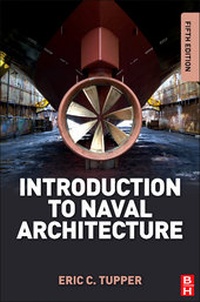
Introduction to Naval Architecture
Formerly Muckle's Naval Architecture for Marine Engineers
5th Edition
Published on 4. February 2013
Book
Paperback/Softback
496 pages
978-0-08-098237-3 (ISBN)
Description
Written by an award-winning naval architecture author and former vice-president of the Royal Institution of Naval Architects (RINA), the fifth edition of Introduction to Naval Architecture has been fully updated to take in advances in the field and is ideal both for those approaching the subject for the first time and those looking to update or refresh their knowledge on areas outside of their direct expertise.
This book provides a broad appreciation of the science and art of naval architecture, explaining the subject in physical rather than in mathematical terms. While covering basic principles, such as hull geometry, propulsion, and stability, the book also addresses contemporary topics, such as computer aided design and computer aided manufacture (CAD/CAM). The new edition reflects the continuing developments in technology, changes in international regulations and recent research.
Knowledge of the fundamentals of naval architecture is essential not only for newcomers to the field but also the wealth of non-naval architects working in the marine area, including marine engineers, marine surveyors and ship crews. This book provides the most well-known and trusted introduction to the topic, offering a clear and concise take on the basics of this broad field.
Praise for previous edition
"...a clear and concise introduction to the subject, giving a good grasp of the basics of naval architecture." - Maritime Journal
"...my go-to book for understanding the general principles of naval architecture. The book is well-written and easy to understand." - Amazon.com reviewer
This book provides a broad appreciation of the science and art of naval architecture, explaining the subject in physical rather than in mathematical terms. While covering basic principles, such as hull geometry, propulsion, and stability, the book also addresses contemporary topics, such as computer aided design and computer aided manufacture (CAD/CAM). The new edition reflects the continuing developments in technology, changes in international regulations and recent research.
Knowledge of the fundamentals of naval architecture is essential not only for newcomers to the field but also the wealth of non-naval architects working in the marine area, including marine engineers, marine surveyors and ship crews. This book provides the most well-known and trusted introduction to the topic, offering a clear and concise take on the basics of this broad field.
Praise for previous edition
"...a clear and concise introduction to the subject, giving a good grasp of the basics of naval architecture." - Maritime Journal
"...my go-to book for understanding the general principles of naval architecture. The book is well-written and easy to understand." - Amazon.com reviewer
Reviews / Votes
"...nicely presented and provides an up to date introduction to naval architecture that would be hard to better in one volume by a single author of eminence in naval architecture...much to commend in keeping the fully capable naval architect abreast of recent developments, with the direct knowledge provided and guidance to further detail through not just publications but also useful websites in the comprehensive reading list." --The Naval Architect, March 2014More details
Edition
5th edition
Language
English
Place of publication
Oxford
United Kingdom
Publishing group
Elsevier Science & Technology
Target group
College/higher education
Professional and scholarly
Novice naval architects, marine engineers and other marine industry professionals needing an introduction to and working knowledge of naval architecture. Students of naval architecture and marine engineering; Ship crew working towards certificated command and engineering positions in merchant and naval sectors; Ship surveyors and related technical/engineering groups.
Dimensions
Height: 229 mm
Width: 152 mm
Weight
870 gr
ISBN-13
978-0-08-098237-3 (9780080982373)
Copyright in bibliographic data and cover images is held by Nielsen Book Services Limited or by the publishers or by their respective licensors: all rights reserved.
Schweitzer Classification
Other editions
Additional editions
E. C. Tupper
Introduction to Naval Architecture
E-Book
01/2013
5th Edition
Butterworth-Heinemann
€62.95
Available for download
Previous edition
E.C. Tupper
Introduction to Naval Architecture
Formerly Muckle's Naval Architecture for Marine Engineers
Book
10/2004
4th Edition
Butterworth-Heinemann
€59.41
Shipment within 10-15 days
Person
Eric Tupper is a Fellow and Honorary Vice-President of the Royal Institution of Naval Architects (RINA), UK. In 2011 he received the William Froude Medal for outstanding contribution to naval architecture from RINA for his Basic Ship Theory books, co-authored with Ken Rawson. His long career in naval architecture has included ship design, hydrodynamic and structural research, and ship production.
Content
Preface to the fifth edition
Acknowledgements
1 Introduction
2 Definition and regulation
3 Ship form calculations
4 Flotation
5. Stability
6 Launching, docking and grounding
7 Resistance
8 Propulsion
9 The ship environments
10 Seakeeping
11 Vibration, noise and shock
12 Manoeuvering
13 Structures
14 Ship design
15 Ship types
References and Further reading
Appendix A: Presentation of data
Appendix B: The displacement sheet and hydrostatics
Appendix C: Basic ship dynamics
Appendix D: The Froude notation
Appendix E: Questions
Acknowledgements
1 Introduction
2 Definition and regulation
3 Ship form calculations
4 Flotation
5. Stability
6 Launching, docking and grounding
7 Resistance
8 Propulsion
9 The ship environments
10 Seakeeping
11 Vibration, noise and shock
12 Manoeuvering
13 Structures
14 Ship design
15 Ship types
References and Further reading
Appendix A: Presentation of data
Appendix B: The displacement sheet and hydrostatics
Appendix C: Basic ship dynamics
Appendix D: The Froude notation
Appendix E: Questions