

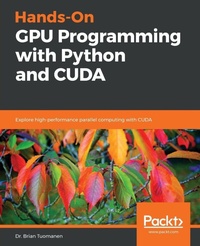
Hands-On GPU Programming with Python and CUDA
Explore high-performance parallel computing with CUDA
Published on 27. November 2018
Book
Paperback/Softback
310 pages
978-1-78899-391-3 (ISBN)
Description
Build real-world applications with Python 2.7, CUDA 9, and CUDA 10. We suggest the use of Python 2.7 over Python 3.x, since Python 2.7 has stable support across all the libraries we use in this book.
Key Features
Expand your background in GPU programming-PyCUDA, scikit-cuda, and Nsight
Effectively use CUDA libraries such as cuBLAS, cuFFT, and cuSolver
Apply GPU programming to modern data science applications
Book DescriptionHands-On GPU Programming with Python and CUDA hits the ground running: you'll start by learning how to apply Amdahl's Law, use a code profiler to identify bottlenecks in your Python code, and set up an appropriate GPU programming environment. You'll then see how to "query" the GPU's features and copy arrays of data to and from the GPU's own memory.
As you make your way through the book, you'll launch code directly onto the GPU and write full blown GPU kernels and device functions in CUDA C. You'll get to grips with profiling GPU code effectively and fully test and debug your code using Nsight IDE. Next, you'll explore some of the more well-known NVIDIA libraries, such as cuFFT and cuBLAS.
With a solid background in place, you will now apply your new-found knowledge to develop your very own GPU-based deep neural network from scratch. You'll then explore advanced topics, such as warp shuffling, dynamic parallelism, and PTX assembly. In the final chapter, you'll see some topics and applications related to GPU programming that you may wish to pursue, including AI, graphics, and blockchain.
By the end of this book, you will be able to apply GPU programming to problems related to data science and high-performance computing.
What you will learn
Launch GPU code directly from Python
Write effective and efficient GPU kernels and device functions
Use libraries such as cuFFT, cuBLAS, and cuSolver
Debug and profile your code with Nsight and Visual Profiler
Apply GPU programming to datascience problems
Build a GPU-based deep neuralnetwork from scratch
Explore advanced GPU hardware features, such as warp shuffling
Who this book is forHands-On GPU Programming with Python and CUDA is for developers and data scientists who want to learn the basics of effective GPU programming to improve performance using Python code. You should have an understanding of first-year college or university-level engineering mathematics and physics, and have some experience with Python as well as in any C-based programming language such as C, C++, Go, or Java.
Key Features
Expand your background in GPU programming-PyCUDA, scikit-cuda, and Nsight
Effectively use CUDA libraries such as cuBLAS, cuFFT, and cuSolver
Apply GPU programming to modern data science applications
Book DescriptionHands-On GPU Programming with Python and CUDA hits the ground running: you'll start by learning how to apply Amdahl's Law, use a code profiler to identify bottlenecks in your Python code, and set up an appropriate GPU programming environment. You'll then see how to "query" the GPU's features and copy arrays of data to and from the GPU's own memory.
As you make your way through the book, you'll launch code directly onto the GPU and write full blown GPU kernels and device functions in CUDA C. You'll get to grips with profiling GPU code effectively and fully test and debug your code using Nsight IDE. Next, you'll explore some of the more well-known NVIDIA libraries, such as cuFFT and cuBLAS.
With a solid background in place, you will now apply your new-found knowledge to develop your very own GPU-based deep neural network from scratch. You'll then explore advanced topics, such as warp shuffling, dynamic parallelism, and PTX assembly. In the final chapter, you'll see some topics and applications related to GPU programming that you may wish to pursue, including AI, graphics, and blockchain.
By the end of this book, you will be able to apply GPU programming to problems related to data science and high-performance computing.
What you will learn
Launch GPU code directly from Python
Write effective and efficient GPU kernels and device functions
Use libraries such as cuFFT, cuBLAS, and cuSolver
Debug and profile your code with Nsight and Visual Profiler
Apply GPU programming to datascience problems
Build a GPU-based deep neuralnetwork from scratch
Explore advanced GPU hardware features, such as warp shuffling
Who this book is forHands-On GPU Programming with Python and CUDA is for developers and data scientists who want to learn the basics of effective GPU programming to improve performance using Python code. You should have an understanding of first-year college or university-level engineering mathematics and physics, and have some experience with Python as well as in any C-based programming language such as C, C++, Go, or Java.
More details
Language
English
Place of publication
Birmingham
United Kingdom
Dimensions
Height: 235 mm
Width: 191 mm
Thickness: 17 mm
Weight
582 gr
ISBN-13
978-1-78899-391-3 (9781788993913)
Copyright in bibliographic data and cover images is held by Nielsen Book Services Limited or by the publishers or by their respective licensors: all rights reserved.
Schweitzer Classification
Other editions
Additional editions
Dr. Brian Tuomanen
Hands-On GPU Programming with Python and CUDA
Explore high-performance parallel computing with CUDA
E-Book
06/2024
1st Edition
Packt Publishing Limited
€34.99
Available for download
Person
Dr. Brian Tuomanen has been working with CUDA and general-purpose GPU programming since 2014. He received his bachelor of science in electrical engineering from the University of Washington in Seattle, and briefly worked as a software engineer before switching to mathematics for graduate school. He completed his PhD in mathematics at the University of Missouri in Columbia, where he first encountered GPU programming as a means for studying scientific problems. Dr. Tuomanen has spoken at the US Army Research Lab about general-purpose GPU programming and has recently led GPU integration and development at a Maryland-based start-up company. He currently works as a machine learning specialist (Azure CSI) for Microsoft in the Seattle area.
Content
Table of Contents
Why GPU Programming?
Setting Up Your GPU Programming Environment
Getting Started with PyCUDA
Kernels, Threads, Blocks, and Grids
Streams, Events, Contexts, and Concurrency
Debugging and Profiling Your CUDA Code
Using the CUDA Libraries with Scikit-CUDA Draft complete
The CUDA Device Function Libraries and Thrust
Implementing a Deep Neural Network
Working with Compiled GPU Code
Performance Optimization in CUDA
Where to Go from Here
Why GPU Programming?
Setting Up Your GPU Programming Environment
Getting Started with PyCUDA
Kernels, Threads, Blocks, and Grids
Streams, Events, Contexts, and Concurrency
Debugging and Profiling Your CUDA Code
Using the CUDA Libraries with Scikit-CUDA Draft complete
The CUDA Device Function Libraries and Thrust
Implementing a Deep Neural Network
Working with Compiled GPU Code
Performance Optimization in CUDA
Where to Go from Here