

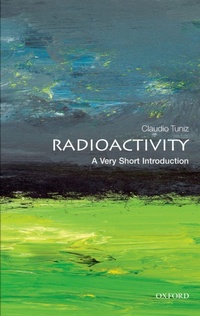
Radioactivity
A Very Short Introduction
Published on 26. July 2012
Book
Paperback/Softback
176 pages
978-0-19-969242-2 (ISBN)
Description
You cannot hide from radioactivity. Even the book you are holding is slightly radioactive, but there are more serious risks. Radioactivity - the breakdown of unstable atomic nuclei, releasing radiation - is a fundamental process in nature. It is a process that has been harnessed to provide wide and important applications in science, medicine, industry, and energy production. But it remains much misunderstood - and feared, perhaps because nuclear radiation cannot be detected by human senses, and can undoubtedly do great harm if appropriate precautions are not taken. In recent times there have been increasing concerns about nuclear terrorism.
The traces of radioactive atoms in rocks have allowed us to understand the nature and history of the Earth, in particular to date events in that history. Radioactive dating has been used for a variety of purposes, from determining the age of the first hominids to the dating of the Turin Shroud. The discovery of radioactivity has improved our survival kit, but also gave us the chance to reach a new level of awareness on the history of our species and its environmental impacts.
In this Very Short Introduction, Claudio Tuniz explains the nature of radioactivity and discuss its role in nature. Describing radioactivity in the stars and in the Earth, he also looks at its wide range of applications in biomedicine and in science, as well as the mechanisms of nuclear fission and fusion, and the harnessing of nuclear power.
ABOUT THE SERIES: The Very Short Introductions series from Oxford University Press contains hundreds of titles in almost every subject area. These pocket-sized books are the perfect way to get ahead in a new subject quickly. Our expert authors combine facts, analysis, perspective, new ideas, and enthusiasm to make interesting and challenging topics highly readable.
The traces of radioactive atoms in rocks have allowed us to understand the nature and history of the Earth, in particular to date events in that history. Radioactive dating has been used for a variety of purposes, from determining the age of the first hominids to the dating of the Turin Shroud. The discovery of radioactivity has improved our survival kit, but also gave us the chance to reach a new level of awareness on the history of our species and its environmental impacts.
In this Very Short Introduction, Claudio Tuniz explains the nature of radioactivity and discuss its role in nature. Describing radioactivity in the stars and in the Earth, he also looks at its wide range of applications in biomedicine and in science, as well as the mechanisms of nuclear fission and fusion, and the harnessing of nuclear power.
ABOUT THE SERIES: The Very Short Introductions series from Oxford University Press contains hundreds of titles in almost every subject area. These pocket-sized books are the perfect way to get ahead in a new subject quickly. Our expert authors combine facts, analysis, perspective, new ideas, and enthusiasm to make interesting and challenging topics highly readable.
Reviews / Votes
an enjoyable discussion of the light and dark side of radioactivity. * Times Higher Education Supplement *More details
Series
Language
English
Place of publication
Oxford
United Kingdom
Target group
Interested general readers, students of physics, and the geosciences.
Illustrations
Approx 20 black and white illustrations
Dimensions
Height: 181 mm
Width: 113 mm
Thickness: 15 mm
Weight
129 gr
ISBN-13
978-0-19-969242-2 (9780199692422)
Copyright in bibliographic data and cover images is held by Nielsen Book Services Limited or by the publishers or by their respective licensors: all rights reserved.
Schweitzer Classification
Other editions
Additional editions
E-Book
07/2012
OUP eBook
€9.49
Available for download
E-Book
07/2012
1st Edition
OUP eBook
€9.49
Available for download
Person
Claudio Tuniz was Assistant Director of the Abdus Salam International Centre for Theoretical Physics in Trieste . Previously he was Nuclear Counsellor at the Australian Embassy to the IAEA in Vienna and Director of the Physics Division at the Australian Nuclear Science and Technology Organization in Sydney. He is co-author of the book The Bone Readers (2009).
Content
PROLOGUE; EPILOGUE; REFERENCES; FURTHER READING